Encounters with strangers often leave me feeling deeply connected at the fundamental level of our common humanity. People you don’t know, who may be needy themselves, or may help you in an emergency, or with whom you share a crisis, are often easier to feel close to than your dearest friend or your cousin you’ve loved since you were children. That is because you have nothing but your humanity to connect with. No offenses given or received have been stuffed into your baggage regarding that person.
Like the Indian woman I once sat next to, so very close to, on a plane from Mumbai to Frankfurt. She actually had been seated behind me when we first boarded, but before we were told to fasten our safety belts the man next to me, I guessed he was her son, traded places with her, perhaps so she could sit by a woman. I don’t know, but she and I liked each other, we could tell by our smiles, though we said not a word to each other during eight hours, not knowing the words.
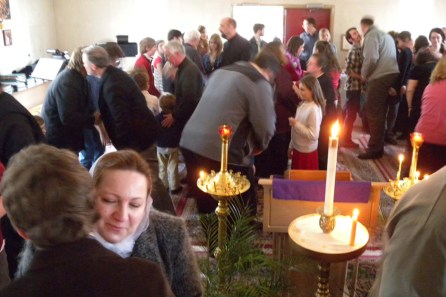
Today in the Orthodox Church we enter Great Lent with the Vespers of Forgiveness, when we also connect with many people we hardly know, on the ground of our fallen humanity. We admit with a bow and a kiss that we have sinned against them, whether we’ve ever spoken to them or have even seen them before. We exchange the words, “Please forgive me!” with each person in the service in turn, and each of us responds, “God forgives!”
Why? Because, as Elder Sophrony said, “Every sin, manifest or secret, committed by each one of us, affects the rest of the universe.”
I’m sure many of us find it difficult to comprehend, but going through this exercise every year will help us learn the truth in our hearts. Father Stephen Freeman helps, too, in passages like this:
The universe as an event of communion, a reality in which we literally participate, is quite foreign to the modern mind. The fiction of our radical individualism is an invention designed to promote the most irresponsible account of human freedom possible. It tells us that our lives “are our own,” and that we can act without consequences for anyone other than ourselves. “It is none of your business!” is the heart-cry of modernity. But this is simply not true.
We are born into everyone’s business and everyone’s business sets the stage and the very parameters of our existence. The language we speak, the thoughts we think, everything in our lives comes to us already burdened with the history and experience of the world around us. The saints treat this reality in the strongest possible sense. “My brother is my life,” St. Silouan says. By this, he does not mean simply that he cares strongly about his brother. He means it in its most literal sense. Not only is my own life not my own, but the life of the other is, in fact, my true life, or my true life certainly has no existence or reality apart from the life of the other.
Read the rest of the article: Why We Forgive
And if you are keeping Lent, I pray that through your efforts and God’s grace you and we all will grow in understanding of this life that we share. God bless you!

*pictures found online







 In the house, the refurbished little half-bath downstairs and the all-new full bath upstairs saw major progress. The little one was torn apart last July when it was discovered that a drain had been leaking into the wall. The wall was replaced, and eventually everything else, but the painting hadn’t been done until this week, so I only now hung the mirror I’d bought many months ago. It’s such a small space I had a hard time taking a picture of that.

 When
When  ow challenging, and maybe get some momentum going for more of Kierkegaard. You know I will update you!
 The main thing I brought back from my hike with friend Polly — our first-ever such outing together — was tired feet. We had walked on a hilly trail for a solid two hours, along an unnamed creek, around an unnamed pond, through areas that were burned in the fires of 2017 but are healing.