All posts by GretchenJoanna

Unknown's avatar

About GretchenJoanna

Orthodox Christian, widowed in 2015; mother, grandmother. Love to read, garden, cook, write letters and a hundred other home-making activities.

He paints in fairy lines.

JACK FROST

The door was shut, as doors should be,
Before you went to bed last night;
Yet Jack Frost has got in, you see,
And left your window silver white.

He must have waited till you slept;
And not a single word he spoke,
But penciled o’er the panes and crept
Away again before you woke.

And now you cannot see the hills
Nor fields that stretch beyond the lane;
But there are fairer things than these
His fingers traced on every pane.

Rocks and castles towering high;
Hills and dales, and streams and fields;
And knights in armor riding by,
With nodding plumes and shining shields.

And here are little boats, and there
Big ships with sails spread to the breeze;
And yonder, palm trees waving fair
On islands set in silver seas,

And butterflies with gauzy wings;
And herds of cows and flocks of sheep;
And fruit and flowers and all the things
You see when you are sound asleep.

For, creeping softly underneath
The door when all the lights are out,
Jack Frost takes every breath you breathe,
And knows the things you think about.

He paints them on the window-pane
In fairy lines with frozen steam;
And when you wake you see again
The lovely things you saw in dream.

~ Gabriel Setoun (1861-1930)

A river of light poured in.

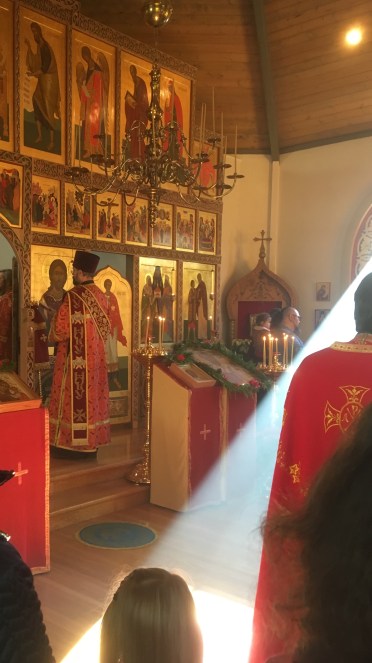
To be at St. Nicholas Church for their patronal feast day, or altar feast, was heavenly. I rode down with friends and it took quite a while to get through the early morning commuter traffic. We ended up coming in a little late, but as soon as I entered I could feel that I was in a temple full of joy, the fullness of Christ and His Church.

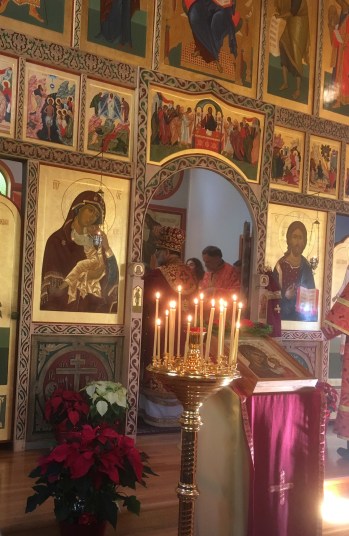
Many people were wearing red and green clothing for the celebration, and plenty of poinsettias and red vestments and altar cloths filled the space. I had only been to this church once before, and I loved looking around at their icons, thinking about the significance of the different groupings of holy ones. Through a southern window the sunlight beamed down in a wide swath, which must have made the position of the choir director critical. It was very dramatic.

After Liturgy we enjoyed a concert of bells, and a feast of earthly food. A raffle is traditional for this parish’s feast day, and today the funds raised were to go to the victims of the Camp Fire in northern California. They raised a record amount, about $1500, and everyone was thrilled about that.

One of my last images of the blessed day was of three little girls all in red and white dresses, shyly singing a song in honor of the saint. You will have to form your own picture of that, because I had used up my phone’s battery by then. Holy Father Nicholas, we rejoice with you!

He lived daily with the Lord.

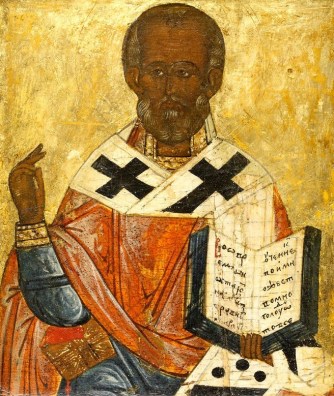
St. Nicholas is one of the “favoritest” saints in the Orthodox Church. I have read about him many times and don’t usually remember much. I didn’t grow up hearing about him as the real historical not-Santa-Claus person that he is, or knowing that there was such a thing as St. Nicholas Day, and since I became Orthodox I haven’t succeeded in implanting him in my heart in any satisfying way.

But we both live by and in the love of Christ, so he must be in my heart in spite of my neglect. I will pass on to you (again) what blessed me some years ago, from The Winter Pascha:

The extraordinary thing about the image of St. Nicholas in the Church is that he is not known for anything extraordinary. He was not a theologian and never wrote a word, yet he is famous in the memory of believers as a zealot for orthodoxy, allegedly accosting the heretic Arius at the first ecumenical council in Nicaea for denying the divinity of God’s son.

He was not an ascetic and did no outstanding feats of fasting and vigils, yet he is praised for his possession of the “fruit of the Holy Spirit…love, joy, peace, patience, kindness, goodness, faithfulness, gentleness, self-control” (Gal. 5:22-23). He was not a mystic in our present meaning of the term but he lived daily with the Lord and was godly in all his words and deeds. He was not a prophet in the technical sense, yet he proclaimed the Word of God, exposed the sins of the wicked, defended the rights of the oppressed and afflicted, and battled against every form of injustice with supernatural compassion and mercy.

In a word, he was a good pastor, father, and bishop to his flock, known especially for his love and care for the poor. Most simply put, he was a divinely good person.

-Fr. Thomas Hopko

Red for the Word made flesh.

When the doorbell rang one evening after dark, dark coming so early this season, Susan and I were both on our guard, because we are two vulnerable women and we weren’t expecting anyone.

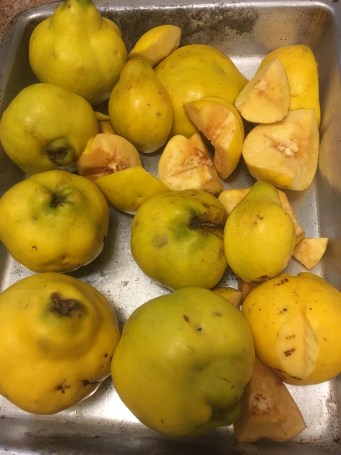
I have a peephole in my door, and I peeped, and saw that it was a human shape and not a package on the step, but I had to turn on the porch light to see if it was someone I recognized. It was Linda! Linda is  my friend who took me to the Heirloom Festival recently. She has been gifting me with garden things for four decades, and she’d mentioned last month that her neighbor — they live fifteen miles from here! — had some quinces she would try to bring me. Here she stood at my door with a dozen in the bottom of a shopping bag. I kissed her.

She’d heard about the puny and rock-hard fruits I’d gathered and tried to use, but this will be my last mention of that batch, because these were perfect. For a couple of days I let the good quinces perfume the kitchen, and then I faced the challenge of making use of them for food, when I didn’t have time to peel them. I took time instead to find a recipe for oven-poaching whole quinces with star anise, lemon, honey and cinnamon. As they baked, the whole house filled with an even complex and delicious aroma.
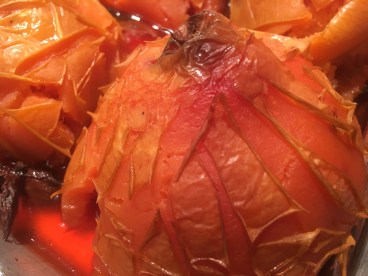
It is worth cooking quinces just to see how the fruit changes to this beautiful orange-pink color. I found it festive in Christmasy way, partly because I had that morning heard a talk that our rector gave the children after Liturgy, about the sequence and meaning of the layers of vestments that he puts on for the services, and he started out telling what the different colors symbolize.

Liturgical churches do not all use the same colors for various seasons or feasts on the calendar, and there are numerous options and meanings. But during Advent in our tradition, the vestments and altar cloths are red, as we are anticipating the birth of the Savior born to a human mother, who gave him human flesh and blood. Red for blood. To remind us of that tenet of our Christology.

In the beginning was the Word, and the Word was with God, and the Word was God.  He was with God in the beginning.  Through him all things were made; without him nothing was made that has been made.  In him was life, and that life was the light of all mankind. The light shines in the darkness, and the darkness has not overcome it.

The Word became flesh and made his dwelling among us. We have seen his glory, the glory of the one and only Son, who came from the Father, full of grace and truth.

-The Gospel of John