This morning, another visitor, whom my Facebook friends identified for me.
It’s a Gulf Fritillary:
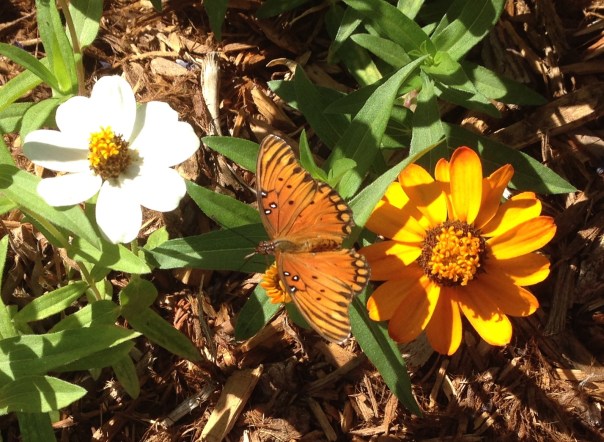

This morning, another visitor, whom my Facebook friends identified for me.
It’s a Gulf Fritillary:
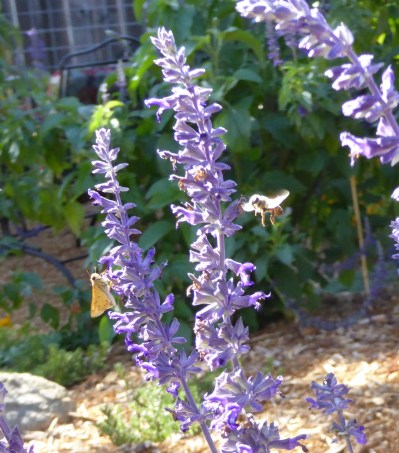
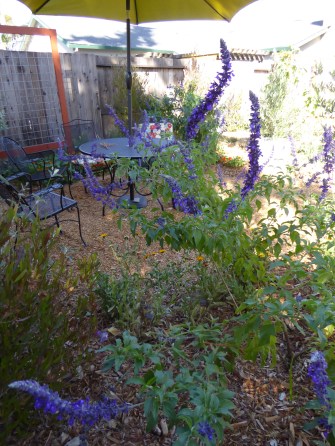
I am sitting in the garden, in the corner where the unbelievable salvias and the olive trees have grown up to make a sort of alcove. The three salvias are each six to nine feet in diameter and four feet high; they amazed me by taking a big leap in July and August of their first year. The umbrella is shielding me from the sun, and I am enjoying the insects that make the air alive with their darting and swooping from one flower to another above and all around me.
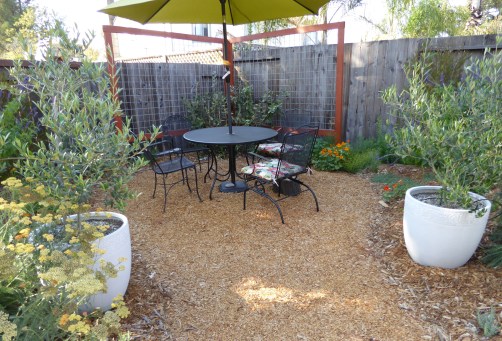
The only reason I thought to move out here with my bowl of plums is that my house is so cold. I brought the laptop so I could continue reading Fr. Stephen’s article while I ate, but the fruit drew all of my attention to my mouth, and to the juicy plumminess too intense to consume mindlessly while reading. Now I remember why I planted two Elephant Heart Plum trees last fall — which, by the way, didn’t produce any fruit from their pretty green and white blossoms this season. Pearl brought me some of her plums yesterday; a year ago the mature trees at her new house had been the inspiration for my decision to grow some of my own.

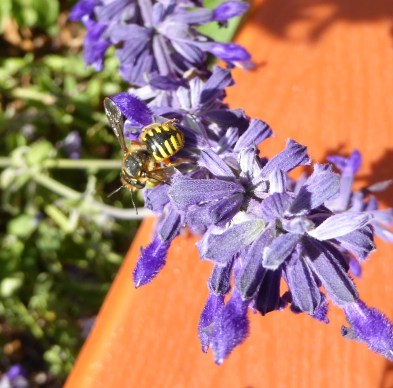
If I could just sit out here in the soft air, I would most certainly eat less; shivering in the house makes me distracted and uneasy without knowing why, and I unconsciously start stoking the furnace of my body with whatever fuel I can find in the cupboards.
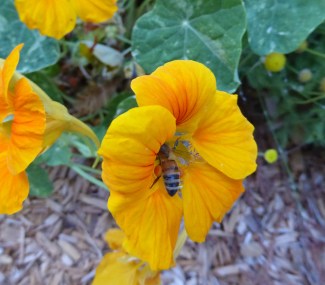
And being in the garden makes me want to share the experience in words, so I looked to see if I have a good summer poem from a previous year. I’m sure it must be here somewhere, if I only had the patience. While looking I found a verse that is new to me, from Walter de la Mare, about one of the winged creatures flitting about.
After pasting it in (and thereby shaping this article into another Pollinator post) I thought perhaps I shouldn’t be so hasty, and I began to look online for a different poem, maybe about a dragonfly or a butterfly ? which, after all are more to my liking. I also hunted around for a clue to the meaning of “specks of sale” in the poem. Does anyone know? I wonder if sale is a word for salt? [Duh. It was a typo, as commenter shoreacres pointed out below. But from now on I think I will always think of it as a synonym 🙂 ]
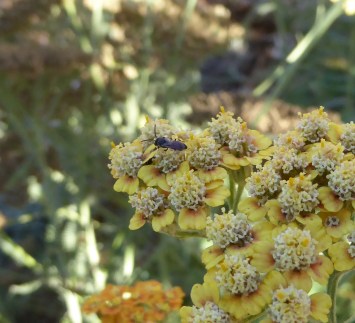
But before any more pages had time to load – I must be too far from the house for the wifi – a common housefly dropped in on me, on my arm, on my keyboard, my shoulder, and he would not be shooed away for anything. I think he sensed what was going on, and wanted me to tell his story, and not another’s. Maybe as soon as I hit “Publish” he will go back to playing.
THE FLY
How large unto the tiny fly
Must little things appear!-
A rosebud like a feather bed,
Its prickle like a spear;
A dewdrop like a looking-glass,
A hair like golden wire;
The smallest grain of mustard-seed
As fierce as coals of fire;
A loaf of bread, a lofty hill;
A wasp, a cruel leopard;
And specks of salt as bright to see
As lambkins to a shepherd.
-Walter de la Mare
 One thing leads to another. I had the sudden and unusual urge to clean my shower door this morning, and ended up spending hours on the bathroom, the bedroom, the laundry area in the garage…. I made myself stop at six o’clock so I could take a walk, which was more of a chore than some evenings, because I had already been on my feet most of the day.
Even so, I didn’t want to take the shortcut, because the sight of the slant rays through the redwood trees at the park is not to be missed. This is where my children played soccer and softball, and climbed those trees, before they were trimmed of their lower branches. I like experiencing the park this way more than the former version, when we used to stand around shivering on the damp sidelines to watch an hour of soccer.

But getting back to earlier in the day: Before indulging in the flurry of vacuuming and scrubbing, I had followed other, quieter prompts, in the realm of poetry. I was reading some recommendations for anthologies, when the collection Come Hither showed up on my mental path. This was probably the first book of poetry I ever bought. We were homeschooling and I had borrowed Walter de la Mare’s anthology from the library. But I couldn’t renew it forever, and it was clearly a book that one would like to delve into forever. So I splurged on a copy of our own, and my students would leaf through its pages week by week to find an appealing poem to memorize.

In the last months I had forgotten about this book; I knew it was in the spare bedroom on a shelf full of poetry books, and I made a note to myself to get it down and enjoy it again. After this evening’s walk I did that, but I had to limit myself to reading only the first poem, so that I will get to bed at a reasonable hour tonight. I also discovered a wonderful article by David M. Whalen, about the anthology and its editor: “Walter de la Mare’s Come Hither.”
He explains the frontispiece address to the “Young of All Ages”: “Anthologies of children’s verse usually fall into sentimentality. They reflect their editors’ attempts at indulgence in feelings that have become unreal to editors and readers both. Come Hither: A Collection of Rhymes and Poems for the Young of All Ages is markedly free of this blot as de la Mare, a Twentieth-Century British poet and author, never left behind the numinous sense of mystery that characterizes childhood.”
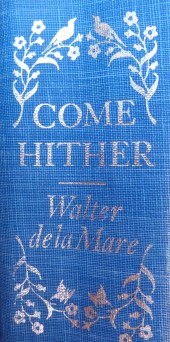
British author Alice Thomas Ellis is quoted in the article as saying that if she could have the Bible and Shakespeare and one other book, when stranded on a desert island, the third book would be Come Hither. The copious notes alone I find fascinating; they are obviously written with the older and even oldest Young in mind, and they lead me always to one more musing .
Here is that first poem of the collection. As the turning of the page will reveal a different offering, and another following that, I feel certain that I will have more to share with you in the future. But as Whalen points out, this one poem already contains everything.
THIS IS THE KEY
This is the Key of the Kingdom
In that Kingdom is a city;
In that city is a town;
In that town there is a street;
In that street there winds a lane;
In that lane there is a yard;
In that yard there is a house;
In that house there waits a room;
In that room an empty bed;
And on that bed a basket–
A Basket of Sweet Flowers
Of Flowers, of Flowers;
A Basket of Sweet Flowers.
Flowers in a Basket;
Basket on the bed;
Bed in the chamber;
Chamber in the house;
House in the weedy yard;
Yard in the winding lane;
Lane in the broad street;
Street in the high town;
Town in the city;
City in the Kingdom–
This is the Key of the Kingdom.
Of the Kingdom this is the Key.
 This morning I had to wait around to take my walk, until the dawn lightened enough. When I went outside the first time to check the visibility, the feeling in the air was thrilling. The combination of the light and the humidity and everything was something you don’t get to experience if you are in the house smelling the coffee.
I’m not usually outdoors before 6:00, though there was one summer when for a few weeks at least Pippin and I would go to the high school track so that she could run, while I walked, in the dark — because it was the only time we had.
When I did start out a little later, the sky was filled with beautiful clouds. All the plants along the path were breathing into the space where my face was coming along with its nose. It was very intimate; I wanted to stand a while in the middle of the path and breathe with them.
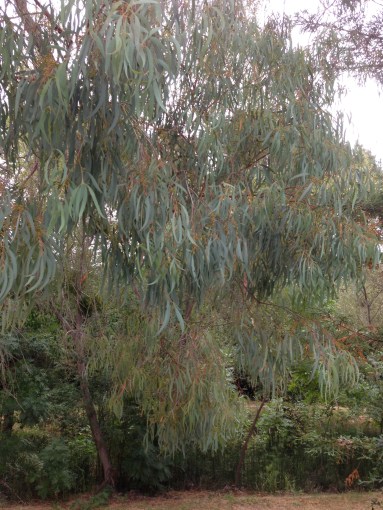
I’ve been walking the same path almost every day, and getting to know some landmarks, or seeing how they have developed in the last 26 years. I feel that I didn’t notice them before…. or I forgot, is more likely. I am not the same person I was, and some of them are also more grown up, if they are still there.

When my tires were getting rotated the other day I took a walk in that neighborhood and it had its own scents and views. With fennel! I know I am always talking about the wild fennel, but it is everywhere, and giving off that sweet licorice smell as it makes its seeds and dries up. The banks of the creek are full of it — my summer is full of it — and this field is decorated, too.


Today I will go to the funeral and burial for the young man who fell asleep in the Lord last week. His casket was brought into the church this week and while we were commemorating the Beheading of John the Baptist yesterday morning it was in the middle of the nave. After the Liturgy we had more prayers for him, and koliva.

We have sung these prayers as an adjunct to every service that has happened since he died, and this week there has been a service every day. I wasn’t present for every one.
A new icon of the Forerunner of Christ was recently commissioned for the church, showing several scenes from his life. It was finished just in time for this feast.

Yesterday we heard words from St. Justin Popivic’s homily on this feast, about how St. John the Baptist had been the Forerunner of Christ not just on earth, but also into Hades:
The glorious Forerunner also entered into the kingdom of death as the Forerunner of all of the true Confessors of Christ in the world, all of the true Prophets in the world, to announce to all of the souls in the kingdom of death: Lo, death is defeated, the demons destroyed, the kingdom of death will be destroyed when, in a little while, the Lord appears here, and you will be led out of this horror and into heavenly joy, into the Kingdom On High.
….
Thus, for us Christians today is like unto Great Friday. Just as for the Savior, the Resurrection follows Great Friday, so the Forerunner joyously dies and enters into death, for he sees the victory over death, and knows that the Lord has prepared for him as well eternal life and resurrection from the dead on the day of the Great Judgment.
When the Lord was crucified, He descended into the nether regions, into Hades, into the kingdom of death, with His human Soul. His Body lay in the tomb, but His Soul, the fullness of his Divinity, descended into death’s kingdom. And how astonished must have been all of the human souls in Hades, on seeing God in a human soul, shining with ineffable light, light impossible for a human being to imagine. Who would not come to believe in Him? Who, when He appears in the kingdom of death so filled with Eternal Truth, Eternal Life, Eternal Justice?
He appears as conqueror over death. And as death’s kingdom could not hold God Who was in Jesus’ soul, as it could not hold God in its hands, it fell apart because of Christ’s Divinity, because of His Most-holy Soul, in which was the fullness of God. And the Lord led out of death’s kingdom all those who had earlier come to believe the Forerunner, and those who had come to believe in Him, the Lord Jesus Christ, to believe that in truth, He was True God in Heaven and on earth.