All posts by GretchenJoanna

Unknown's avatar

About GretchenJoanna

Orthodox Christian, widowed in 2015; mother, grandmother. Love to read, garden, cook, write letters and a hundred other home-making activities.

Is this unbecoming — or a radiance?

ON HUMILITY

“If there is a moral quality almost completely disregarded and even denied today, it is indeed humility. The culture in which we live constantly instills in us the sense of pride, of self-glorification, and of self-righteousness. It is built on the assumption that man can achieve anything by himself and it even pictures God as the One who all the time ‘gives credit’ for man’s achievements and good deeds.

“Humility—be it individual or corporate, ethnic or national—is viewed as a sign of weakness, as something unbecoming of real man. Even our churches—are they not imbued with that same spirit of the Pharisee? Do we not want our every contribution, every ‘good deed,’ all that we do ‘for the Church’ to be acknowledged, praised, publicized?

“But what is humility? The answer to this question may seem a paradoxical one for it is rooted in a strange affirmation: God Himself is humble! Yet to anyone who knows God, who contemplates Him in His creation and in His saving acts, it is evident that humility is truly a divine quality, the very content and the radiance of that glory which, as we sing during the Divine Liturgy, fills heaven and earth.”

—Father Alexander Schmemann, from the book Great Lent

I was wordless in the singing world.

It is never my lot to “trifle around with a poem” the way Mary very profitably does, but I know about the thrill of getting unstuck and running (after a fashion) out the door. Just wandering in the garden often changes my mood drastically.  Rain is falling here at this moment, and watering my being.

WORK, SOMETIMES

I was sad all day, and why not. There I was, books piled
on both sides of the table, paper stacked up, words
falling off my tongue.

The robins had been a long time singing, and now it
was beginning to rain.

What are we sure of? Happiness isn’t a town on a map,
or an early arrival, or a job well done, but good work
ongoing.  Which is not likely to be the trifling around
with a poem.

Then it began raining hard, and the flowers in the yard
were full of lively fragrance.

You have had days like this, no doubt. And wasn’t it
wonderful, finally, to leave the room? Ah, what a
moment!

As for myself, I swung the door open. And there was
the wordless, singing world. And I ran for my life.

-Mary Oliver

Older photo, from a little later in spring.

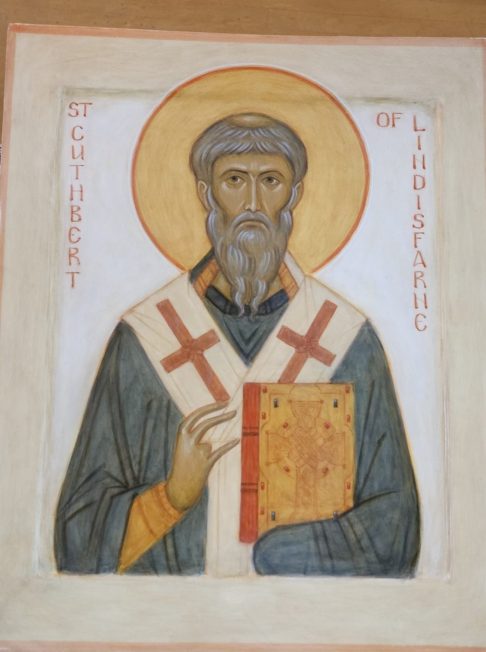
Wonderworker of Britain

Saint Cuthbert is another bright saint of the church who is remembered this week; he is called Wonderworker of Britain, and is the most beloved English saint in that country’s history. I missed my best chance to become familiar with St. Cuthbert when I visited Durham Cathedral in England where his relics are. I hadn’t become a catechumen in the Orthodox Church yet and didn’t yet grasp the holiness of such things. There is a lot of information online about the saint, and stories from his life in the 7th century; so many miracles are associated with him.

Here is a simple and early event, from his first monastery at Melrose:

The first obedience of Cuthbert at Melrose was to receive guests. So one morning Cuthbert, not knowing who it was, received and ministered to an angel who was sent him by God. Cuthbert cordially met him, washed his feet, gave him food and drink, but at that moment the guest suddenly disappeared. When Cuthbert looked at the table, he saw that the guest had left white and fragrant loaves on it that were sweeter than honey. Cuthbert’s life was very hard, at times he had to endure the brethren’s slander, frequent attacks of demons and many other hardships, but he always remained peaceful and trusting God. And angels more than once saved him in a visible way, in some cases bringing him food directly from heaven.

Durham Cathedral

Because we have just entered the Great Fast, that story, though it is more about eating than fasting, reminds me of the saying of another worthy saint even farther in antiquity, St. Athanasius the Great:

“To fast is to banquet with angels.”