“Ralph Waldo Emerson once declared that language is fossil poetry. Many words that we use carelessly have, embedded within their amber-like exterior, the remnants of long lost perceptions and intuitions. When received thoughtfully and with some delicacy, words have the capacity to allow us to travel back in time, to imagine how and what the world meant to our ancestors. But unlike the insects, or dinosaur DNA fixed in amber, the meanings within words are changing, evolving, as human perceptions change.”
-Ken Myers on Mars Hill Audio Journal, introducing his interview of John Durham Peters about his new book, The Marvelous Clouds: Toward a Philosophy of Elemental Media.
I listened to this interview and have ordered the book, though I fear it will be above my head, like clouds. The author was not hard to understand when he was talking, and he spoke of so many things that I would like to “hear” him discuss further, after I get the book and can read the words on paper, and flip back and forth and underline a phrase here and there of his meaningful prose. How can I resist a book that contains all together in its title the words Marvelous, Philosophy, and Clouds?
Even before I had left my neighborhood, the day before I was scheduled to fly out of San Francisco to Washington DC, I had “adventures.” In the morning, my back went out. After church traveling prayers were said for me, and I paid close attention to the request that my journey be healthful. Would God heal me overnight? That afternoon I took a walk in the neighborhood, because my chiropractor told me once that when you walk, every step is like a little adjustment; I know from experience that walking is healthful, and I hoped that the kinks would work themselves out, and the spasms cease.
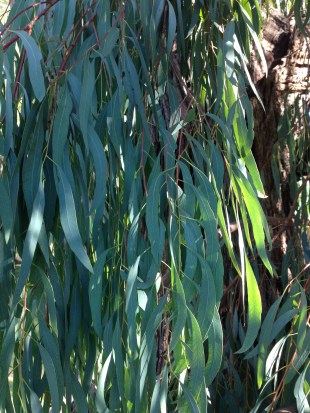
While I was walking I admired the eucalyptus trees; they caught my attention by the loud hum overhead, the noise of hundreds of flies and bees of every sort working at the blooms. Blooms? Indeed, in November. Some of the species of this tree do bloom in the fall, as I found by first-hand observation, and when I got home and read about them online. The flowers were mostly too high up for me to get a good picture, and the leaves were prettier, anyway.
from the Internet
While walking I got a text message from daughter Kate, whom I was going to see at the end of my journey the next day. “My” bench was close by, so I sat down to type a message back to her. Yowie! A beast I never saw stung me on the finger, and it filled with biting pain. I cut my walk short and started back the way I had come, thinking I should hurry home and take my wedding ring off before swelling could tighten it and add to the discomfort. Then I realized that my flesh was already puffing up, and I managed to remove my ring with the help of some saliva.
My back was feeling a little better, but my finger was stabbing for several hours, anytime I took it out of the ice water, and that distracted me from my final preparations — but I guess I did at least pack what I needed, and I went to bed hoping for a better tomorrow.
I don’t think often about my wedding bands. I have one on each hand since my late husband and I bought new ones for our 40th anniversary four years ago; at that time I had the original band resized and I wear it on my right ring finger. When I became a widow I had no desire to take off my rings – I feel that in my heart and soul I am still married.
But before I set off for the airport the next morning, when I tried to put my newer ring back on, the finger was still too swollen, and I had to leave the ring behind and go naked on that finger for the first time in nearly 45 years. So that was the first new thing I experienced on my trip.
My back seemed to be fine when I woke. I was taking the usual NSAIDs, but it remained to be seen how I would do sitting in buses and airplanes and cars for the next nine hours. Sitting is typically the opposite of walking as far as back health goes.
When I was planning for this trip I was looking forward to uninterrupted reading time on the plane(s), ten hours or more, plus reading for a few minutes in bed each night before sleep. I wanted to read on a topic somehow connected to the people or sights I would see, and one obvious one was India. No, India was not on my itinerary, but one big reason I was making a trip to visit Kate right now is that she and her husband are moving to India next year for work. They will be there two years; since they are very important people to me I’d like to know something about this place that will be their home. Also, I hope to visit them there!
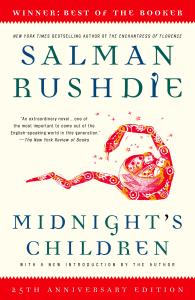
So as soon as I settled on to the airporter bus, I opened my Kindle and began to read Midnight’s Children by Salmon Rushdie. I had brought along a fat fleece neck pillow, tied with a ribbon to my backpack, and I tucked that behind me for back support, and was good to go. For a while I talked with my seatmate, a woman much older than I who was traveling to a North Carolina wedding brave and cheerful in spite of having just recovered from a broken hand, and not quite recovered from the death of her foster son. She was encouraging just by being herself.
Nothing eventful happened on my flight east. My naked finger never stopped feeling odd; it was Something New the whole week. I had extra legroom on that nonstop flight, the seat next to me was empty, and I enjoyed the quiet and solitude. The book was good, and my back hurt not a bit, thanks be to God. I spent a few hours in India, and then my plane touched down in Washington, DC.
“I wandered everywhere, through cities and countries wide. And everywhere I went, the world was on my side.” – Roman Payne
I feel a bit foolish, having written in my last book review that I had been put off from “all things Danish.” The fact is, I was that very week exulting in what I had forgotten was a Danish phenomenon, the Tolkien Ensemble and their achievement of composing and performing music for all of the songs in The Lord of the Rings trilogy.
It was a blog discussion of poetry that alerted me to the existence of this group, founded in 1995, and their recordings on four CD’s. I’m surprised that I never heard of them in the last fifteen years. As a mom reading the trilogy aloud to my children 25 years ago, I vaguely remember feeling inadequate when we came to one of the many songs in the novels. Tolkien’s verse has meter, and the poetry is affecting, but they are songs to the hobbits and other characters, and one longs to really sing them. I am not good at composing tunes on the spot; I wonder if Tolkien hummed appropriate melodies as he was writing? [Update: evidently he did!]
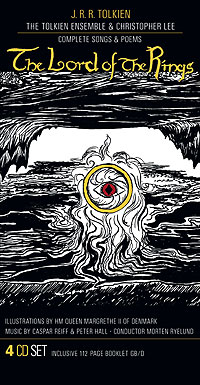
A 4-CD set was compiled after all of the recordings had been made over several years. There seem to be slight variations in the different editions and collections, but I have all four CD’s now, totaling 69 tracks, which I bought separately and mostly used. I’ve listened to some of songs many times, and I continue to be amazed at the quality of the music, and how each song is fitted with a composition that seems to me to be just right for it. I admit to being an amateur music critic, but I’m going to plow on ahead. If any of my readers are familiar with these recordings and know more about the field of music, maybe you can further instruct or correct me, or just tell me what are your favorite songs.
Tolkien Ensemble 2000
Caspar Reiff, one of the composers, founded the Tolkien Ensemble in Copenhagen when he was in his late 20’s and studying guitar at the Royal Danish Academy of Music. His former guitar teacher and “multi-musician” Peter Hall joined as co-composer, along with fellow students from the music academy. They are a convincing advertisement for that school.
The Ensemble manages to create a fitting expression for every mood and activity that was put to verse in these books. The song of “Tinúviel” captures the urgency and enchantment of Beren who falls in love with an Elven maid and chases her through the forest and the seasons, calling achingly, “Tinúviel! Tinúviel!” until she in turn falls under his spell, and in her eyes “The trembling starlight of the skies/He saw there mirrored shimmering.” The drinking song Frodo sings at the Inn of Bree is a lot of fun, with accordion and fiddle, spoons and dishes. There are riddles, laments, and even a bath song. We have a hearty upbeat walking song as the few Hobbits are starting out bravely:
Farewell we call to hearth and hall!
Though wind may blow and rain may fall,
We must away ere break of day
Far over the wood and mountain tall.
To Rivendell, where Elves yet dwell
In glades beneath the misty fell,
Through moor and waste we ride in haste,
And whither then we cannot tell.
With foes ahead, behind us dread,
Beneath the sky shall be our bed,
Until at last our toil be passed,
Our journey done, our errand sped.
We must away! We must away!
We ride before the break of day!
Contrast this with Frodo’s more melancholy mood when he sings alone the song he learned from Bilbo. It seems like the theme song for the entire tale:
The road goes ever on and on
Down from the door where it began.
Now far ahead the road has gone,
And I must follow, if I can,
Pursuing it with weary feet,
Until it joins some larger way,
Where many paths and errands meet,
And whither then? I cannot say.
Many of the songs are sad. The whole story is rather bleak, of course, with the growing and unrelenting awareness that the former glory of kings and elves is fading fast and can’t be regained. The unhurried drama enacted in a lumbering musical conversation between the separated Ents and Entwives is heartbreaking, but it is one of my favorites.
They call to one another in their stately Ent voices that convey their tree-like, large physiques and great age. The Ent sings stanzas in a beautiful but heavy tone, with the refrain, “Come back to me,” and she replies, “I’ll linger here,” until the last verses when he says he will come to her, and then they sing in unison of a time when they will converge on a journey to where their hearts may be at rest.
The Elf Legolas sings a “Song of the Sea” that I didn’t like at first, I think because it put me off balance, as though I were on a ship being buffeted by the waves. But after a few times through, I got my sea legs and began to enjoy the feeling of the moist wind in my hair, and the sense of adventure.
The women of The Tolkien Ensemble have lovely voices that one imagines might be heard among those “misty glades” where Elves dwell and sing. They use them to good effect in several tracks about the lands and heroes of these wise and ageless creatures.
What might be called a Thinking Song, “Bilbo’s Song,” is one that he sings meditatively. The guitar accompaniment reminds me very much of the way my own mind can go round and round on a subject, ruminating. The strings are plucked in a quick and repetitive rhythm, perhaps with a drone note coming back frequently.
I sit beside the fire and think
of all that I have seen
of meadow-flowers and butterflies
in summers that have been;
Of yellow leaves and gossamer
in autumns that there were,
with morning mist and silver sun
and wind upon my hair.
I sit beside the fire and think
of how the world will be
when winter comes without a spring
that I shall ever see.
For still there are so many things
that I have never seen:
in every wood in every spring
there is a different green.
I sit beside the fire and think
of people long ago
and people who will see a world
that I shall never know.
But all the while I sit and think
of times there were before,
I listen for returning feet
and voices at the door.
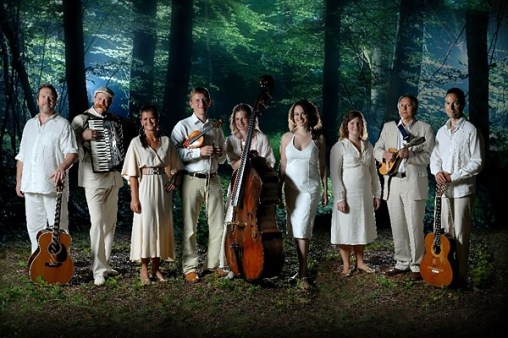
The group in 2007
At right is the cover of the set of two disks I first bought, to find out if even liked them. It’s hard to find samples of the music online; you might pull up one or two on YouTube, and then you might find them taken down the next minute. If bought separately, the disks in order of production are:
1 An Evening in Rivendell
2 A Night in Rivendell
3 Dawn in Rivendell
4 Leaving Rivendell
But don’t worrry – not all the action takes place in Rivendell. Those are just the disk titles, and the songs included on each disk are not necessarily in an obvious order, either.
I immediately found so much to love in those first two collections that I shopped sources for the other two disks. And after listening for a day or two, it was clear: I must read the trilogy again to put the newly appreciated songs in their context. That had been my desire after watching Peter Jackson’s film interpretation that was so disappointing, but I hadn’t followed through. So I dropped all my other Currently Reading books to read The Fellowship of the Ring. Now I am on to The Two Towers, still in the Company!
When I am listening to the recordings, and now reading the novel again, I often think about those days when I had my children gathered around me and we were all vicariously traveling across the mountains and wastes of Middle Earth. If it had been only ten years later, we could have paused at each song as it appeared in the story to play the companion track on a CD, and let the music sink into our consciousness and draw us deeper into the story. That kind of enrichment would have raised the quality of our literary immersion a notch, to be sure. The Tolkien Ensemble gave their final concert in 2008, but I’m confident that the fruits of their project will continue to give joy to Tolkien-lovers for a long time.
With winter coming on, it’s time I gave a report about a book I read on my Kindle, under my wool blankets last winter: The Year of Living Danishly: Uncovering the Secrets of the World’s Happiest Country by Helen Russell. Why did I choose this book in the first place? It had something to do with the erratic and perplexing workings of my mind in that first year of widowhood, combined with the popularity of the concept of hygge and the instantaneous nature of Kindle shopping.
Once I began, an unhealthy curiosity took hold and overcame my better impulses; I wanted to find out if the author decided to stay a second year. I also hoped she might reveal moral principles in herself, or a change of attitude, or anything to show that she was more than an unemployed journalist using the Danish experience to make a buck.
Russell’s husband had been offered a job with LEGO, and after some deliberating about leaving her job and mother behind in Britain, they decided to try it for a year. Why not, when it’s known to be the happiest country in the world! During the year that they live there, she writes about various aspects of Danish life, and gives the reader tons of statistics (which I didn’t check) from various research studies not specifically about Denmark, to show that maybe the Danes are on to something. She does not hide statistics about the sky-high divorce rate, the highest anti-depressant use in Europe, high suicide rate, how people change jobs frequently (certainly not because they are unhappy at work), but the many people she asks personally always say that their happiness level is either 9 or 10.
What bothered me was how the author didn’t appear to like the Danish people, her new neighbors and friends. She uses them as humorous subject matter for her book, but if she likes living in Denmark, it doesn’t appear to be out of appreciation for the natives. Also, I kept waiting for her to show that she held to principles against which to assess the culture, but by example, she quickly got over an initial concern over the way Danes casually expose children to pornography, and seems to easily absorb whatever socialist values are expedient, in trade for living in a welfare state with free everything.
Danish children – www
It may be that Russell is only trying to maintain an objective stance as a journalist; when she lacks her own ideas, she finds some statistics to throw out there. We are told about the Danes, “They cherish their freedom to indulge every whim,” and they “really enjoy themselves, safe in the knowledge that they’ll be looked after if (or rather, when) anything goes wrong.” This is important, because “women here have the highest rates of lung cancer in the world, and Denmark also tops the overall worldwide cancer charts for all types of cancer in both sexes.” Related statements are about how they are “among the highest drinkers in Europe,” and “smoke with zeal.” She also lets us know, using language I find oddly travelogue-ish, that Denmark is the “top spot for STI’s [a.k.a. STD’s] in Europe.”
She’s less non-committal about the many more wholesome customs she learns about. When a neighbor tells her about the importance of church confirmations, saying, “It’s tradition!” she calls the concept “That old chestnut.” One belief I’m sure was inculcated before she ever left the U.K. is “…sometimes the practice of religion goes against human rights, for instance in the case of abortion.” That she doesn’t say whose human rights she is thinking of, we must chalk up to her not being in the habit of thinking outside the box that the typical journalist these days is ensconced in, and not even being aware of her bias. She states in several places her assessment that religion doesn’t really mean much to most Danes, but if it is “going against” something in the popular culture, I am encouraged.
As to hygge, Russell does try to learn to slow down, to burn candles and eat pastries in the winter as she’s told to do, and she credits this more relaxed life with ending her infertility. Though it means that the grandmother will be across the sea, the couple do decide to stay another year.
I can’t help wondering if her new friends read her book, and how they felt about it. Maybe they don’t like to be the targets for her sarcasm… but probably she is a good neighbor in real life and they forgive her for not treating them as more than superficial-sounding book characters. I don’t like to think about the possibility that the author and her subjects truly have been reduced to mere contented, or sated, consumers; but when I factor in all those alarming statistics, the image I get of what people are doing on those long winter nights is not inspiring.
This winter, I will be glad not to live in a frigid place like Jutland. I will work on my own style of being cozy at home, and it will no doubt include the reading of many books. But reading this one hasn’t made me want to pursue anything Danish, and it has done nothing at all for my hygge.
 Even before I had left my neighborhood, the day before I was scheduled to fly out of San Francisco to Washington DC, I had “adventures.” In the morning, my back went out. After church traveling prayers were said for me, and I paid close attention to the request that my journey be healthful. Would God heal me overnight? That afternoon I took a walk in the neighborhood, because my chiropractor told me once that when you walk, every step is like a little adjustment; I know from experience that walking is healthful, and I hoped that the kinks would work themselves out, and the spasms cease.
 this trip I was looking forward to uninterrupted reading time on the plane(s), ten hours or more, plus reading for a few minutes in bed each night before sleep. I wanted to read on a topic somehow connected to the people or sights I would see, and one obvious one was India. No, India was not on my itinerary, but one big reason I was making a trip to visit Kate right now is that she and her husband are moving to India next year for work. They will be there two years; since they are very important people to me I’d like to know something about this place that will be their home. Also, I hope to visit them there!
 I feel a bit foolish, having written in my last book review that I had been put off from “all things Danish.” The fact is, I was that very week exulting in what I had forgotten was a Danish phenomenon, the


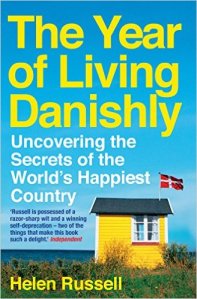 With winter coming on, it’s time I gave a report about a book I read on my Kindle, under my wool blankets last winter: The Year of Living Danishly: Uncovering the Secrets of the World’s Happiest Country by Helen Russell. Why did I choose this book in the first place? It had something to do with the erratic and perplexing workings of my mind in that first year of widowhood, combined with the popularity of the concept of hygge and the instantaneous nature of Kindle shopping.

 Gladsome Lights