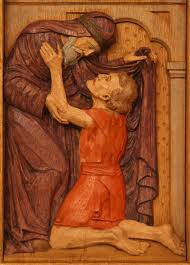
I was reminded by another blogger this week of how we need to ask God, not to remove our burdens, but to give us grace to bear them, and to bear them to Him, so that He can use them in our lives to bring us fully into His Heavenly Kingdom.
In the Orthodox Church this Sunday of the Prodigal Son is one of our markers letting us know that Lent is approaching, and I’ve been thinking again about what I can learn from the story about this grace I need.
The parable for this week is about a journey, and every journey consists of putting one foot in front of the other, or “doing the next thing.” We are all familiar with this sort of activity when we are ill, and need to take our medicine, follow the prescriptions of our doctors, according to schedule. And don’t stop taking the medicine until you are all well!
The extra effort we put forth during Lent is not to show our zeal but to acquire humility which puts us in the place to receive grace. Paul Evdokimov writes about just one of the many “treatments to be taken” in the Church:
The sacrament of confession is metanoia or transformation more than penitentia. Confession is understood as a ‘clinic,’ that is, a place of healing. That prayer before confession says: ‘You have come to the physician, may you not return without being healed.’ … St. John Chrysostom describes this quite precisely: ‘Time is of no matter. We do not ask if the wound has been treated often but if the treatment has been successful. The state of the wounded one indicates when the disease has been removed.”
“In patience you possess your souls,” the Lord has told us. (Luke 21:19) That is what I have to learn, to say, “I will arise and go to my Father,” as the prodigal did, today, tomorrow, and the next day and the next, until I am completely healed. And I don’t expect to see the day on this earth that I won’t need to stay with the program.
Here are the thoughts I had on this parable a few years ago:
He Came to Himself
One thing that impressed me about the story was the distance factor. The son was in a far country, when he realized what he needed to do. He was hungry and wasted, but he still needed to rise and go, to travel a long way, which must have been a struggle.
All of humanity is represented by the prodigal son, and most of us are still on the journey. Some of us have begun to repent and are a bit farther on our way, but we are all clothed in our flesh, struggling with our sins, anticipating the day when we sit in the Kingdom and feast with our Father, enjoying the restoration of our full inheritance.
In the story, the son receives everything he had thrown away and lost. For now, we have the earnest of the Holy Spirit, and the grace of God to help us continue. Every day I need to decide to take the next step on the way. But I know more than the son in the parable, who hoped for a corner of the pig shed. “…for he that cometh to God must believe that he is, and that he is a rewarder of them that diligently seek him.” (Hebrews 11:6)
I’m afraid I often act a bit nonchalant, as though I am at the gate or even in my Father’s arms already. My initial coming to myself has to be followed up by a constant facing-up to the toil of the road. Maybe I have been sitting on the grassy shoulder wishing the trip weren’t so long, wondering if maybe someone will arrive and carry me the rest of the way.
St. Herman of Alaska reminds me: “The true Christian is a warrior making his way through the regiments of the invisible enemy to his heavenly homeland.”







 Gladsome Lights