Category Archives: church

being, being, being

The poem below, about being in love, is speaking to me and for me, though of course it’s imperfect for that use, coming from a unique and distinct soul, with his own lonely knowings and loves.

Imperfect, but skilled and helpful, and conveying so much of the humanity that belongs to all of us. Love. God Is Love, and if we do any of this work that is the verb to love it is by His grace. If we feel anything like love coming to us or flowing from us, it is the Holy Spirit, for He fills all things.

The poem might be primarily about romantic love, which is inconstant — not that most of us don’t fail to be steadfast in all our loves. In the second stanza the lover declares his constancy, and in the last admits that his love is “in a moment gone.”

But I can’t help feeling the effusion and mystery of divine Love in it, and am reminded of Christ’s teaching that we ought to first love our God with all our heart, soul, mind and strength. Isn’t all love, whether we are giving or taking, essentially God sharing His Life with us and among us, the Love of the Holy Trinity? He uses people to do it, but after all, we find out that it was The Lord.

IN LOVE FOR LONG

I’ve been in love for long
With what I cannot tell
And will contrive a song
For the intangible
That has no mold or shape,
From which there’s no escape.

It is not even a name,
Yet is all constancy;
Tried or untried, the same,
It cannot part from me;
A breath, yet as still
As the established hill.

It is not any thing,
And yet all being is;
Being, being, being,
Its burden and its bliss.
How can I ever prove
What it is I love?

This happy happy love
Is sieged with crying sorrows,
Crushed beneath and above
Between todays and morrows;
A little paradise
Held in the world’s vice.

And there it is content
And careless as a child,
And in imprisonment
Flourishes sweet and wild;
In wrong, beyond wrong,
All the world’s day long.

This love a moment known
For what I do not know
And in a moment gone
Is like the happy doe
That keeps its perfect laws
Between the tiger’s paws
And vindicates its cause.

~ Edwin Muir

Elder Zosima and his brother

In my reading of The Brothers Karamazov, I came this morning, Monday of Holy Week, to the part “From the Life of the Elder Zosima.” The elder first relates about his older brother, who only at the age of seventeen and sick unto death, turned from anger and scoffing toward a path that might lead to repentance, and seemingly only to please his mother. But that is not an entirely bad reason.

…on Tuesday morning my brother started keeping the fast and going to church. “I’m doing it only for your sake, mother, to give you joy and peace,” he said to her….But he did not go to church for long, he took to his bed, so that he had to confess and receive communion at home. The days grew bright, clear, fragrant — Easter was late that year. All night, I remember, he used to cough, slept badly, but in the morning he would always get dressed and try to sit in an armchair. So I remember him: he sits, quiet and meek, he smiles, he is sick but his countenance is glad, joyful. He was utterly changed in spirit — such a wondrous change had suddenly begun in him!

The young man asked forgiveness of everyone and talked about his great sin, but at the same time was so happy and full of thankfulness and exhortations, that people thought he was going mad.

Thus he awoke every day with more and more tenderness, rejoicing and all atremble with love. The doctor would come — the old German Eisenschmidt used to come to us: “Well, what do you think, doctor, shall I live one more day in the world?” he would joke with him. “Not just one day, you will live many days,” the doctor would answer, “you will live months and years, too.” “But what are years, what are months!” he would exclaim. “Why count the days, when even one day is enough for a man to know all happiness. My dears, why do we quarrel, boast before each other, remember each other’s offenses? Let us go into the garden, let us walk and play and love and praise and kiss each other, and bless our life.”

This older brother died a few weeks after Easter, when the teller of the story, the elder Zosima, was only eight years old. He talks, now near death himself, more about his childhood, and how it was also during Holy Week that he began to see more when he went to church.

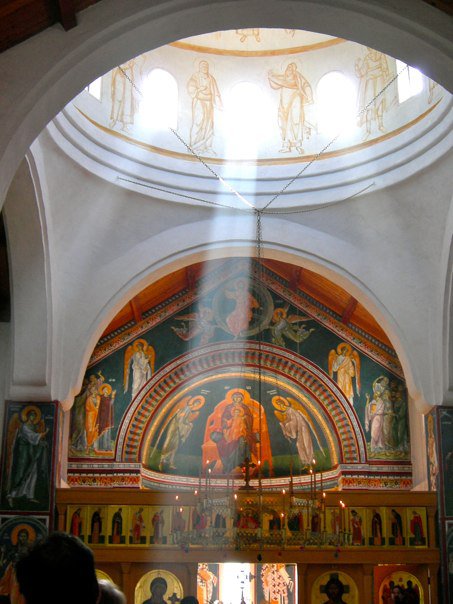
But I remember how, even before I learned to read, a certain spiritual perception visited me for the first time, when I was just eight years old. Mother took me to church by myself (I do not remember where my brother was then), during Holy Week, to the Monday liturgy. It was a clear day, and, remembering it now, I seem to see again the incense rising from the censer and quietly ascending upwards, and from above, through a narrow window in the cupola, God’s rays pouring down upon us in the church, and the incense rising up to them in waves, as if dissolving into them. I looked with deep tenderness, and for the first time in my life I consciously received the first seed of the word of God in my soul. A young man walked out into the middle of the church with a big book, so big that it seemed to me he even had difficulty in carrying it, and he placed it on the analogion [lectern], opened it, and began to read, and suddenly, then, for the first time I understood something, for the first time in my life I understood what was read in God’s church.

The reading was from the book of Job. And tonight I myself plan to attend this liturgy, and though I haven’t seen the program for the service, I now have confidence that I will hear this same reading. How many times have I also watched the beams of light shining down when I stood in church, and even felt their heat on my face, like the warmth of God’s Holy Spirit?

The Elder Zosima is a fictional character, but he is believed to be based on a real-life monk in old Russia. In the novel, where I am reading, Zosima goes on in his very moving fashion to tell his life’s story: “– and over all is God’s truth, moving, reconciling, all-forgiving!”

Isn’t it sweet that God should arrange for me to read this passage this morning, to help me in an unusual way to become even more receptive to His being with us tonight by means of hymns such as, “Let my prayer arise in Thy sight as incense….,” and the Psalms of Ascent — and the Holy Mysteries!

Last week our bishop was present with us, and he gave us a good word about the last days of Lent — well, technically Lent has come to an end, but we are still in the anticipation and preparation that is Holy Week. He said that Lent is not about finding every bit of dirt in our souls, but about the bridal chamber, about discovering the great love that our Lord Jesus has for us.

Perhaps Zosima’s brother went to a Bridegroom Matins service on Tuesday; we have three of them this week, and tomorrow I hope to attend at 6:30 in the morning. The Lord Himself has been filling my lamp with the oil of His Holy Spirit!
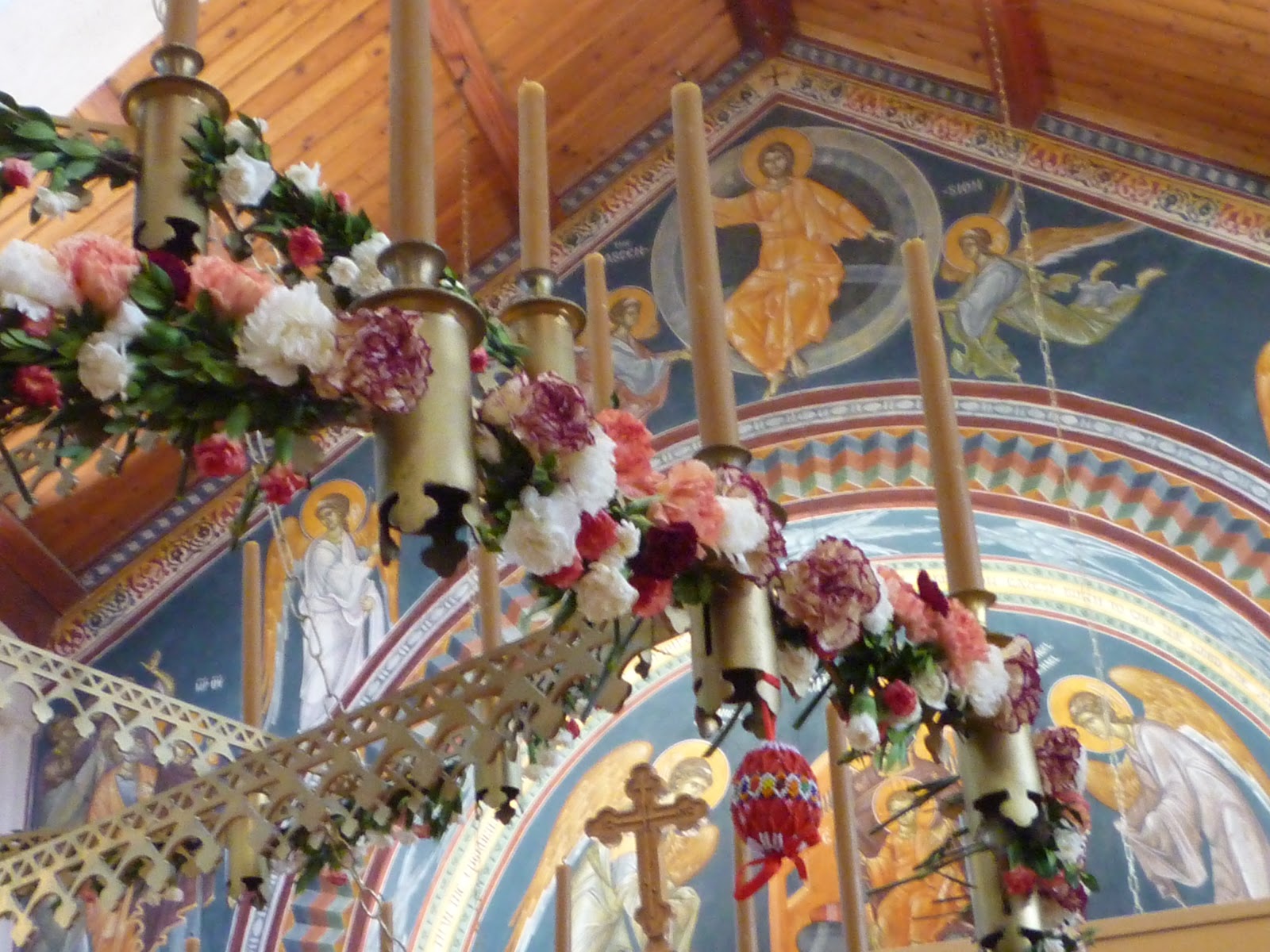
Jesus, unbind us!

For Orthodox Christians, today is Lazarus Saturday. We don’t celebrate Easter until next week, but the raising of Lazarus gives us a glimpse of Christ’s own rising from the dead a week later, and of our own coming resurrection.

This year I am a sponsor/godmother to a catechumen who will be baptized a week from today; last night I attended the last of her classes with her, and listened in on the explanation of all the services to come this week, and their meaning in our lives.

I was reminded of my own baptism five years ago, and also filled with joy in remembering and anticipating the many stops along this last stretch of the journey to Pascha. The liturgical landscape is marked by beloved hymns and prayers I have sung year after year, and which will bring me into the shining presence of Christ again, by His grace.

It’s easy to be emotional today, even thinking about an experience that is not primarily emotional, because I am housebound for a relatively minor disability, and have to miss a few services this coming week. So I’m feeling sorry for myself, but trying to be thankful at the same time, and accept all the blessings God is giving me.

When God is constantly pouring down love and blessing, it’s easy to get overwhelmed or confused. One day, the blessings look to any passerby to be good fortune, and another day, it takes a discerning eye to see Him, and be at peace. Even in the church services there are so many “things” going on that I can never attend to them all at once. One time I notice a particular hymn and how it blends perfectly into the whole message of the day; another time I spend most of the service in a battle just to return again and again from my distracting thoughts.

In my large parish we have numerous opportunities to participate in the services held, especially during Lent and Holy Week. I’m sure there is no one who can attend all of them, even the priests. Because circumstances change, including the circumstances of our own hearts and health, every Lent is at least a little different in how God deals with us. The upcoming week is part of that reality of having to live day-by-day and moment-by-moment, in thankfulness.

So often I come up against my own weakness and laziness. Father Stephen touches on this in his recent blog post about Lazarus, relating his meditations while sitting in the tomb of Lazarus a few years ago:

For me, he is also a sign of the universal entombment. Even before we die, we have frequently begun to inhabit our tombs. We live our life with the doors closed (and we stink). Our hearts can be places of corruption and not the habitation of the good God. Or, at best, we ask Him to visit us as He visited Lazarus. That visit brought tears to the eyes of Christ. The state of our corruption makes Him weep. It is such a contradiction to the will of God. We were not created for the tomb.

I also note that in the story of Lazarus – even in his being raised from the dead – he rises in weakness. He remains bound by his graveclothes. Someone must “unbind” him. We ourselves, having been plunged into the waters of Baptism and robed with the righteousness of Christ, too often exchange those glorious robes for graveclothes. Christ has made us alive, be we remain bound like dead men.

I sat in the tomb of Lazarus because it seemed so familiar.

Whether you celebrate tomorrow or next week, may your celebration of the Resurrection be a glorious feast.