Category Archives: church

Like an anvil, and bread baking: St. Polycarp

St. Polycarp was born in the first century and was burned at the stake in the second. Because of an early and well known document, The Martyrdom of Polycarp, thought to be the oldest authentic account of an early Christian martyr’s death, he is one of the most famous who have refused to deny Christ in the face of extreme threats.

His life is connected to several other notable saints, earlier and later, starting with St. John the Apostle and Evangelist, whom he knew and talked with; St. Ignatius, who met him and afterward sent a long letter of exhortation to him; and St. Irenaeus of Lyons, who was baptized by Bishop Polycarp when a youth and was sent by him as a missionary to Gaul.

The Letter of St. Ignatius to St. Polycarp resonates with life and the vibrant faith of the writer and the churches of Christ in those early centuries. An excerpt:

“Stand firm, as does an anvil which is beaten. It is the part of a noble athlete to be wounded, and yet to conquer. And especially, we ought to bear all things for the sake of God, that He also may bear with us. Be ever becoming more zealous than what you are. Weigh carefully the times. Look for Him, who is above all time, eternal and invisible, yet who became visible for our sakes; impalpable and impassible, yet who became passible on our account, and who in every kind of way suffered for our sakes.”

The author of “The Martyrdom of Polycarp” is unknown, but it was sent to the church in Philomelium, Asia Minor, from the church in Smyrna. Here is one paragraph from the letter:

“And as the flame blazed forth in great fury, we, to whom it was given to witness it, beheld a great miracle, and have been preserved that we might report to others what then took place. For the fire, shaping itself into the form of an arch, like the sail of a ship when filled with the wind, encompassed as by a circle the body of the martyr. And he appeared within not like flesh which is burnt, but as bread that is baked, or as gold and silver glowing in a furnace. Moreover, we perceived such a sweet odour, as if frankincense or some such precious spices had been smoking there.”

In a letter to his friend Florinus, after the death of Polycarp, St. Irenaeus writes fondly of his elder in the faith:

“I can even describe the place where the blessed Polycarp used to sit and discourse — his going out, too, and his coming in — his general mode of life and personal appearance, together with the discourses which he delivered to the people; also how he would speak of his familiar intercourse with John, and with the rest of those who had seen the Lord; and how he would call their words to remembrance. Whatsoever things he had heard from them respecting the Lord, both with regard to His miracles and His teaching, Polycarp having thus received from the eye-witnesses of the Word of life, would recount them all in harmony with the Scriptures. These things, through God’s mercy which was upon me, I then listened to attentively, and treasured them up not on paper, but in my heart; and I am continually, by God’s grace, revolving these things accurately in my mind.”

On this day on which we commemorate St. Polycarp, I will be listening to a sonata composed in his honor by Heinrich Biber (1644-1704): “Sancti Polycarpi”, and “revolving these things” I’ve been learning about these men in my own mind —  their struggle to stand firm, as St Ignatius exhorted, and to “Weigh carefully the times. Look for Him, who is above all time….” Thank you, Lord, for the ever encouraging testimony of your saints, and on this day, especially that of Saint Polycarp of Smyrna. +

She visits her garden… sometimes.

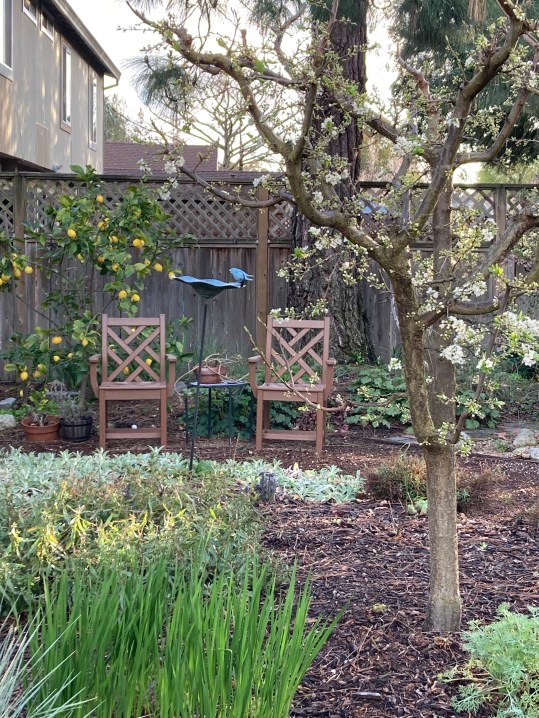
I wish I could be a better gardener, the kind who visits her garden each and every day for at least a few minutes, to pull one weed, or sniff a flower, or pinch aphids. Today I got my hands into the dirt and into the slimy fountain, and accomplished the setting out of these starts I bought a week ago. I checked on my worm bucket and found the worms happy. I picked all the Swiss chard from two mature plants and cooked it up into a recent favorite: Extra Garlicky Chard with Cannellini Beans; this time I threw in some dried tomato bits as well.

The last two weeks have been full to bursting with all the best sorts of non-garden busyness. Two book clubs had discussions in the same week. At a sister parish a baby was baptized, and another baby soon to be born into our parish was showered.

One day I drove to Sacramento and Davis to visit people, and another day I took care of two girls, A&Z, who played house upstairs and down, using all my dress-up collection, every doll and doll blanket and stuffie and pillow, toy animals and Playmobil…. Most of it they dragged over by the (cold) woodstove and set up their house with the two loveseats for beds, and played going-to-sleep.

This all may sound mundane to many of you, but to me it is unusual; never in my family or my children’s families have we birthed two girls in a row in the same household, and when you have mostly boys, or girls five or more years apart, the children play differently. I have been fascinated to watch these little homemakers.

For Valentine’s Day my grandchildren in Colorado sent me a box full of heart cookies that they had baked, redolent of butter and love ❤ They didn’t last long!

One day I spent experimenting with red dye to color eggs for Pascha. As some of you know, because I asked you directly for advice, I offered to take on the project this year for our Orthodox parish, which gives out about 200 red eggs on Pascha night. I wanted to try different dyes, colors of eggs and methods ahead of time so that during Holy Week I would have my plan firmly in mind, and the best dye on hand. I have yet to write up all that I learned so far, but I accomplished my goal that day, and also ended up with quite a few eggs, in various shades of red and pink, to eat in the next week.

I have been doing at least a little bit of my Purging-Organizing Project every day. I took a carload to the thrift store, and keep dumping pounds of papers into the recycling bin. The  more of that I do, the more fun it is.

My church Book Group #2, which I might call the Wednesday Book Group, to distinguish it from our Women’s Book Group, is reading C.S. Lewis’s Space Trilogy, also called the Ransom Trilogy. Though I read it two years ago, or maybe because the story is fairly fresh in my mind, I am really happy to have an excuse to get into it again, and have a really diverse group to discuss it with, too.

There are always so many things I want to write about, regarding my reading and thinking. But less and less do I feel the liberty to spend the necessary time to think that much — so I am considering replacing at least some of my blogging with barking….

What late was hidden in the heart.

LOVE’S BONDMAN

Great joy it were to me to join the throng
That thy celestial throne, O Lord, surround,
Where perfect peace and pardon shall be found,
Peace for good doings, pardon for the wrong;
Great joy to hear the vault of heaven prolong
That everlasting trumpet’s mighty sound,
That shall to each award their final bound,
Wailing to these, to those the blissful song.
All this, dear Lord, were welcome to my soul,
For on his brow then every one shall bear
Inscribed, what late was hidden in the heart;
And round my forehead wreath’d a lettered scroll
Shall in this tenor my sad fate declare:
“Love’s bondman, I from him might never part.”

-Fra Guittone d’Arezzo (c. 1235–1294)
……Translated by Henry Francis Cary


The honey and the harp.

St. Ephraim the Syrian, c. 306-373

One of the church book clubs I currently try to keep up with met recently to discuss our current selection, Christ the Conqueror of Hell: The Descent into Hades from an Orthodox Perspective, by Metropolitan Hilarion Alfeyev. It is an impressive compendium of material on the subject from Scripture, patristic tradition, and early Christian liturgical texts and poetry. I was intrigued by the section on liturgical poetry from the 4th-6th centuries, especially the verses of St. Ephraim (or Ephrem) the Syrian.

While St. Romanos the Melodist, who lived in the 6th century, is considered by most to be the preeminent poet of the Byzantine period, he “was familiar with Ephrem’s works and drew from them. He learned from Ephrem’s poetical artistry as well as from his handling of particular literary plots and theological themes.”

The author of Conqueror explains how Ephraim and the Syrian tradition differed from that of the Greek fathers and their Ecumenical Councils. While he also formulated dogmatic teaching for his flock, he “clothed theological truths not in the armor of precise dogmatic definitions but with the bright garments of poetic symbols and metaphors …. to theologize for Ephrem meant to glorify God rather than talk about or reflect upon God. He believed the truths of Christianity should not only be comprehended, reflected upon, defined, and established but also experienced by the faithful through prayer. This same avenue was followed by most of the writers of the liturgical texts in the tradition of the Orthodox Church.”

The subject matter of Christ the Conqueror of Hell is especially appropriate for Holy Saturday and Pascha, and maybe I will post some of the liturgical poetry in that season; at this time I wanted to mention the part about Saint Ephraim because January 28th is the day we commemorate this poet and theologian. I found an enjoyable historical video about his life, using the title that has been given to him: “The Harp of the Holy Spirit.”

You may be familiar with his Lenten Prayer we use daily during the Great Fast; also, hymns and meditations of St. Ephraim were collected by St. Theophan the Recluse into A Spiritual Psalter. I have this on my shelf and could stand to spend some time perusing it, especially after reading today’s entry in The Prologue of Ohrid, where there is a hymn to Ephraim by St. Nikolai opening with the words,

Ephraim’s heart burns
With love for Christ,
And Ephraim’s tongue speaks
Of the pure wisdom of the Gospel.
Ephraim, the honey-bearing bee;
Ephraim, the fruit-bearing rain!

Just as God sends the bees and the rain to work for our joy and profit, so He sends people like this man. Let me keep that image of a buzzing and busy bee in my mind a while; let me drink holy nectar and refresh others the way God uses His creatures and creation to constantly renew my spirit.

And for today, one morsel of honey from this holy bee:

The chutzpah of our love is pleasing to you, O Lord,
just as it pleased you that we should steal from your bounty.

-Saint Ephraim the Syrian