Category Archives: death

Holy Friday and our own holy bodies.

On Holy (“Good”) Friday we Orthodox keep vigil next to the “shroud” icon of Christ all night through, until noon on Saturday, remembering our Lord in the tomb.  From the time of His death until His Resurrection on Sunday, we don’t go about our “usual business.” In my parish, parishioners take turns reading or chanting Psalms at a small lectern, with the aid of a candle during the hours of darkness.
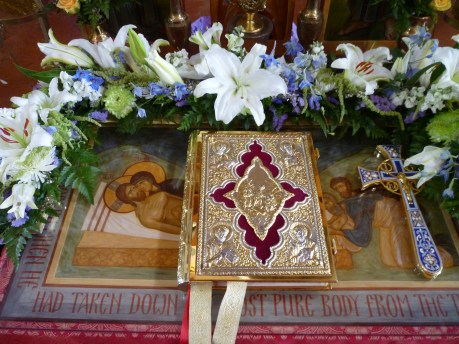
This vigil is something we also try to do, if at all possible, for any mere human from whom the spirit has departed, as each one bears the image of Christ. And as He blessed Creation and the material world by becoming part of it in His Incarnation, so each body of flesh is holy and precious.

(I don’t know if I wrote here previously about how we were able to honor my husband this way two years ago, between the time of his death and his burial, as his coffin remained in our house until the day of his funeral, and many people came to pray the Psalms nearby over the course of three days.)
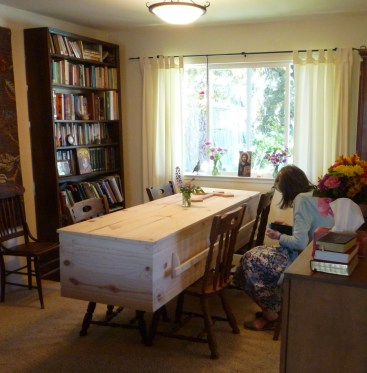
Even if you are not a Christian, or a worshiper of any kind, the body is that aspect of your person with which you have exerted your will to live and love — to stand up, to feed yourself, and even better, to embrace those you love and to express thanks and kindness. All these actions and behaviors build a heritage and a history attached to your physical self, a unique life given by God. It’s not a “shell” or a thing to be discarded as unimportant. You are honorable, every part of you, because of Who made you, and because of His love.

Christians have the added motive to honor the body, that we want to follow the example of our Savior in every way that we can. As His body was lovingly prepared for burial, so we want to do when it is in our power.

I was gratified to read the following explanation of some of these things that was included in a funeral program last summer, when we were saying goodbye to one of our parishioners and laying his body to rest:

“…we believe the body to be an honorable and even a holy thing. For us the body is not something which is dishonorable or defiled, or to be hidden away or hurriedly disposed of. It is less than the soul, and we know that, deprived of the soul, it will dissolve into its elements, but we believe also that on the last day, whether the deceased were a Christian or not, it will be raised up again. We believe that it was part of that person who has died and is therefore to be treated with reverence….

“The body of an Orthodox Christian is a holy thing. It is that body which was washed in Holy Baptism, anointed with holy Chrism, which partook of the Body and Blood of Christ in the Eucharist, which was anointed with holy oil, which received the tonsure at Baptism, at Ordination or at monastic profession, which was crowned in marriage, which made the sign of the Cross, which looked at and kissed the holy icons, which reverenced and touched the sacred relics, which stood in prayer, which made prostrations, which listened to the chants and readings, which read the Scriptures and prayers, which smelled the incense and fragrances, which went on pilgrimage, wept, suffered illnesses and pains, suffered in child-birth, which struggled against the passions, which gave alms, which fasted, restrained itself, tried to keep itself pure, indeed which participated in the true worship of the True God.”

Know ye not that your body is the temple of the Holy Spirit? (I Cor: 6:19)

More on this subject is in the article online from which these paragraphs were taken.

The entire faith and love and hope.

My whole church is bereaved, because one of our strong young men, the only son of his parents, grown up for 35 years in the parish, suddenly sickened and died. It happened so fast, it seems unreal to us. This morning I attended a prayer service in advance of the funeral proper.

One of the lines that is repeated in song is, “Blessed art Thou, O Lord; teach me Thy statutes,” and I mused on what God might be teaching me right now. Certainly, we should all “number our days, that we may apply our hearts unto wisdom.” But I don’t want to forget something else that our rector reminded us of, at the end of the service, that even in our grief we have joy, knowing that Christ has overcome death — that’s why we could pray that our brother will be granted rest “with the spirits of the righteous made perfect.”

Every time there is another death or funeral, my own soul’s griefs are awakened, acknowledged and comforted. And our pastor also kindly included in our church bulletin today an encouraging passage (an excerpt from this article) from Father Alexander Schmemann. He starts out explaining why death must be understood as an evil enemy. But keep reading:

God created man with a body and soul, i.e. at once both spiritual and material, and it is precisely this union of spirit, soul and body that is called man in the Bible and in the Gospel. Man, as created by God, is an animate body and an incarnate spirit, and for that reason any separation of them, and not only the final separation, in death, but even before death, any violation of that union is evil. It is a spiritual catastrophe. From this we receive our belief in the salvation of the world through the incarnate God, i.e. again, above all, our belief in His acceptance of flesh and body, not “body-like,” but a body in the fullest sense of the word: a body that needs food, that tires and that suffers. Thus that which in the Scriptures is called life, that life, which above all consists of the human body animated by the spirit and of the spirit made flesh, comes to an end — at death — in the separation of soul and body. No, man does not disappear in death, for creation may not destroy that which God has called from nothingness into being. But man is plunged into death, into the darkness of lifelessness and debility. He, as the Apostle Paul says, is given over to destruction and ruin.

Here, I would once more like to repeat and emphasize that God did not create the world for this separation, dying, ruin and corruption. And for this reason the Christian Gospel proclaims that “the last enemy to be destroyed is death.” The Resurrection is the recreation of the world in its original beauty and totality. It is the complete spiritualization of matter and the complete incarnation of the spirit in God’s creation. The world has been given to man as his life, and for this reason, according to our Christian Orthodox teaching, God will not annihilate it but will transfigure it into “a new heaven and a new earth,” into man’s spiritual body, into the temple of God’s presence and God’s glory in creation.

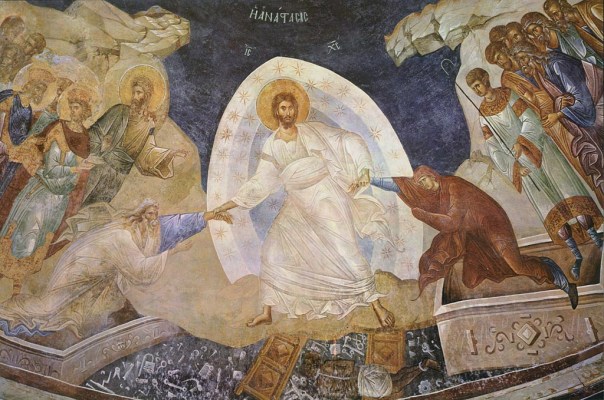
“The last enemy to be destroyed is death…” And that destruction, that extermination of death began when the Son of God Himself in His immortal love for us voluntarily descended into death and its darkness, filling its despair and horror with His light and love. And this is why we sing on Pascha not only “Christ is risen from the dead,” but also “trampling down death by death…”

He alone arose from the dead, but He has destroyed our death, destroying its dominion, its despair, its finality. Christ does not promise us Nirvana or some sort of misty life beyond the grave, but the resurrection of life, a new heaven and a new earth, the joy of the universal resurrection. “The dead shall arise, and those in the tombs will sing for joy…” Christ is risen, and life abides, life lives… That is the meaning; that is the unending joy of this truly central and fundamental confirmation of the Symbol of Faith: “And the third day, He rose again according to the Scriptures.” According to the Scriptures, i.e. in accordance with that knowledge of life, with that design for the world and humanity, for the soul and body, for the spirit and matter, for life and death, which has been revealed to us in the Holy Scriptures. This is the entire faith, the entire love, and the entire hope of Christianity. And this is why the Apostle Paul says, “If Christ is not risen, then your faith is in vain.”

–Protopresbyter Alexander Schmemann, 1980,
Translated from Russian by Robert A. Parent

harrowing of hell wide

We pray and kiss her good-bye.

The picture below is of a cemetery that I have visited a few times in the last two years. This week I was here for the burial of Nina, about whom I told you not long ago, when she was still going strong.

Fvl cemetery Radonitsa 15

Nina said recently, and smiling, I’m sure, that she didn’t really want to celebrate another birthday on this earth; and though she wasn’t sick or in pain, her heart did stop one day, just before she would have turned 104.

When I heard that she had died I was still in the mountains, and it made me sad to think I would not be able to pray at her funeral – so I was pleasantly surprised to learn that it would not take place until later. It’s not traditional to wait that long, but perhaps the birth of one of her great-great-grandchildren, who was present at the service and two weeks old, had something to do with the delay.

It was to love and honor Nina that I made the effort to get to church that morning, and not because I knew her or her family very well. I wasn’t feeling energetic or “spiritual” and you might even say I was in a bad mood. So I was completely surprised at how personally and deeply I was affected.

Her casket was in the center of the church. We were all gathered around singing, and the priests and deacons were censing Nina and the church, because something fundamental and important and holy was going on. Yes, they were censing Nina. Father addressed the common but mistakgl photos ninaen idea that people often express about the dead, saying, for example, “That’s not my mother!” as though the material aspect of the self was unessential. “Well, who is it, then?” he asked.
Father Stephen in a recent blog told about a Protestant church in his town that forbids the presence of the body at funerals. He writes, “Biology is easily the most fundamental aspect of our human existence. We do not ‘have’ bodies – we ‘are’ bodies.”

I’m so thankful that in my church we do not whisk away the body, but instead acknowledge it as the most “fundamental aspect” of the person and the way that we have known them their whole life. We sang a hymn about “the last kiss,” and we had the opportunity to kiss and venerate Nina’s holy body, with which she worshiped God and loved so many people during her many years on the earth.

I did think a lot about my husband that day, and I wept, because I still feel the raw places where he was torn away from me; but because it has been over a year since his own falling asleep, I was less distracted by my own grief and able to pay closer attention to the service than I could at the two funerals I attended last spring and summer. I noticed Christ with us at Nina’s funeral, and the palpable love of the Holy Trinity, which we reflected in and from our own bodies, still more or less intact.

gl Nina graveside

The liturgy of the funeral service is rich and deep. It is a commending of the believer to God, praying, “Grant rest in blessed repose, O Lord, to the soul of your servant,” many times, solemnly and lovingly, with Psalms and many readings from the Gospels and other scriptures, such as this passage from John, in which Jesus tells His disciples,

Verily, verily I say unto you, he that heareth My Word and believeth in Him that sent Me, hath everlasting life and shall not come into condemnation, but is passed from death unto life…. the hour is coming and now is, when the dead shall hear the voice of the Son of God; and they that hear shall live. For as the Father hath life in Himself, so hath He given to the Son to have life in Himself, and hath given Him authority to execute judgment also, because He is the Son of Man.

Marvel not at this; for the hour is coming in which all that are in the graves shall hear His voice and shall come forth….

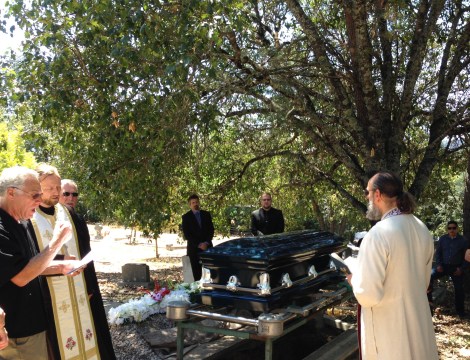
gl blessing grave w holy water

Hearing words like this, I couldn’t dwell too long on the horrible unnaturalness of death, and the sorrow of a soul being torn from its body. Again, I am helped by the way that Fr. Stephen explains our perspective:

In the traditional theology of the Eastern Church, this world and the “next,” are not two worlds. We use the language of place (heaven and earth) for lack of language not for accuracy. There is more to the created order than we see (“all things visible and invisible”). But that which is not seen is not inherently separate from that which is. Sacrament (mystery in the East) is a way of describing the relationship between what is seen and what is unseen. Everything is sacrament, icon and symbol.

In such a setting, death is a change, but not an end. That which we see, the body, remains important and worthy of honor. A funeral, the service of remembrance, is a sacramental gathering in the presence of God. The body is honored, even venerated. The life of remembrance, eternal remembrance, begins.

gl shovel of dirt into grave

I hadn’t planned to go to the cemetery for the burial, for various reasons, but I didn’t want to leave this event that seemed to have a stately and grace-filled momentum – I wanted that grace!

So I drove over with a couple of other women, and stood with the family and fellow parishioners, including that brand-new baby, while we committed our dear friend to the earth – for a time. The epistle we had just heard echoed in my mind,

(I Thessalonians 4) 13 But I would not have you to be ignorant, brethren, concerning those who are asleep, that ye sorrow not, even as others who have no hope.

14 For if we believe that Jesus died and rose again, even so will God bring with Him those also who sleep in Jesus.

15 For this we say unto you by the Word of the Lord: that we who are alive and remain unto the coming of the Lord, shall not precede those who are asleep.

16 For the Lord Himself shall descend from Heaven with a shout, with the voice of the archangel and with the trumpet of God; and the dead in Christ shall rise first;

17 then we who are alive and remain shall be caught up together with them in the clouds to meet the Lord in the air. And so shall we ever be with the Lord.

If you would like to read more about the Orthodox funeral service, there is a good article on this site. It’s all very encouraging!

With the saints give rest, O Christ, to the soul of Thy servant where sickness and sorrow
are no more, neither sighing, but life everlasting
.

gl harrowing med resurrection anastasis

Blackberries, hospice, and being late.

gl IMG_2749 berriesI stopped and snacked on a few blackberries along my walking path this week, and that made me think about my dear late husband. And I wondered, how long does one use the descriptor “late” to refer to the deceased? So I read about that here. And after I read, I wanted to call him my “swete and late amyable husbonde.”

We are used to hearing that adjective attached to its noun, but I found it charming to read in Alexander McCall Smith’s novels of Botswana how people would simply state about someone who had died, “He is late.” You might think that the phrase refers to someone who has only recently died, but I can attest to the relative meaning of recently when we are talking about one’s lifelong partner.

A quote from this month’s New Yorker magazine, in the article about hospice worker Heather Meyerend, “The Threshold”, by Larissa MacFarquhar:

“People react differently to a death. Some cry, some are calm….Wives sometimes throw themselves on the body, weeping and grasping it, especially when the couple have been married forty, fifty, sixty years. ‘The Bible says, And two shall become one,’ Heather says. ‘It’s a wrenching that happens, a tearing, like a garment that’s being pulled apart.'”

Mr. Glad and I married when we were both 21, and soon moved from southern to northern California. Before we had even settled on what county we might live in, we were picking wild blackberries together, up in the redwood forests of Humboldt County. From then on it was a July tradition to search around the country roads or empty lots to gather enough for several pies and a few quarts of syrup as well. That’s how it happened that we formed the habit of his birthday pie.

gl IMG_2747 blackberries

As I’ve thought so much about my husband and our life together over the last year, Sheldon Vanauken’s book A Severe Mercy comes to mind, because it includes a lot about the death of his wife and his dealing with that. I didn’t like the book very much when I read it many years ago, because of the way the two of them seemed unswervingly self-absorbed as a couple; but one thing the grieving husband did tell about always stuck with me and made me ponder, long before I imagined myself in his position.

His wife’s nickname was “Davy,” and within days after her death he experienced the “flooding back to me of all the other Davys I had known. She had been in the year of her dying the Davy she had become — the Christian Davy of Oxford and since,” but he began to remember her at various times of their life together and even before, and to liken this process to what happens when you come to the end of a novel. You have been focused on each page and what the character is doing, who she is at that point in the story. Then you close the book and begin to grasp the meaning of it all from the first chapter on through.

When you are a hospice nurse, or the sole caregiver of a dying person, you have to focus on that day, that page of the life, to give all the love and attention you can. I hope it is possible for you to read the article I linked to above, about this particular nurse – if it becomes unavailable try googling her name – because the description of her work and ministrations is that of a saint. The author of the article follows her on her visits to several different homes and chronicles her interactions with the patients, and her wise assessments of the needs of the dying generally. The story of her own life shows how she was formed and guided by God into this realm that she seems imminently suited for.

When my husband was dying, our family didn’t need the hospice workers to help us with matters of the heart, but I appreciated Heather’s insight about such things as this:

When a patient was tormented and having a difficult time dying, or was hanging on despite no longer eating or drinking, Heather would ask, Is there someone you need to see? If a patient was preoccupied with someone he was resolved never to forgive, Heather might say that this unforgiveness was like bondage, and that if he forgave the person who had injured him that person would no longer be his jailer.

I thought that when I helped my goddaughter in her last days that the experience provided plenty of revisiting of the last months of my husband’s life, but reading about hospice care a year later is actually helpful. I’m less self-absorbed myself and can look back more calmly and see many reasons for thanksgiving in the last weeks and even hours.

One phenomenon that is mentioned in the article is how many people when they are in their last days seem to wait until they are alone before they let themselves “go.” One wife worried a lot about this when her husband was in hospice care, concerned that she might not be with him at that moment, and she was relieved when she was able to be by his side at the end.

I didn’t worry about it, but I would have preferred to be with my husband, and I was. Only from this vantage point does it occur to me that this was a gift from him to me and the daughters who were also there holding his hand, to let us accompany him all the way until the crossing over.

Whenever Heather entered a patient’s home for the first time, she knew that she was walking into a long, long, complicated story that she understood nothing about, a story that was just then reaching its final crisis.

Until today most of my own efforts to look back on my husband’s life have taken me far from last year’s final crisis, and by means of photos I’ve been helped to remember him at earlier stages in his life. But reading things he’s written is perhaps even more satisfying. I’ve just begun to sort through papers to find notes and creations that surprise me, that make me see the depth and complexity of the man whom I was mostly reading page-by-exciting-page all those years. We were living out our own novel, so to speak, and we were, as protagonists usually are, unknowing of what was going to be on the next page. But our Heavenly Father was the author, and He was making the ending very good, in spite of crazy things the characters might do or go through along the way.

gl tract coverI had forgotten about this gospel tract that he created — was it in his 30’s? Unfortunately he didn’t put a date on anything I have dug up so far. In those days he did like to have some “literature” to give people he met, something they could read later on, and I imagine he found most such material too reductionist to be called The Gospel, so he had to make his own. The content of it tells of his foundation in Christ, and also of what he died knowing.

gl tract inside 1

I miss my husband terribly. The grief ebbs and flows and is never the same, except for being always present. I’m glad I’ll be in this process for some time, of rereading my husband’s life and remembering more things to love him for, and be thankful. I’m loath to give up that berry pie tradition, so next week, on his birthday, I’ll be baking  one again — even though I already know he will be late for the party.

gl P1030289