Category Archives: feasts

Exaltation of the Cross

But God forbid that I should glory, save in the cross of our Lord Jesus Christ…          -Galatians 6:14

Thy Cross is for all men a well of blessings and a cause of thanksgiving. Thereby for them that believe in thee, weakness is turned into strength, shame into glory, and death into life.
-St. Leo the Pope (d. 461)
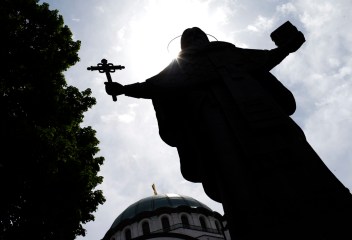
Monument of St. Sava is seen in front of the temple during Good Friday in Belgrade

Feast of the Exaltation of the Cross — September 14

I feel too tired to write a blog post today, but I couldn’t let this feast go by without mention. It isn’t always possible for me to get to Vespers or Vigil on Saturday evenings, but last night I did. I love the hymns that we sing at the feast of the cross. In the Orthodox Church, when we sing something like:

“Before Thy Cross we bow down O Master, and Thy holy Resurrection we glorify,” we actually prostrate ourselves on the floor for each of three refrains. (Many hymns have this triplet aspect to them, as a reminder of the Holy Trinity.)

If you are struggling with a bad attitude, it’s amazing how effective this kind of behavior can be in setting you on a better track, and helping you to pray. This morning at Divine Liturgy we had more of the same majestic hymns, and “O God, save Thy people, and bless Thine inheritance… preserve Thy habitation!”

The Church is the habitation of Christ. His presence fills His temple, and today our new chandeliers were set to swinging for the joy of Him being among us.
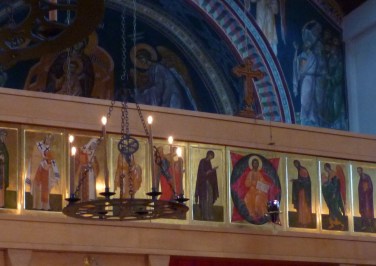
P1110337cross crp

In our church bulletin we have for this week a pertinent quote from Fr. Basil Zebrun of Fort Worth, Texas:

“…when we are told in today’s Gospel, ‘Turn away from yourself, take up your Cross, Follow Me (Mark 8:34) — we are not called to something dark and frightening; we are told by God: ‘Open yourself to love! Do not remain a prisoner of your own self-centeredness.’ Do not be, in the words of St. Theophan the Recluse, ‘like  a shaving of wood which is rolled around its own emptiness.’ Open yourself up! Look — there is so much to love, there are so many to love! There is such an infinity of ways in which love can be experienced, and fulfilled and accomplished.

“Open yourself and love (others) — because this is the way of the Cross! Not the way which the two criminals trod together with Christ to be punished for their crimes; but the wonderful way in which giving oneself unreservedly, turning away from self, existing only for the other, loving with all one’s being so that one exists only for the sake of the other — this is the Cross and the glory of the Cross.”
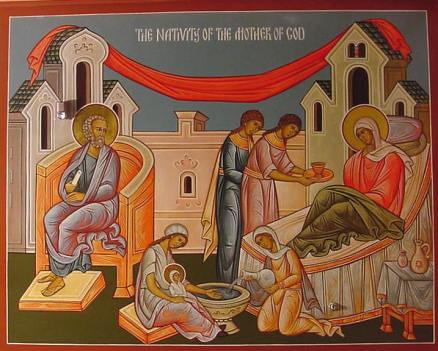
Mary also was given a gift.

This week we Orthodox celebrate one of the Twelve Great Feasts of the Church, The Birth of Christ’s mother Mary, whom we Orthodox call the Theotokos. This name, which means God-bearer, honors Jesus Christ in that it contains the statement of our belief that He is “…very God of very God, begotten, not made, being of one substance with the Father.”

In this article about the feast Fr. Alexander Schmemann tells us that Mary’s birth was not unlike that of any other human, with all its gifts and potential. Putting it that way, though, belies the immensity of what happens when someone is born, if you believe Fr. Alexander who says that “…with each birth the world is itself in some sense created anew and given as a gift to this new human being to be his life, his path, his creation.” This is hard for me to wrap my head around; probably because it’s something that the heart has to learn.

Mary was given this gift – and she gave the world a great gift. Certainly she played a big role in our salvation history, and we love her for it, and love to celebrate her birthday.

These excerpts are from a slightly longer article here: On The Nativity of The Theotokos

Nat_Theot

THE BIRTH OF THE THEOTOKOS:

Son of God, Son of Man… God descending and becoming man so that man could become divine, could become partaker of the divine nature (2 Peter 1:4), or as the teachers of the Church expressed it, “deified.” Precisely here, in this extraordinary revelation of man’s authentic nature and calling, is the source of that gratitude and tenderness which cherishes Mary as our link to Christ and, in Him, to God.

And nowhere is this reflected more clearly than in the Nativity of the Mother of God. Nothing about this event is mentioned anywhere in the Holy Scriptures. But why should there be? Is there anything remarkable, anything especially unique about the normal birth of a child, a birth like any other?

The Church began to commemorate the event with a special feast…because, on the contrary, the very fact that it is routine discloses something fresh and radiant about everything we call routine and ordinary, it gives new depth to the unremarkable details of human life…. with each birth the world is itself in some sense created anew and given as a gift to this new human being to be his life, his path, his creation.

This feast therefore is first a general celebration of Man’s birth, and we no longer remember the anguish, as the Gospel says, “for joy that a human being is born into the world” (Jn. 16:21). Secondly, we now know whose particular birth, whose coming we celebrate: Mary’s. We know the uniqueness, the beauty, the grace of precisely this  child, her destiny, her meaning for us and for the whole world. And thirdly, we celebrate all who prepared the way for Mary, who contributed to her inheritance of grace and beauty….

And therefore the Feast of her Nativity is also a celebration of human history, a celebration of faith in man, a celebration of man. Sadly, the inheritance of evil is far more visible and better known. There is so much evil around us that this faith in man, in his freedom, in the possibility of handing down a radiant inheritance of goodness has almost evaporated and been replaced by cynicism and suspicion.

This hostile cynicism and discouraging suspicion are precisely what seduce us to distance ourselves from the Church when it celebrates with such joy and faith this birth of a little girl in whom are concentrated all the goodness, spiritual beauty, harmony and perfection that are elements of genuine human nature. Thus, in celebrating Mary’s birth we find ourselves already on the road to Bethlehem, moving toward the joyful mystery of Mary as the Mother to God.

—Fr. Alexander Schmemann

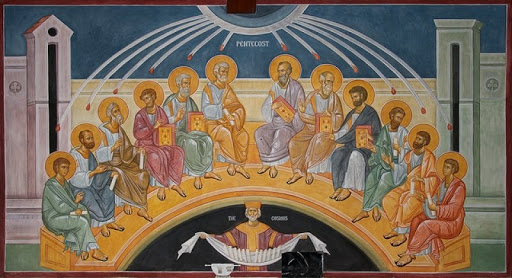
Pentecost has happened to us.

“…the fiftieth day stands as the beginning of the era which is beyond the limitations of this world, fifty being that number which stands for eternal and heavenly fulfillment in Jewish and Christian mystical piety: seven times seven, plus one.

“Thus, Pentecost is called an apocalyptic day, which means the day of final revelation. It is also called an eschatological day, which means the day of the final and perfect end (in Greek eschaton means the end). For when the Messiah comes and the Lord’s Day is at hand, the “last days” are inaugurated in which “God declares:… I will pour out my Spirit upon all flesh.” This is the ancient prophecy to which the Apostle Peter refers in the first sermon of the Christian Church which was preached on the first Sunday of Pentecost (Acts 2: 1 7; Joel 2: 28-32).

“Once again it must be noted that the feast of Pentecost is not simply the celebration of an event which took place centuries ago. It is the celebration of what must happen and does happen to us in the Church today. We all have died and risen with the Messiah-King, and we all have received his Most Holy Spirit. We are the “temples of the Holy Spirit.” God’s Spirit dwells in us (Rom 8; 1 Cor 2-3, 12; 2 Cor 3; Gal 5; Eph 2-3). We, by our own membership in the Church, have received “the seal of the gift of the Holy Spirit” in the sacrament of chrismation. Pentecost has happened to us.”

Read the whole article here: Pentecost: The Descent of the Holy Spirit