
Christ is risen from the dead, trampling down death by death,
and upon those in the tombs bestowing life!
Christ is risen from the dead, trampling down death by death,
and upon those in the tombs bestowing life!
 |
||
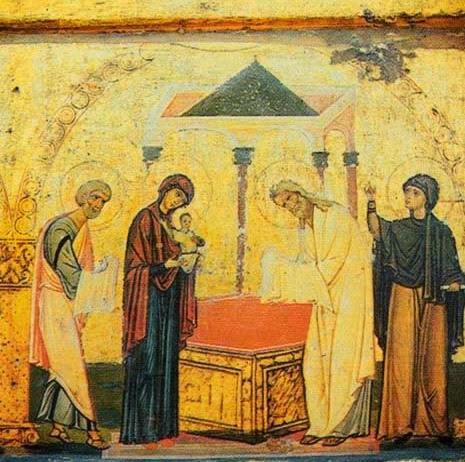
| Presentation of Christ in the Temple, St. Catherine’s Monastery, Sinai, 12th century |
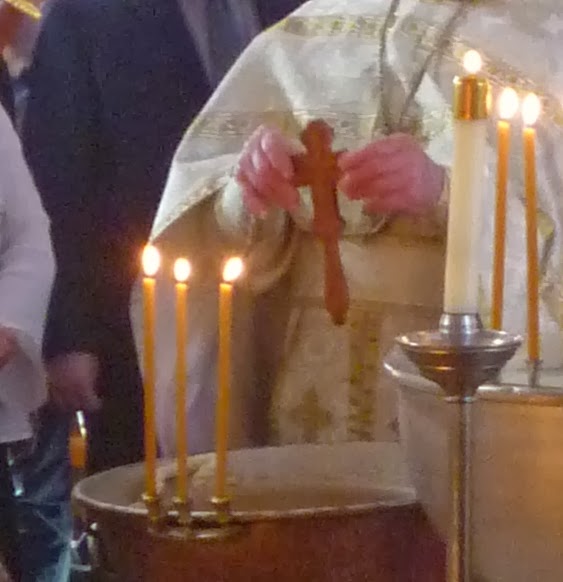
In the Orthodox Church we have been celebrating the glorious Feast of Theophany, remembering the baptism of Christ and all that happened when the Son took on our humanity.
Every year when this commemoration comes around I find myself maxed-out with meaning, because who can fathom it, what God has done for us? and I usually try to meditate on something to do with the symbolism of water as the basic element of Creation. It’s so tactile and material, and when my mind is overwhelmed I can simply stand in church and receive the joyous sprinkling and be happy.
This year a more particular aspect of our sacramental life was the focus of my thoughts. As Christ was baptized, so have I been baptized, and as the scripture and hymn tell me, “As many as have been baptized into Christ have put on Christ.”
After we’ve had a few days of trying to improve ourselves by means of resolutions of will, the Church gives us again the solution to our emptiness and weakness, and it comes in Theophany hymns such as this:
“The voice of the Lord upon the waters cries aloud saying: “Come ye all, and receive the Spirit of Wisdom, the Spirit of understanding, the Spirit of the Fear of God, from Christ who is made manifest.”
And this:
Ho, everyone that thirsteth, come ye to the waters,
Ye that have no money, come ye buy and eat.
And:
Instead of the thorn shall come up the cypress tree,
And instead of the brier shall come up the myrtle tree.
All of this sounds so much more vital and thrilling and real than my paltry goals for 2014. If I would only live each day renewing the God-breath of my baptism, remembering that I have put on Christ….
But Christ Himself, when he came out of the waters of baptism, went into the wilderness to be tempted for 40 days. I am tempted and begin to fall as soon as I walk out of the church. All I can do is pray to be more resolute to pray more, which I think will work better than resolving to pray more, and it gets to the point faster. Lord, give me that Water of Life that You are.
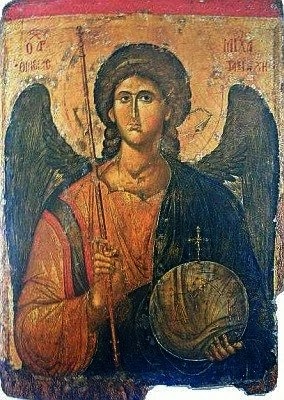 Being raised in Protestant churches, I learned little about angels. Since coming to Orthodoxy, I’ve been introduced to a large body of teaching, and some practices that help me learn experientially, too. Some lessons come through the feasts such as on November 8th (beginning with Vespers tonight, actually), when we celebrate the Feast of The Synaxis of the Chief of the Heavenly Hosts, Archangel Michael and the Other Heavenly Bodiless Powers.
I read that the commemoration was established at the beginning of the fourth century at the Council of Laodicea. It was set to be celebrated in what was at that time the ninth month of the year, because there are nine ranks of angels.
This very rich article also tells a lot about angels according to our tradition. One teaching that gets me thinking about the mysteries of God’s Kingdom is about the angels’ bodies. But aren’t they body-less, as the name of the feast calls them? On that topic and others, here are some excerpts from the blog post, passing on to us the teachings of several church fathers:
St. John of Damascus says they are creatures limited in space and time; they have their own specific external appearance. Compared to humans, they are bodiless due to the human’s “heavy body,” but compared to God they have a body. “We speak about the angels as bodiless and immaterial compared to us, but in fact everything is heavy and material compared to God, to Whom nobody can be compared, because only the Divine is non-material and bodiless.”
St. John Chrysostom says that “… every one of us has his angel;” and St. Basil the Great adds, “Beside every believer in God sits his angel, so repent.” Finally, the angel of prayer is the angel who helps us to pray. St. Clement of Alexandria says, “Even when a person prays alone, he is accompanied by angels.” Tertullian commands the Christian not to sit when he prays in respect for the angel of prayer standing beside him.
That last sentence is the kind of nugget of truth that I can hope to remember, and let it influence my everyday life. Some will say, Why not just remember that God Himself sits with you, so repent? etc. What I have concluded after debating about these things many years ago is that if God has chosen to use angels in His salvation work, why should we ignore or reject them? Why don’t we just say, Thank you, Lord! and show our appreciation by our acts?
In our parish we have many who are named for the Archangel Michael; we’ll have Divine Liturgy tomorrow morning and give thanks for the work of angels in our lives. I’d like to muse longer over more quotes from this article but I better return to my housework if I want to make it to church in the morning.
 Gladsome Lights