 Light, joy, glory… If you don’t know the story of what happened when Jesus was presented in the temple at 40 days old, skip to the bottom of this post and read the account from Luke before going on.
It’s been a few days now since we celebrated the feast of The Meeting of the Lord. It’s interesting that the Orthodox usually know it from the perspective of Simeon and Anna, but it is also called The Presentation of Christ, from the point of view of Jesus’s parents.
As I’ve mentioned more than once, it is one of my favorite feasts (I’ve written about it before), so I was expectant and so glad that I was able to be at Divine Liturgy on what can be an inconvenient day — this year February 2nd was a Monday. But I had missed church the day before and was feeling very needy.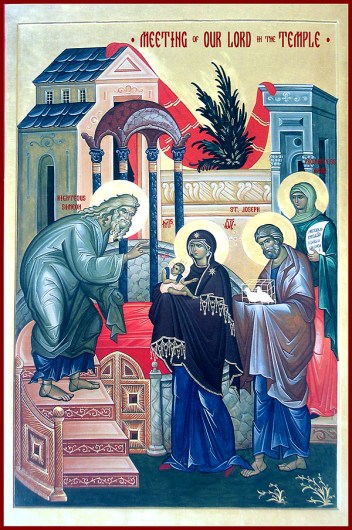
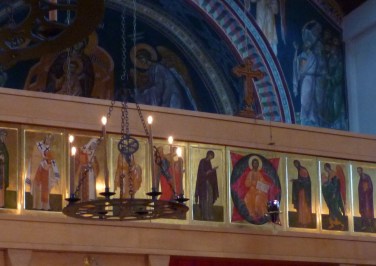
We began with Matins, and every element of the service beginning with the refrain, “Let every breath praise the Lord!” seemed to be calculated to straighten up my bent soul. By means of the most aromatic incense, the chandeliers swinging, the Six Psalms, and many more gifts known and unknown, many kinks in the conduit were at least temporarily untwisted so I could receive the light and the joy.
I got the usual goosebumps when the gospel for this feast was read. Oh, dear Simeon! What must it have been like for you to hold The Christ in your old arms?… knowing not just as information but in your very heart and flesh that this infant was your own God and Redeemer? To help us meditate on this, the words of a hymn ascribe to Christ the words, “I am not held by the Elder; it is I Who hold him, for he asks Me for forgiveness.”
 That hymn was part of yesterday’s remembrance of Saint Simeon the God-Receiver and also St. Anna the Prophetess. We remember them especially the day following the event in which they figured. But it’s still not time to leave the nourishment of this feast behind: The Leavetaking of The Meeting of Our Lord is not until next Monday, and by then we won’t be too sad to say good-bye because we will be well into the pre-Lent period, the Sunday of the Prodigal Son being the day before.
In the Church calendar we have these layers of history and sacrament and celebration constantly orienting us to the deepest realities of life. The light and truth that we draw from the lives of the saints and from the events of our salvation history are not random ideas in our individual heads, but are shared experience with the whole Church family as we worship together by means of all the graces and sacraments pertaining to each season.
St. Nikolai on this day encourages us to contemplate joy, and his homily elaborates: “Just as the bleak forest clothes itself in greenery and flowers through the breath of spring, so every man – regardless of how arid and darkened he is by sin – becomes fresh and youthful from the nearness of Christ. For the nearness of Christ is like the closeness of some life-giving and fragrant balsam that restores health, increases life, and gives fragrance to the soul, to the thoughts and to the words of man.”
I came home from church with a candle from among the stack that had been blessed, as this feast is also Candlemas. Candlelight is reminding me to hold on to the joy that has been given to me, and to be renewed in it every morning. Let every breath praise the Lord!

21 And when eight days were accomplished for the circumcising of the child, his name was called Jesus, which was so named of the angel before he was conceived in the womb.
22 And when the days of her purification according to the law of Moses were accomplished, they brought him to Jerusalem, to present him to the Lord;
23 (As it is written in the law of the Lord, Every male that openeth the womb shall be called holy to the Lord;)
24 And to offer a sacrifice according to that which is said in the law of the Lord, A pair of turtledoves, or two young pigeons.
25 And, behold, there was a man in Jerusalem, whose name was Simeon; and the same man was just and devout, waiting for the consolation of Israel: and the Holy Ghost was upon him.
26 And it was revealed unto him by the Holy Ghost, that he should not see death, before he had seen the Lord’s Christ.
27 And he came by the Spirit into the temple: and when the parents brought in the child Jesus, to do for him after the custom of the law,
28 Then took he him up in his arms, and blessed God, and said,
29 Lord, now lettest thou thy servant depart in peace, according to thy word:
30 For mine eyes have seen thy salvation,
31 Which thou hast prepared before the face of all people;
32 A light to lighten the Gentiles, and the glory of thy people Israel.

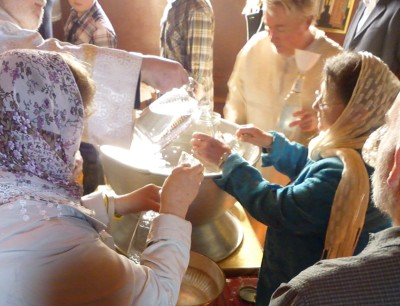
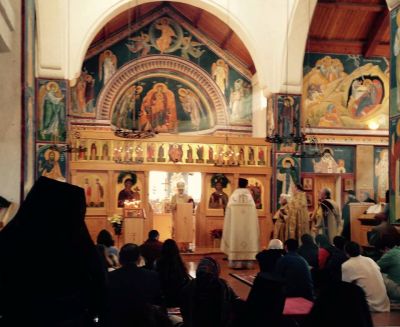 Both times I was on the left in front of a pillar. On Theophany, when the light was coming in the chandeliers were also being set swinging nearby; we were singing a hymn, and the sweetest incense was beautifying the air to honor the Lord.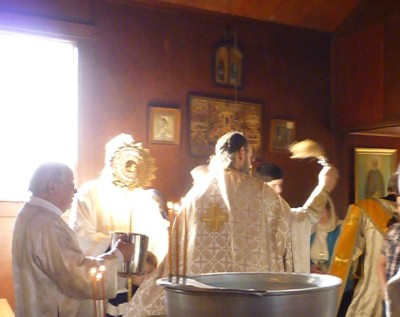
 Gladsome Lights