Since my first reading of Leon Kass on the subject of dinner parties, I’ve wanted to share my excitement via my blog, and also to use this enthusiasm to try to host the sort of event he writes about toward the end of The Hungry Soul: Eating and the Perfecting of our Nature. That was many years ago, and since then I’ve read a similarly inspiring chapter in Supper of the Lamb by Robert Farrar Capon.
But actually giving the kind of convivial feast these men describe is a project requiring scores of preparatory steps, none of which is simple to insert into my schedule, crowded as it already is with many entrenched patterns and habits of socializing, or resting after socializing. Until such time as I had participated at some level in a formal dinner party, all I would be able to do on my blog would be to copy passages from books.
That longstanding situation changed last month when I was surprised and delighted to be part of a dinner for eight, given by my goddaughter Sophia. Her labor of love fulfilled the vision I had been given in the books, such as this from Kass’s introduction to his chapter “From Eating to Dining,” on what can happen when the plans have been laid with care and the guests chosen and seated wisely:
“One could speak about freedom — the ever-increasing emancipation from the bonds of instinct and appetite and the progressive cultivation of self-command. One could speak about beautification — the adornment of self and surroundings, the grace of gesture and movement, the delight in taste and tastefulness. One could speak of friendship and love, beginning with the companionable sharing of bread and moving, through the appreciative sharing of speech, to the meeting and cherishing of souls. One could speak about the cultivation of the mind, beginning in speech liberated by the satisfaction of necessity and moving through playful conversation and wit in the direction of the pursuit of wisdom.”
Both authors emphasize that in praising the glories of formal dinners done right, they are not denigrating all the other more casual arrangements that can be blessed and sanctified by thankfulness and love. When I started to expound on this elevated form to one of my daughters she was quick to defend the value of the more humble sort of hospitality that our family has extended to hundreds of people over the decades, or the meals I have served to my husband and children. I said not to worry, this is something else.
In some ways the simple soup and bread served to one’s own family, or a feast given for those one goes into the highways and byways to find, expresses a more Christlike spirit. The many generous and delicious meals friends have bestowed on me over my life, especially when accompanied by true fellowship, lacked nothing in graciousness and satisfaction. But the formal dinner party brings together at once many elements that add up to a supreme joy in our common humanity, and a taste of that Supper of the Lamb that we will enjoy in the coming Kingdom. The party I attended, given by Sophia, definitely imparted that flavor.
The evening began with the House Blessing itself. In the days and weeks following Theophany it’s the custom in Orthodox churches for the priest to visit the parishioners’ homes with some of the water that has been blessed on the feast day, and to sprinkle it around in every room, as everyone present prays along with him and sings the hymns of Theophany from room to room.
So we had all started out by singing and praying together through the house, and then we came to the table and found our assigned places. I love to go to a party where someone has chosen my place for me, and this, along with the relatively small number of diners, was the first sign to me that it would be a good evening. Capon tells us that “assignment to place by name is the host’s announcement that he cares.”
Capon spends the first pages of his chapter telling us why cocktail parties are so unsatisfying. It may be that many of my readers are like me in rarely having been to a cocktail party, but I well know the feeling of being at other events that follow a model seemingly designed “to frustrate any real meeting of all concerned.” No host has taken you personally into consideration and thought about whom you might like to sit next to. This informal system fails “to provide each person with an assigned and proper place,” which prevents them from forming a company. Not enough care is taken with the guest list, and the guests are left to themselves, making for an impersonal atmosphere.
I know that I often go to parties with a sort of rescuer or missionary mentality, thinking that the best thing I can do is to find someone who looks even more alone or forlorn than I myself feel, and try to be friendly. Capon thinks the whole cocktail party effort is doomed to failure:
“Besides being inhuman, however, the exercise is unmerciful. Too much liquor too fast is only the half of it. What is just as bad is having to wander around like a lost soul while people spill drinks down your back and wipe dips on your front. We are homeless enough, without having to come in out of the cold to nothing better than a warm exile, followed by a cleaner’s bill.”
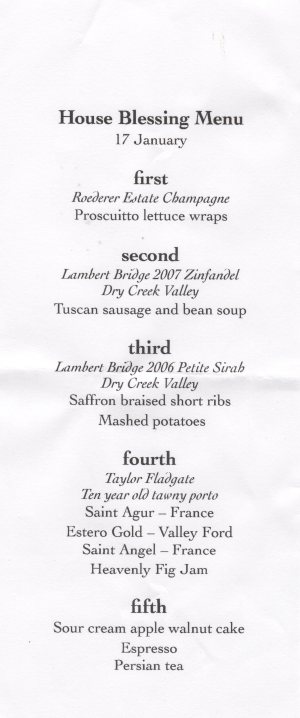
Obviously our own group, assembled by my friend, had the advantage of being a company from the outset. We sat down to find a short printed menu on our plates – short, but promising more than ample feasting – and soon we were drinking champagne and eating the lovely salad, and having lively though sober table conversation.
The bill of fare I have posted above for your enjoyment; our hostess had cooked everything except the bread herself. That mysterious fourth course was cheese, with jam she had made. And she did not have anyone helping her in the kitchen except one of our party who must have given most of his help early on. She made the whole operation look very doable, without appearing at all put out by her labors. On the contrary, she was purely happy to have us.
Capon calls the formal dinner party “a sovereign remedy for the narrowness of our minds and the stinginess of our souls…It is precisely because no one needs soup, fish, meat, salad, cheese, and dessert at one meal that we so badly need to sit down to them from time to time. It was largesse that made us all; we were not created to fast forever. The unnecessary is the taproot of our being and the last key to the door of delight.”
Many of us have experienced a formal dinner party indirectly by reading Jane Austen or watching period movies or “Downton Abbey.” That doesn’t work for me, because we can’t enjoy the best parts of the experience, actually eating the food and having ourselves been cared for by the host. In these storybook events we can’t talk with our own real friends, but must instead participate vicariously in all the dramatic undercurrents of the fiction of which the dinner is a part.
So I’m for the revival of formal dinner parties given in our own homes, and not as a sort of historical reenactment. Each of us will practice this art in his unique way, customizing plans and expectations to accommodate his circumstances and particular ideals, perhaps opting for five courses as Sophia did, instead of the fourteen courses that Miss Manners says used to be common in some mythical time. If you are like me you will be required either to study up for a few years on the subject of wine or to settle for a much simpler offering in that department than what the dinner party pros can accomplish. But I agree with both Kass and Capon that wine is important.
You must choose your guests carefully. Capon reminds us that “To ask a man to break bread with you is to extend friendship, to proclaim in love that you want not his, but him….To invite guests is a courtesy, a courtly act: It confers greatness on all concerned, and therefore must never be done for mean reasons.” I think it is o.k. to have some quieter people in the group (Sophia had invited two little girls who were reserved), but you must have a good number who know how to be convivial without talking too much. And you must think about how you seat them. I read one time that if you have two people who tend to dominate conversation, they may be restrained a bit by being seated side-by-side. That’s just an example of things that a good hostess thinks about. And if a group is larger than eight or ten, it is more likely that multiple conversations will spring up, which might divide the company and dilute the camaraderie.
Kass writes about the ideal dinner conversation, which “imitates the artfully prepared dinner. There is frequent change of course and topic. Each course in the meal is carefully prepared to look beautiful and to taste good, yet to be different from the rest. Conversation, too, will reflect that variety, yet each ‘course’ will please the palate of the mind. Because our interest is in both the speakers and the speeches, conversation enables us to taste, indeed to savor, the souls of our fellow diners — not their intimate private depths or their polished public personae, but that wonderful side of the soul at play, when it is unselfconsciously and immediately being its open, companionable, and responsive self.”
Along about the dessert course our host Sophia guided our dessert conversation by bringing out some books of poetry and prayers and asking us each to either read something from a book or to offer a story or song of our own, etc. Even the little girls could read, and did surprisingly well with 19th-century poetry. A humorous story was told about a grandpa, one read a Psalm, two of us sang scripture songs — we discovered that my goddaughter and I knew the same one that no one else had ever heard — and Pablo Neruda’s love poems were shared meaningfully. All of those offerings stimulated more conversation that truly did express the “tasty” souls of the guests.
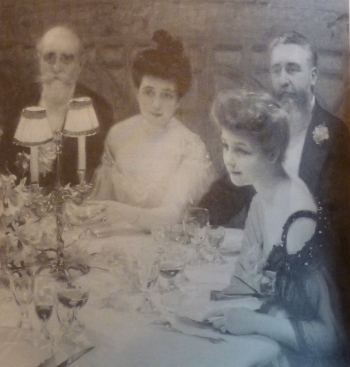
Photos can’t very well express the rich texture of a small dinner party. Most of what you find online are of large wedding receptions or cluttered table decorations, or illustrations mocking these gatherings. I’m glad Leon Kass was able to find a work of art that I think does capture something of the sweetness of sharing such a meal, which is the one by Chabas above; I had to photograph the page in his book to share it here.
It looks as though the diners in that painting may be not only at the end of the table but at the end of their meal as well, and you will be relieved to know that I am at the end of my essay. My readers may wish that they had been spending this long while getting real nourishment for their souls instead of words about it. So I will quickly let Kass finish his paragraph and thought which I introduced at the beginning, because he sums up the highest ideal of the formal dinner party, and also describes the gift we guests received from Sophia that night:
“And one can speak also about piety and reverence, and the human impulse toward transcendence, beginning in awe and fear, and sometimes encouraged by wine, moving through feelings of gratitude and songs of praise in the direction of encountering the divine.”
Bon appétit!
Other posts I’ve written about The Hungry Soul are:
Why I love this book.
Struggle to stand.
How science disappoints.


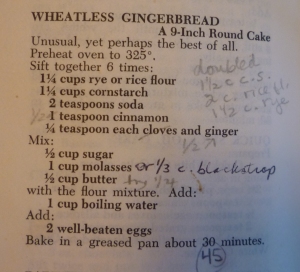
 in Sunset Magazine but have since done my own customization. Most recipes for this cookie call for lard, which I would be happy to use if I could easily find some homemade that hasn’t been hydrogenated and preserved with chemicals. I had a friend who made her own and stored it in the freezer, and I might have bought some from her if she hadn’t moved away. Lacking natural lard, I tried last year to substitute coconut oil. Much as I love coconut, the oil left a disagreeable aftertaste in my cookies (as it did in some shortbread I also tried with coconut oil one time), so from now on I’m sticking with butter.


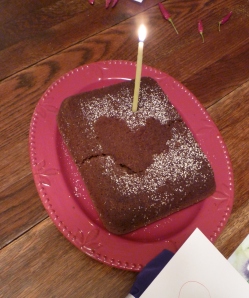 and what do you know? It broke into three pieces! May thought it a special sign of blessing that the shallow divot off the bottom was in the shape of a heart. So that it would be visible for the photo op, before I set that last piece back into place I sprinkled a little powdered sugar on the rest of the surface.
 Gladsome Lights