Just notice how my “About Me” has suddenly changed – today! Our waiting for Baby has ended, and SHE has arrived, whom I will call Ivy, because she was born on my grandmother’s birthday, 120 years later. Thanks be to God!
Category Archives: history
The Celebration of Man in a Little Girl’s Birth
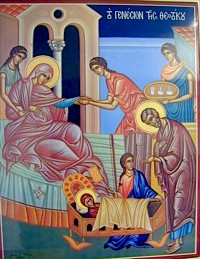
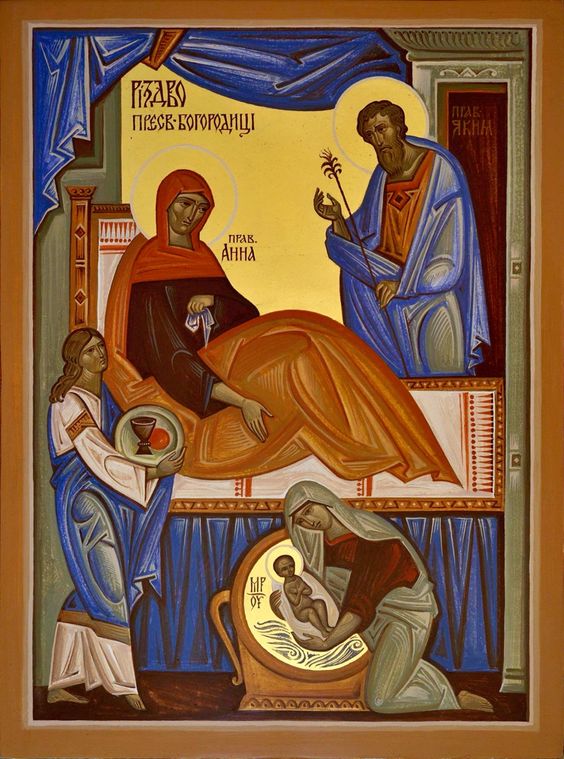
What a joy to be present at the “birthday party” for the beloved mother of our Lord! We began tonight, and will continue tomorrow, to rejoice at this first event of the church liturgical cycle, one of the 12 Great Feasts of the year. In honor and remembrance, I offer this sermon by:
Protopresbyter Alexander Schmemann
Sermon on the Nativity of the Theotokos September 8
The Church’s veneration of Mary has always been rooted in her obedience to God, her willing choice to accept a humanly impossible calling. The Orthodox Church has always emphasized Mary’s connection to humanity and delighted in her as the best, purest, most sublime fruition of human history and of man’s quest for God, for ultimate meaning, for ultimate content of human life.
If in Western Christianity veneration of Mary was centered upon her perpetual virginity, the heart of the Orthodox Christian East’s devotion, contemplation, and joyful delight has always been her Motherhood, her flesh and blood connection to Jesus Christ. The East rejoices that the human role in the divine plan is pivotal. The Son of God comes to earth, appears in order to redeem the world, He becomes human to incorporate man into His divine vocation, but humanity takes part in this. If it is understood that Christ’s “co-nature” with us is as a human being and not some phantom or bodiless apparition, that He is one of us and forever united to us through His humanity, then devotion to Mary also becomes understandable, for she is the one who gave Him His human nature, His flesh and blood. She is the one through whom Christ can always call Himself “The Son of Man.”
Son of God, Son of Man…God descending and becoming man so that man could become divine, could become partaker of the divine nature (2 Peter 1:4), or as the teachers of Church expressed it, “deified.” Precisely here, in this extraordinary revelation of man’s authentic nature and calling, is the source of that gratitude and tenderness which cherishes Mary as our link to Christ and, in Him, to God. And nowhere is this reflected more clearly that in the Nativity of the Mother of God.
Nothing about this event is mentioned anywhere in the Holy Scriptures. But why should it be? Is there anything remarkable, anything especially unique about the normal birth of a child, a birth like any other? The Church began to commemorate the event with a special feast…because, on the contrary, the very fact that it is routine discloses something fresh and radiant about everything we call routine and ordinary, it gives new depth to the unremarkable details of human life…And with each birth the world is itself in some sense created anew and given as a gift to this new human being to be his life, his path, his creation.
This feast therefore is first a general celebration of Man’s birth, and we no longer remember the anguish, as the Gospel says, “for joy that a human being is born into the world” (Jn. 16:21). Secondly, we now know whose particular birth, whose coming we celebrate: Mary’s. We know the uniqueness, the beauty, the grace of precisely this child, her destiny, her meaning for us and for the whole world. And thirdly, we celebrate all who prepared the way for Mary, who contributed to her inheritance of grace and beauty…And therefore the Feast of her Nativity is also a celebration of human history, a celebration of faith in man, a celebration of man.
Sadly, the inheritance of evil is far more visible and better known. There is so much evil around us that this faith in man, in his freedom, in the possibility of handing down a radiant inheritance of goodness has almost evaporated and been replaced by cynicism and suspicion. This hostile cynicism and discouraging suspicion are precisely what seduce us to distance ourselves from the Church when it celebrates with such joy and faith this birth of a little girl in whom are concentrated all the goodness, spiritual beauty, harmony and perfection that are elements of genuine human nature. Thus, in celebrating Mary’s birth we find ourselves already on the road to Bethlehem, moving toward the joyful mystery of Mary as the Mother to God.
Thy nativity, O Virgin,
has proclaimed joy to
the whole universe!
The Sun of Righteousness,
Christ our God,
has shone on thee,
O Theotokos!
By annulling the curse,
He bestowed a blessing.
By destroying death,
He has granted us
Eternal Life.
Philosophy of Pie and Picnics
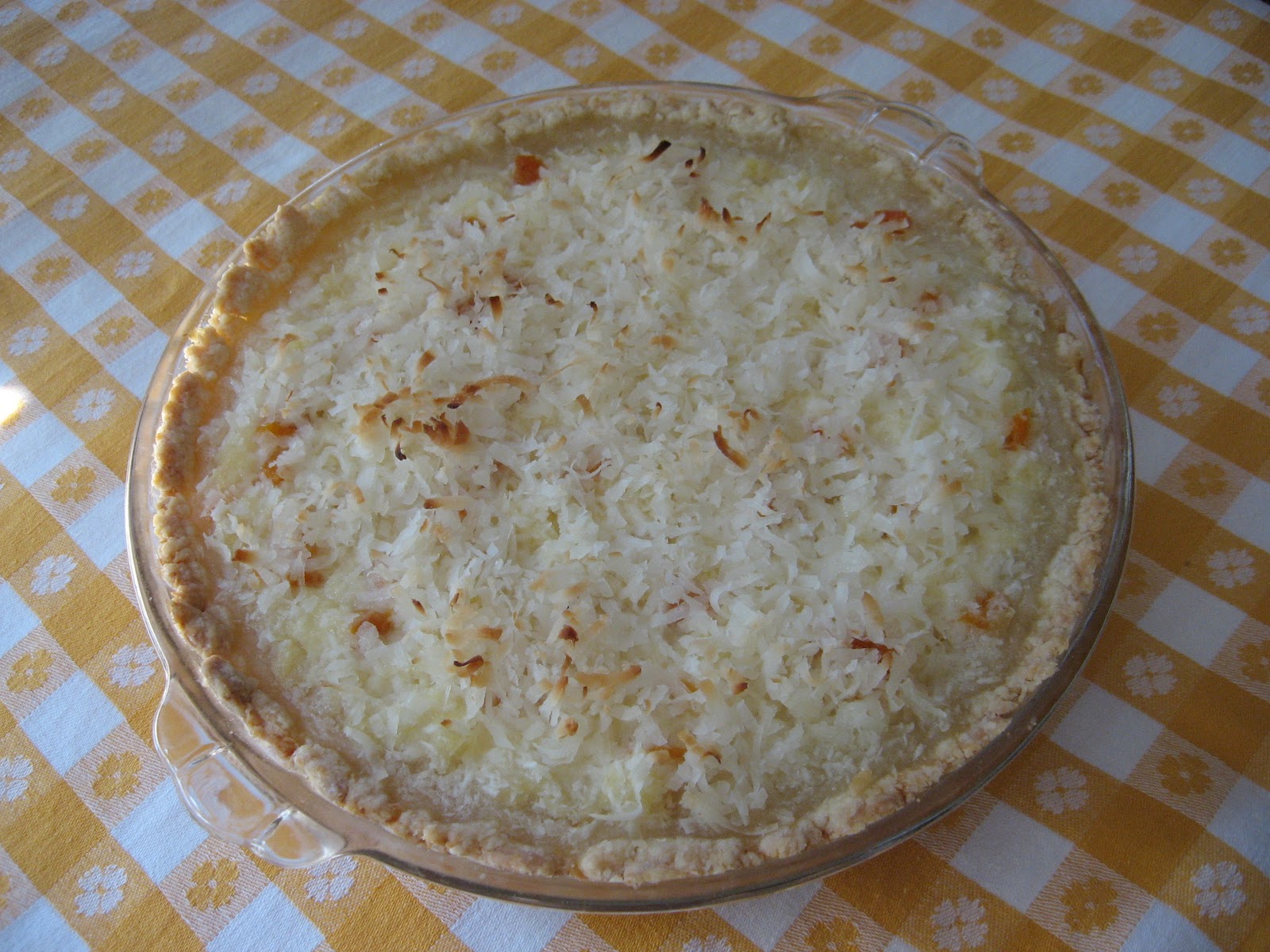 |
| Vegan Coconut Pie |
Between tonight and tomorrow this subject must become theoretical, as Monday my church begins fasting in preparation for the Feast of Saints Peter and Paul. Though I admit to making vegan desserts, like this coconut pie for Father L.’s birthday, usually I’d rather just wait until a fast-free day to enjoy the butter and cream. Hey, by then I’m happy to pour cream in my coffee and call it dessert.
But that’s not festive enough for a picnic, or for a tea party. I think both of those events demand some cake, if they are going to be traditional (in addition to the scones, if you want those). Sadly, our family is generally lacking in cakes, with the major exception of Pearl, who learned on her own and makes lovely ones. I don’t think her household lacks cake; I don’t know anything about their picnics.
The rest of us, going back a couple of generations and on both sides of the family, eat pie. One of us even declared, “Cakes are for looking at.”
 I can’t grant that much myself, because my very few attempts at cake decorating beyond the sprinkling of some coarse sugar did not draw any comments about prettiness. My favorite topping for children’s birthday cakes of long ago was an array of gumdrops — but with that we start slipping into the candy category.
It may have been Big Sister Pearl who baked this birthday cake for Soldier, using plenty of that ingredient that is so important. I can see something in his expression that hints at what he would do 20 years down the road: leave cake out of his wedding altogether, in preference for pie.
I blame bloggers for giving me the feeling that something is missing. Have you noticed how many blog posts have been written about this or that recipe for cake, which comes out of the oven in the late morning or afternoon just in time to have a slice with some tea, at the kitchen table with the children just home from school, or just taking a break from homeschool?
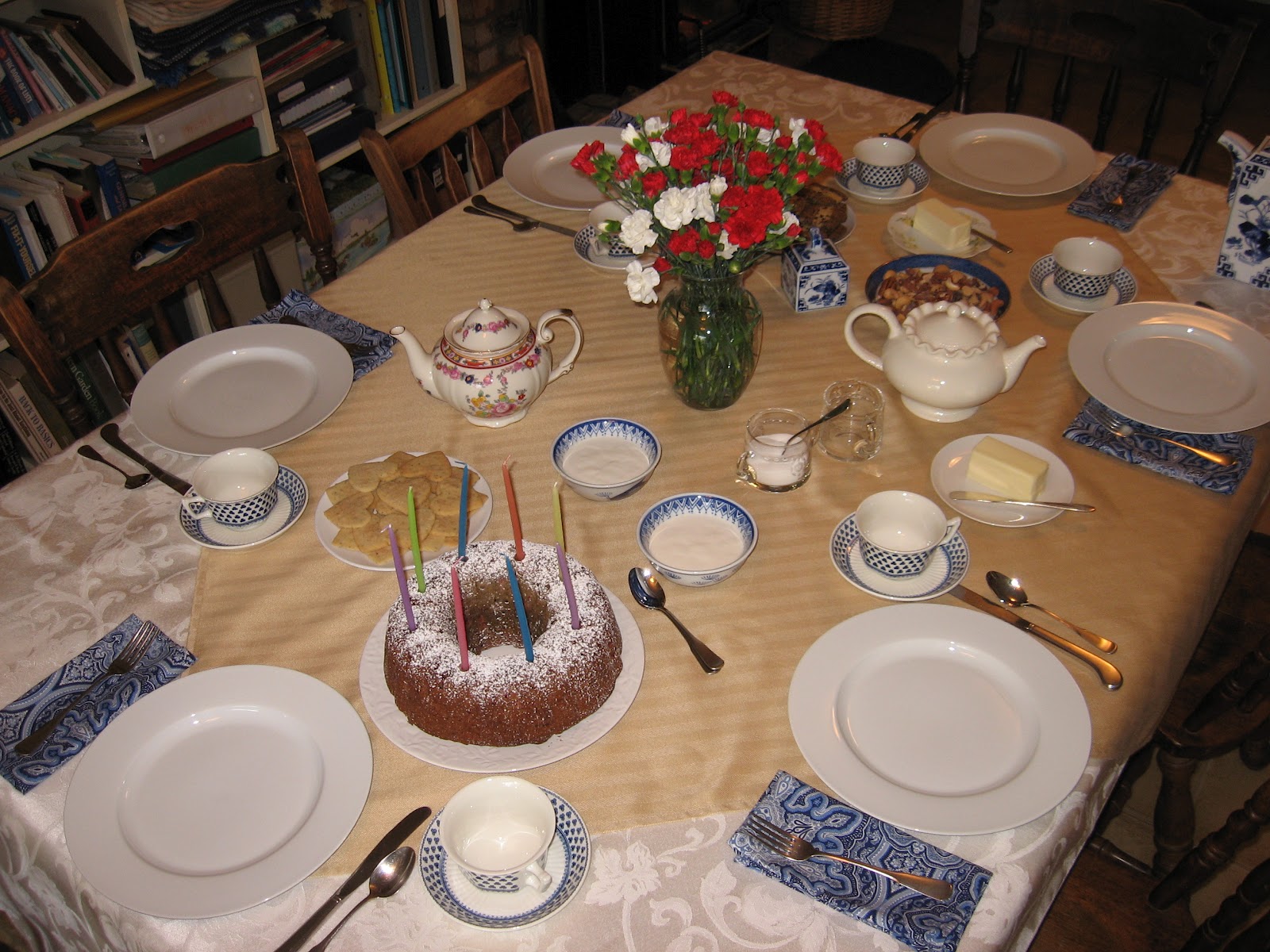 |
| Proof that I baked a cake |
It’s not clear how I would work that tradition into my lifestyle at this point. My husband would be alarmed and reluctant, to put a good spin on it, and might not eat any cake. I’m considering reviving my Girlfriends Tea Parties just so I can make a cake or two. When I did this before it was a great way to try out a few of the hundreds of dessert recipes I have in my collection. After we sampled them together, all the ladies took home most of the leftovers to share with their sweeter-toothed husbands.
One huge advantage to packing the cake into a basket instead, to be eaten on a blanket spread under a tree, is that I wouldn’t have to clean the house beforehand. But the Old English style of picnicking has also not caught on in the Glad Tribe. Our group has favored throwing handfuls of trail mix into their mouths so that they can get to the mountain peak and back before dark. None of this leisurely sitting around eating and fattening up.
But I have a new desire to broaden our style in that regard, too, probably from reading too many blog posts about Wind in the Willows and grown-up girls taking their Toad and Mole dolls on outings with yummy noshables.
It’s good that I will have a few weeks to think about these important questions — or rather, not to think about them. And by then I’ll be too busy getting ready for a new grandchild, and getting ready for a trip…Then there will be another fast, and then another new grandchild. All these ideas for events that require a Lot of Planning really don’t fit in this summer.
But it won’t take long to throw together a pie to set before my dear husband, a blackberry or cherry would suit just fine, and leftovers won’t be a problem.

Venetian Painters
 The covered buttons on Ottaviano Grimani’s shirt jumped out at me when I came around a corner and looked up at the huge painting. Of course I couldn’t find a copy online that conveyed the stunning quality of the buttons, but the search was instructive.
This portrait by Bernardino Licinio was in the Masters of Venice show of 50 paintings that came from a collection that the Habsburgs assembled in Vienna, works of Venetian artists of the High Renaissance, mostly the 16th century.
Since I haven’t paid any attention lately to what is going on in San Francisco, I would have missed this opportunity altogether if my friend “Lorica” hadn’t invited me to go just before the show closed.
I loved that it was small and focused — we didn’t visit any of the permanent collection — so that my easily-overwhelmed brain could stay calm and receptive as we slowly moved from one room to another of the De Young Museum. The time flew, as Lorica elaborated and added to the information posted near the paintings. I am woefully ignorant, and she was the perfect guide for someone like me, who can’t chew very big auditory bites.
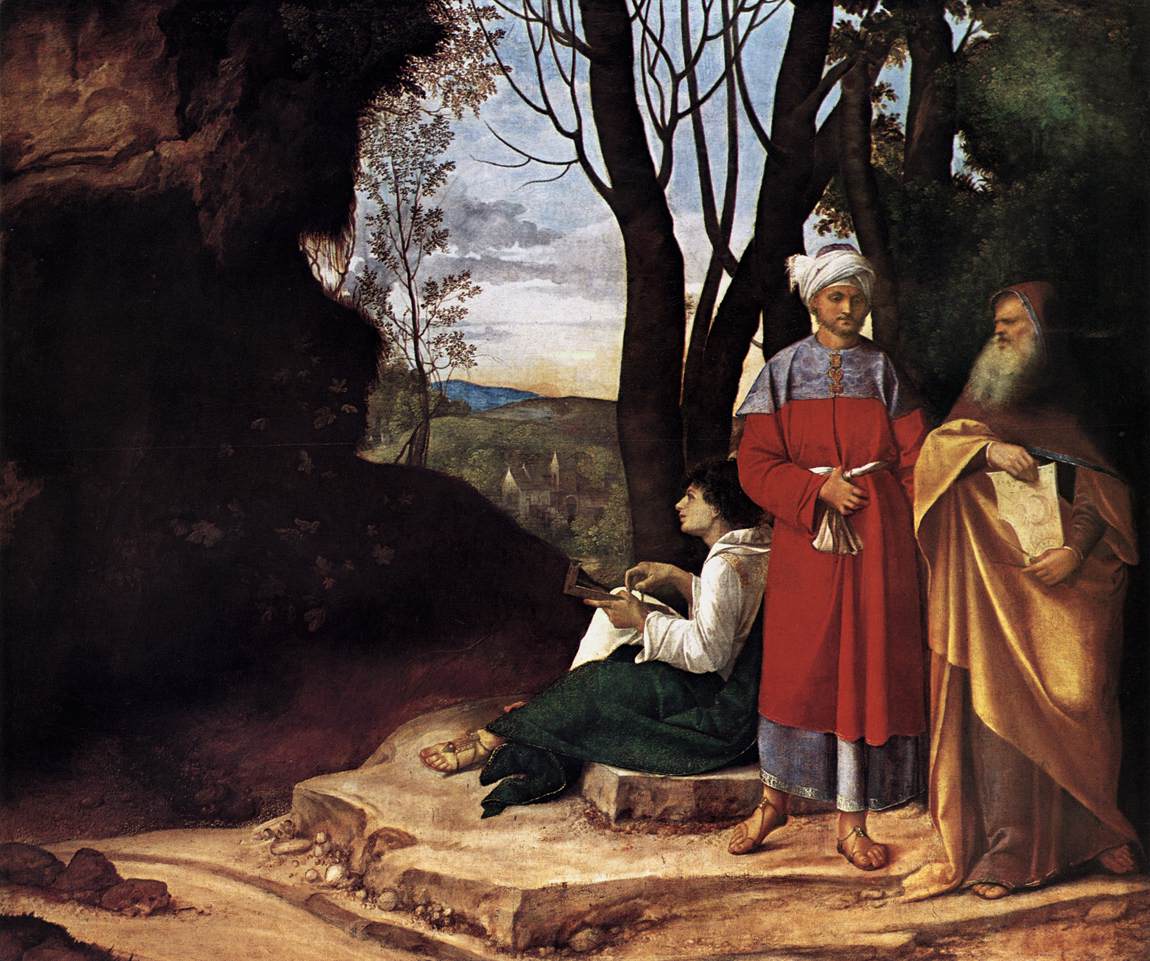 |
| Giorgione’s Three Philosophers |
It seems somehow shameful, but I am doing it anyway: posting some of my favorites here in truly pathetic versions of themselves. As soon as I came home I looked for them on the Internet so I could show my husband, and as it had been only a couple of hours since I’d seen the masterpieces in their glory, I was terribly saddened to see that aspects of the originals that had given me so much pleasure were flattened to the point of extinction.
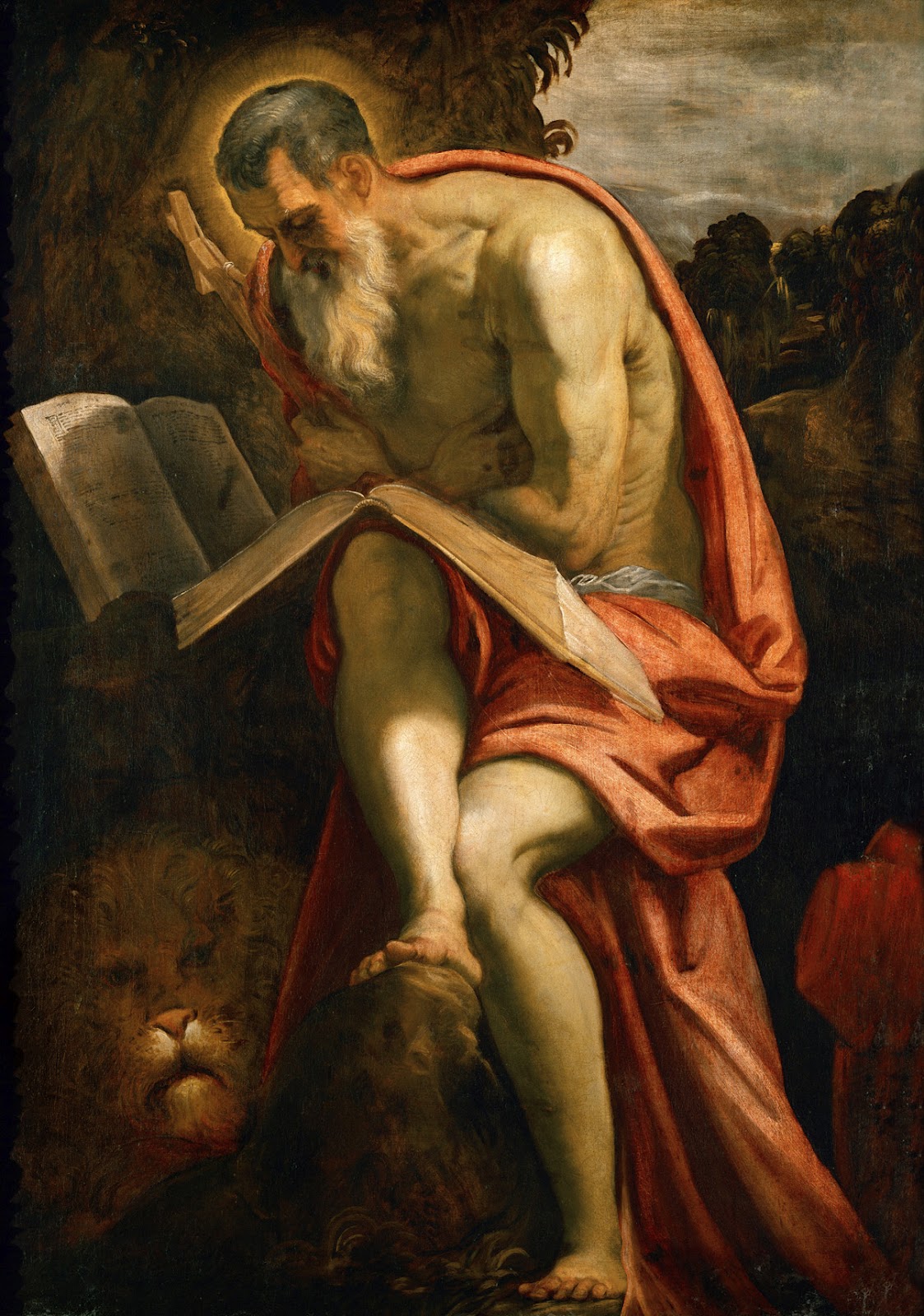 |
| St. Jerome by Tintoretto |
That was an Aha! moment, as I contemplated the truly 3-D nature of paintings. And I realized why one would want to visit a show like this several times — because looking at the little postcards one can bring home is a sorry substitute for Being There.
The first thing I noticed about St. Jerome, who translated The Vulgate, was his smiling eyes. He must have been so happy to be reading God’s Word. (Lorica told me that he was known to be grouchy.) And the face of the lion was lovely, Aslan-like. Neither of those endearing features comes through in this little copy.
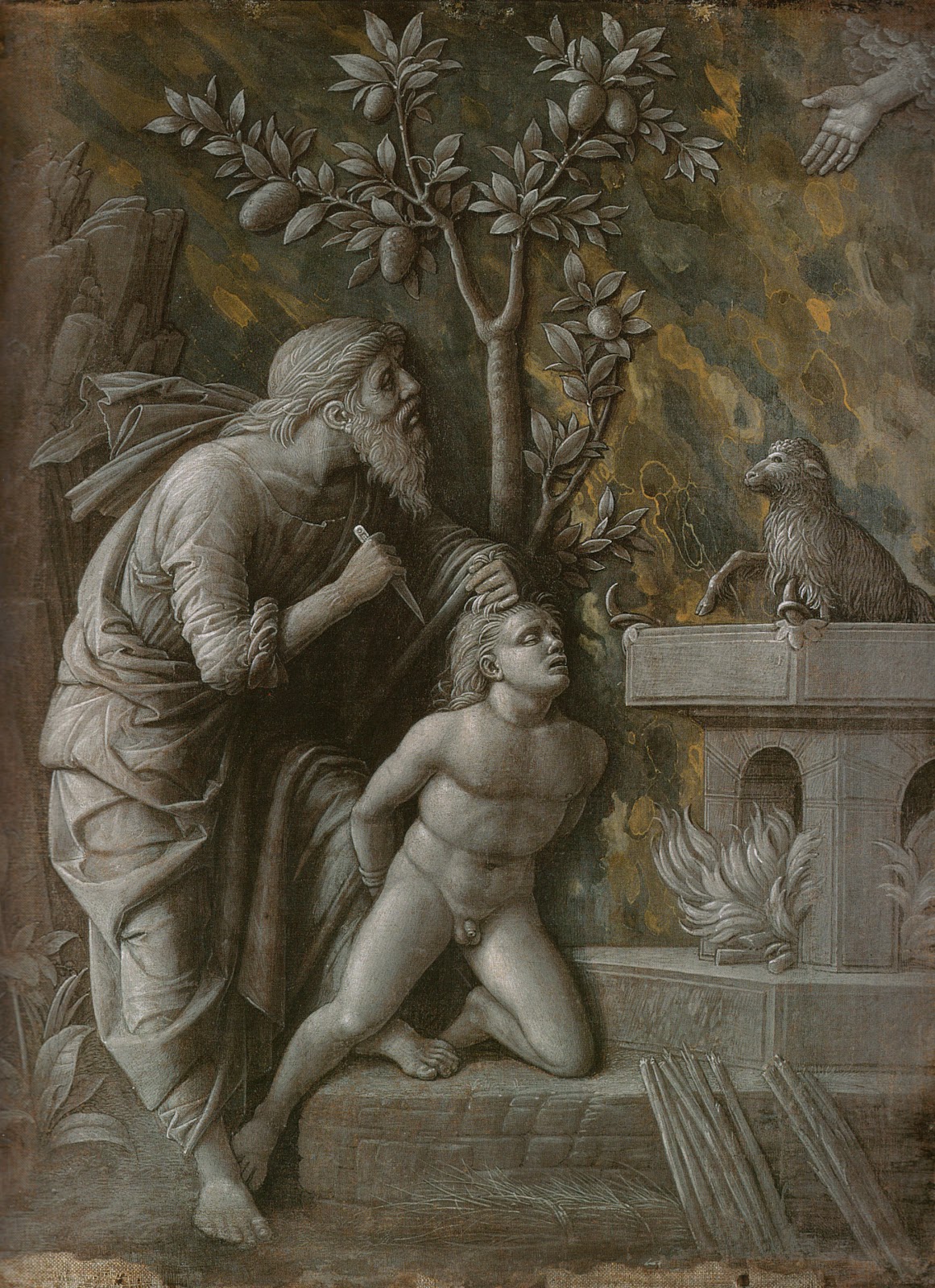 At left is The Sacrifice of Isaac by Mantegna, which I loved. The whiteness and statue-like quality of the painting was new to me, and the whole composition so complete in its portrayal of the event, and with beautifully “carved” figures. The little ram presenting itself, God’s hand presenting it….
One painting of which I could only find a decent representative online a few years after writing this post was Titian’s Entombment of Christ. I have inserted it in an update. My guide pointed out to me that it seems to be all about Mary, as she and her richly blue cape are the focal point of the composition.


Another Biblical scene, Adoration of the Magi, by Bassano the Younger. I think it’s charming in the way it depicts the bustling arrival of the worshipers and how the man in green wastes no time in getting as close as possible to the Christ Child.
Some of the other artists whose paintings we saw were Veronese and Bordone, and Pordenone, whose Christ With the Cross (below) admittedly a very Italian version of our Lord, is still quite arresting, and keeps my thoughts on the Love of God.
Looking at the little pictures here, remembering the great works that I had so recently wondered at — it all made me think I hadn’t been paying enough attention while we were in the museum. After all, it was the chance of a lifetime, and I had been so casual, strolling around dully as though I could just hop over to Vienna anytime I wanted and see the paintings again.
One can see that I need to get to the art museums more often, and that my education in art appreciation has barely begun.

 Gladsome Lights