Category Archives: icons

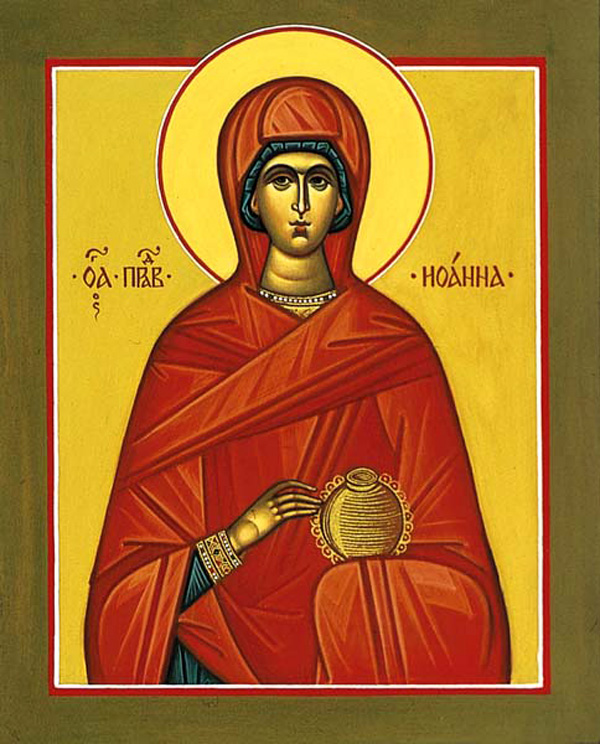
St. Joanna the Myrrhbearer

Today’s my name day, the day we remember Joanna, one of the women who followed our Lord Jesus around during His earthly ministry and helped take care of everyday needs. I don’t know what kinds of work those women did on His behalf, but perhaps it might all come under the broad category of hospitality?

In the two week period of which we are approximately in the middle, I have eleven different house guests coming and going. There isn’t much that makes me happier than creating a comfy and welcoming space for people who are away from their usual routine. 

I like to put fresh flowers in the bathroom, and give the lodgers space for their suitcases and stuff. In weather like this I open the windows wide so that fresh air will greet them, and I give them choices of fat or thin pillows for their beds.

Jesus said that the Son of Man had no place even to lay His head; that was a particularly difficult hospitality challenge. It’s a joy to remember St. Joanna as I prepare one more room this afternoon for people I love.

Here is what is on the Orthodox Church in America website for this woman whom we remember today:

Saint Joanna the Myrrh-bearer, wife of Chusa, the household steward of King Herod, was one of the women following and attending the Lord Jesus Christ during the time of His preaching and public ministry. She is mentioned in Luke 8:3 and 24:10.

Together with the other Myrrh-bearing Women, St. Joanna went to the Sepulcher to anoint the Holy Body of the Lord with myrrh after His death on the Cross, and she heard from the angels the joyful proclamation of His All-Glorious Resurrection. According to Tradition, she recovered the head of St. John the Baptist after Herodias had disposed of it.

Saint Joanna, pray to God for us!
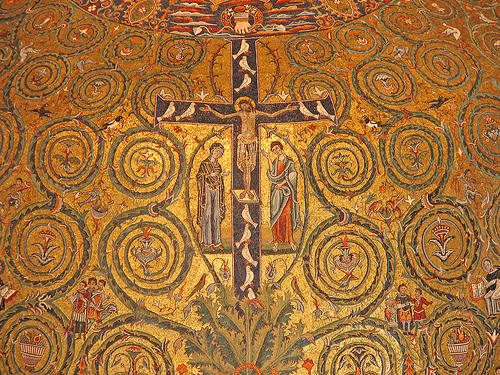
Christ accepted the impossible death.

He died although he cannot die; he dies although he is immortal, in his very human nature inseparably united with his Godhead. His soul, without being separated from God, is torn out of his body, while both his soul and his flesh remain united with the Godhead. He will lie in the tomb incorruptible until the third day, because his body cannot be touched by corruption. It is full of the divine presence. It is pervaded by it as a sword of iron is pervaded by fire in the furnace, and the soul of Christ descends into hell resplendent with the glory of his Godhead.

The death of Christ is a tearing apart of an immortal body from a soul that is alive and remains alive forever. This makes the death of Christ a tragedy beyond our imagining, far beyond any suffering that we can humanly picture or experience.

Christ’s death is an act of supreme love. It was true when he said, “No one takes my life from me; I give it freely myself.” No one could kill him — the Immortal; no one could quench this Light that is the shining of the splendor of God. He gave his life, he accepted the impossible death to share with us all the tragedy of our human condition.

–Metropolitan Anthony Bloom

This hymn of Holy Friday, of which I found a version on YouTube, begins, “Today He Who hung the earth upon the waters is hung upon a tree,” and continues with an exploration of all the impossible details. At Royal Hours this morning I heard a quartet of men sing it, fittingly beautiful and powerful.

Choose your tree.

Thank you to Leah for posting this excellent word from St. Nikolai.

excerpt: Prayer V

How stupid the servants of the tree of knowledge are! They do not measure their strength in You, but in their num­bers. They do not adopt a law of justice in Your name, but by their numbers. Whichever way the majority of them choose is the way of truth and justice. The tree of knowledge has become the tree of crime, stupidity, and icy darkness.

Truly, the knowledgeable men of this world know every­thing except that they are servants of Satan. When the last day dawns, Satan will rejoice in the number of people in his harvest. All the meager ears of grain! But in his stupidity, even Satan counts on quantity rather than quality. One of Your ears of grain will be worth more than the entire harvest of Satan. For You, O Conqueror of death, rely on the fullness of the bread of life, and not on numbers.

In vain I tell the godless: “Head for the Tree of Life and you will know more than you could possibly wish to know. From the tree of knowledge Satan fashions a ladder for you to descend into the nether world.”

Prayers by the Lake St Nikolai Velimirovic

Correct this ugliness.

The desire to be beautiful seems to be common to mankind, but the very atmosphere of this age is toxic with something that feeds a disease, making us obsessed with our image. One part of the toxic mix is the overwhelming abundance of pictures of faces and bodies in magazines and on every electronic device, forming a kind of lesson plan on How to Look. I was happy for a respite this morning when I read St, Nikolai’s homily for the day in The Prologue of Ohrid.

HOMILY
on the beauty of Christ above all other beauty

Thou art fairer than the sons of men (Psalm 45:2).
 

Holy Scripture does not ascribe any particular value to physical beauty, and in general to anything transient. That is why everyone who reads Holy Scripture should take care to be sufficiently attentive and wise to transfer the praise of physical beauty to the soul and to spiritual values. Without a doubt, spiritual beauty gives a wondrous attractiveness to the most unattractive body, just as an ugly soul makes even the most attractive body repulsive. The Prophet David, pouring forth good words (Psalm 45:1), says to his King, the Lord Jesus Christ: Thou art fairer than the sons of men. 

The Lord Himself created His bodily cloak as He wanted. Had He wanted to appear in the world as the physically fairest of men, He could have done so. But there is nothing in the Gospel to indicate that He drew followers to Himself or influenced men by His appearance. He Himself said: the flesh profiteth nothing (John 6:63). Therefore, it is clear that David was not speaking of the physical beauty of Christ, but of His spiritual, divine beauty. This is clearly seen in the following words of the Psalmist: Grace is poured forth upon thy lips (Psalm 45:2). So it is that the unsurpassed beauty of the Son of God is not in the form and shape of His lips, but rather in the stream of grace that flows from His mouth. 

Again, the Prophet Isaiah speaks of Christ: He had no form or comeliness; and when we shall see Him, there is no beauty that we should desire Him (Isaiah 53:2-3). Do Isaiah and David agree? Perfectly well. David speaks of Christ’s inward beauty, and Isaiah speaks of Christ’s external abasement. Isaiah said that He would not be seen as a king or a rich man, but as a servant and sufferer.

O Lord Jesus Christ, Thou art fairer to us than all men and angels: glory to Thine immortal and unending beauty. O gracious Lord, correct the ugliness of our souls, which are disfigured by sin, we pray Thee.


To Thee be glory and praise forever. Amen.