Category Archives: love

Mother Gavrilia had more than personality.

Mother Gavrilia was one of those people I have heard about who know what it is to die to oneself, to “cease to exist,” as she put it. St. Paul wrote about this in his letters, saying, “I have been crucified with Christ. It is no longer I who live, but Christ who lives in me.” You might think that someone for whom this is a reality would lack personality or presence, because if your self is truly swallowed up in Christ, who would you be?

I know this question has come up through the years, talking with various people. It’s been theoretical to those of us who talk, knowing as we have that we ourselves have not advanced very far on that road to “non-existence.” But of course, to be fully in Christ is to be most fully alive, and about the opposite condition Mother Gavrilia also said, “When we lack love, we become corpses, entirely dead.”

gl-gavrilia-mother-or-gerontissa-gabrielaShe was born in 1897, and was the second woman ever to enter a Greek university, but she said, “One thing is education: that we learn how to love God.” Later she trained in physiotherapy in England and returned to Athens to open her own practice when she was over 50 years old. Several years after (and older still) she traveled to India by herself. She treated lepers and helped the poor everywhere. Then Palestine, East Africa, France, America. She was friendly with Muslims and Hindus and Protestant Christians, but often withdrew from society altogether. As John Brady tells in one account of her life, “Mother Gavrilia’s life obliterated the inane distinctions that we so often make between prayer and service, contemplation and action….The difference was immaterial because the Source was the same.”

Lately I have encountered many  thought-provoking sayings from Mother Gavrilia. Reading them, and about her very active and miraculous life, I get the impression of a bright intellect, a radiantly energetic person, so full of life and light as to make the concept of mere “personality” seem tiresome.

Here is one story in her words that makes a good introduction:

Once… some foreign missionary came and said to me, “You may be a good woman, but you’re not a good Christian.”

I said, “Why?”

“Because you have been here so long and you only go about speaking English. What local languages have you learned?”

I said to him, “I haven’t managed to learn any of the local languages, because I travel a great deal from place to place. As soon as I learn one dialect, they start speaking another. I’ve only learned ‘Good morning’ and ‘Good evening.’ Nothing else.”

“Bah, you’re no Christian. How can you evangelize? All the Catholics and Protestants learn all the local dialects in order to . . .”

Then I said, “Lord, give me an answer for him.” I asked it with all my heart, and then I said, “Ah. I forgot to tell you. I know five languages.”

“Really? What are these five?”

“The first is the smile; the second is tears. The third is to touch. The fourth is prayer, and the fifth is love. With these five languages I go all around the world.”

Then he stopped and said, “Just a minute. Say that again so I can write it down.”

With these five languages you can travel the whole earth, and all the world is yours. Love everyone as your own — without concern for religion or race, without concern for anything.

Mother Gavrilia reposed in 1992. Her monastic daughter, with the contributions of others of her spiritual children, wrote the story of her life in the book Ascetic of Love.

Hear the cold splintering.

Those Winter Sundays

Sundays too my father got up early
and put his clothes on in the blueblack cold,
then with cracked hands that ached
from labor in the weekday weather made
banked fires blaze. No one ever thanked him.

I’d wake and hear the cold splintering, breaking.
When the rooms were warm, he’d call,
and slowly I would rise and dress,
fearing the chronic angers of that house,

Speaking indifferently to him,
who had driven out the cold
and polished my good shoes as well.
What did I know, what did I know
of love’s austere and lonely offices?

-Robert Hayden

Hear the poet reading his poem.

The entire faith and love and hope.

My whole church is bereaved, because one of our strong young men, the only son of his parents, grown up for 35 years in the parish, suddenly sickened and died. It happened so fast, it seems unreal to us. This morning I attended a prayer service in advance of the funeral proper.

One of the lines that is repeated in song is, “Blessed art Thou, O Lord; teach me Thy statutes,” and I mused on what God might be teaching me right now. Certainly, we should all “number our days, that we may apply our hearts unto wisdom.” But I don’t want to forget something else that our rector reminded us of, at the end of the service, that even in our grief we have joy, knowing that Christ has overcome death — that’s why we could pray that our brother will be granted rest “with the spirits of the righteous made perfect.”

Every time there is another death or funeral, my own soul’s griefs are awakened, acknowledged and comforted. And our pastor also kindly included in our church bulletin today an encouraging passage (an excerpt from this article) from Father Alexander Schmemann. He starts out explaining why death must be understood as an evil enemy. But keep reading:

God created man with a body and soul, i.e. at once both spiritual and material, and it is precisely this union of spirit, soul and body that is called man in the Bible and in the Gospel. Man, as created by God, is an animate body and an incarnate spirit, and for that reason any separation of them, and not only the final separation, in death, but even before death, any violation of that union is evil. It is a spiritual catastrophe. From this we receive our belief in the salvation of the world through the incarnate God, i.e. again, above all, our belief in His acceptance of flesh and body, not “body-like,” but a body in the fullest sense of the word: a body that needs food, that tires and that suffers. Thus that which in the Scriptures is called life, that life, which above all consists of the human body animated by the spirit and of the spirit made flesh, comes to an end — at death — in the separation of soul and body. No, man does not disappear in death, for creation may not destroy that which God has called from nothingness into being. But man is plunged into death, into the darkness of lifelessness and debility. He, as the Apostle Paul says, is given over to destruction and ruin.

Here, I would once more like to repeat and emphasize that God did not create the world for this separation, dying, ruin and corruption. And for this reason the Christian Gospel proclaims that “the last enemy to be destroyed is death.” The Resurrection is the recreation of the world in its original beauty and totality. It is the complete spiritualization of matter and the complete incarnation of the spirit in God’s creation. The world has been given to man as his life, and for this reason, according to our Christian Orthodox teaching, God will not annihilate it but will transfigure it into “a new heaven and a new earth,” into man’s spiritual body, into the temple of God’s presence and God’s glory in creation.

“The last enemy to be destroyed is death…” And that destruction, that extermination of death began when the Son of God Himself in His immortal love for us voluntarily descended into death and its darkness, filling its despair and horror with His light and love. And this is why we sing on Pascha not only “Christ is risen from the dead,” but also “trampling down death by death…”

He alone arose from the dead, but He has destroyed our death, destroying its dominion, its despair, its finality. Christ does not promise us Nirvana or some sort of misty life beyond the grave, but the resurrection of life, a new heaven and a new earth, the joy of the universal resurrection. “The dead shall arise, and those in the tombs will sing for joy…” Christ is risen, and life abides, life lives… That is the meaning; that is the unending joy of this truly central and fundamental confirmation of the Symbol of Faith: “And the third day, He rose again according to the Scriptures.” According to the Scriptures, i.e. in accordance with that knowledge of life, with that design for the world and humanity, for the soul and body, for the spirit and matter, for life and death, which has been revealed to us in the Holy Scriptures. This is the entire faith, the entire love, and the entire hope of Christianity. And this is why the Apostle Paul says, “If Christ is not risen, then your faith is in vain.”

–Protopresbyter Alexander Schmemann, 1980,
Translated from Russian by Robert A. Parent

harrowing of hell wide

It’s my love language, too.

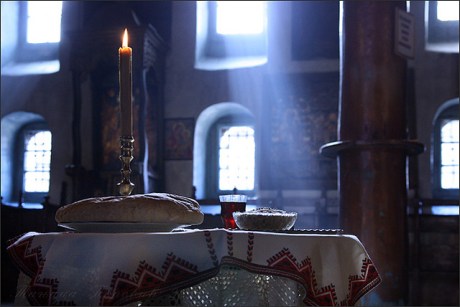
remembering the departed in Orthodox Chrisitian Church - offering bread, boiled wheat and red wine that are blessed by the priest

I want to share an article that is a kind of conversion testimony; it was published earlier this year with the title For the Love, on the blog Persona. The author well conveys the gratitude I also feel for the Church that encourages us above all to love people, and gives us tools for doing that. Tools? What am I saying? The Church gives us The Holy Spirit, a Person of the Holy Trinity Who live in Love, who are the source of any love.

Soon we will be remembering my goddaughter in prayer and song, on the one-year anniversary of her repose in the Lord. These days it is natural for me to think often about the dead, and not only my husband. For that reason I also appreciate what what Fr. Stephen Freeman has to say about our relationship to the departed, and  how, “With the radical individualism of the modern world, the mystery of communion and true participation (koinonia) have been forgotten….” 

The witness that follows is of someone who is discovering koinonia. I join with the writer of Persona in thankfulness for the ways the Church helps me to continue loving my dear Kathleen.

FOR THE LOVE

I attended my first service in an Orthodox Church in December of 2010. In April of 2012 I was chrismated (confirmed) in the church. What I don’t know about the Church could still fill several books, and I’m not very good at being Orthodox.

It’s a tradition that appears confusing and Byzantine to outsiders, with all of its incense and strange pictures, its standing and prostrating and crossing oneself. It seems legalistic, with all of the fasting and written prayers and candle-lighting. Praying to saints and the Virgin Mary? To Protestants, these things are often red flags, warnings of impending Catholicism.

I was frightened when I was first exposed to Orthodoxy. I was educated in a Protestant seminary, where I took classes on the theology of Martin Luther and the spiritual development of women as my electives (I have layers). I found it much easier to read about spirituality than to actually pray. I calmed my doubts with well-reasoned arguments, and I weighed and measured every sermon I heard to assess the soundness of its doctrine. I loved God with my mind.

Yet what drew me to Orthodoxy was not, ultimately the soundness of its doctrine or the reasonableness of its apologetics. From my earliest exposure to the tradition I acknowledged that it was quite likely the oldest expression of Christianity. But what ultimately brought me into the church was not a well-reasoned argument on the merits of prayer to the saints or an articulate defense of the use of icons and veneration of the Theotokos (the Virgin Mary). What ultimately brought me to the church was, quite simply, love.

As I participated in the life of the church, I was moved again and again by the love of the people. Yes, I was attracted by the love shown to me by the priest in my parish, and the new friends I made there. But what changed me, what won me over was realizing that at the root of all the practices that I didn’t understand, that seemed superfluous or legalistic, was love.

The Orthodox do not pray to saints because they feel that they cannot go directly to God. They don’t venerate the Theotokos because they feel that Christ alone is not enough. They don’t prostrate or light candles or fast because they feel they must earn their salvation. The Orthodox Church does what it does because they love – the Trinity, each other, the departed, saints – the Church loves them all. More than that, the church understands that we all love, and it gives us concrete ways to express ourselves.

For me, this all became very real a few months before I became a catechumen and began my (formal) journey towards Orthodoxy. When I was a teenager, someone very close to me passed away. The anniversary of her death approached, and I was sad. When I told my priest, he told me that the Church gives us a prayer service that we can pray on the anniversary of a loved one’s death. I went to the church and we lit a candle and prayed for her, and those of us who loved her.

koliva with roses 4-15

The Orthodox Church understands that we love people. It encourages us to love deeply. And then, when they’re gone, to be comforted by the love the Church has for them, and for us. At the death of a member of the church, listen to how they are spoken of – in glowing terms, seeing only the best, most beautiful parts of the brother or sister in the faith.

The Church invites us to look upon the saints with a similar love. They are not only examples to follow, but as beloved family members. Prayer, lighting candles, keeping their feast days are the ways that we express our love across time, across the chasm of death.

I told my mother recently that Orthodoxy speaks my love language. In Orthodoxy, faith moved from an intellectual proposition that I accepted to a radical love that changed me. I want to love in the way that the Church loves its people. I want to look at others and see the beautiful image of God and love them with fire and determination. I want to feel the genuine affection that I see for bishops and priests and monks. I want that love to move me outward, to serve and pray and be a better version of myself. I want others to know that they are loved.

I fail all the time. I’m not very good at being Orthodox. But I’d rather try and fail at this than succeed at almost anything else.

–from the blog Persona