Category Archives: love

We make festival.

GGL coffee


My parish puts on a huge international food festival every year in September. I’ve written about it before, I think. We have to start baking and doing other kinds of preparations months ahead.


GGL IMG_0207baked crp
GGL IMG_0247 roll Gk crop

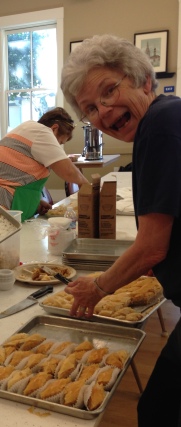
Earlier in the summer when Maggie was visiting we worked together at church on one of the cookie-baking projects, the Rainbow Chocolate Chip. Another week I helped make the Greek twisty cookies.

GGL IMG_0252 GK baked crp

I always enjoy working on church projects like this, where I am on an assembly line and can chat and get to know people a little better. It’s not stressful when someone else has the recipe and the system all figured out and I can just do as I’m told.

GGL green bean prep 2015


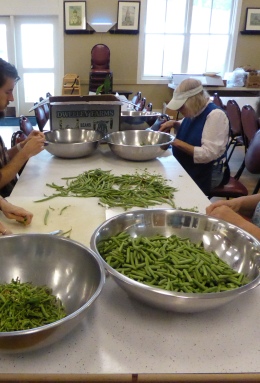
When the date of our event drew closer I went one day to cut up green beans for more than three hours; these would go into my favorite dish that we sell, Serbian Green Beans. The blanched beans are mixed with garlic-laden, buttered bread crumbs, then topped with sour cream and heated in the oven for about 20 minutes. Most of that process happens just before they are served steaming hot.


GGL P1010592 cabbage 2015

That prep day we were also making Sarma, which are stuffed cabbage rolls; the recipe includes a bit of sauerkraut, and the picture below shows the total amount that was needed. Actually, one gallon had already gone into the kitchen before I took the picture.

GGL P1010588sauerkraut

GGL IMG_0682


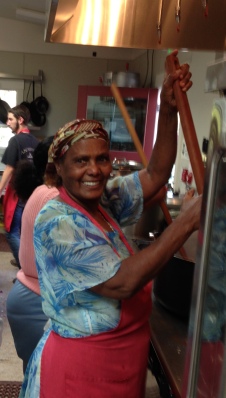
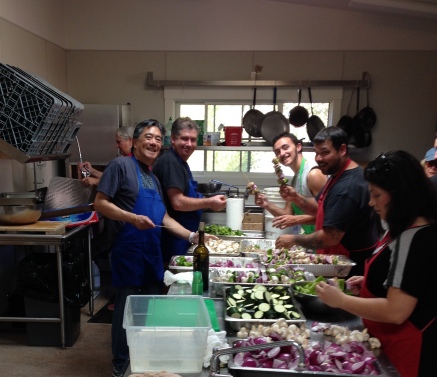
Just one day before, my friend Diane came with me and we offered our four helping hands. So many tasks had to wait until this day, such as cutting up vegetables for the kabobs, and stirring the Eritrean stews.


GGL IMG_0679

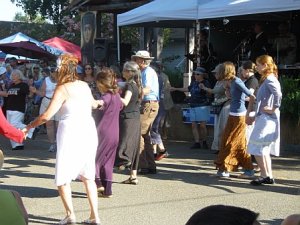
Year after year I notice how happy everyone seems to be, getting our party together, even if they are awfully tired by the end of it. We all see it as an expression of love to our community; if it were merely a fund-raiser I’m sure we couldn’t drum up enough energy for it. But it’s been going on for more than 25 years and a lot of people now look forward to the food, the music and dancing, and the joy.

GGL Glendi dance (2)

GGL IMG_0686

That last day Diane and I ended up sitting at a table where we made finishing cuts to endless sheets of baklava and placed the diamonds carefully into individual serving trays. Some people avoid this job, because it is messy, but there are plenty of little broken corners to snack on while you work, so if you like baklava….well, come to think of it, that might be another reason to avoid that job.

My job on the festival day was not to work in a food or craft booth, or the beer garden or the children’s area, but to mind the bookstore – I’m sure that doesn’t surprise anyone. I served several hours, and then I had a hard time dragging myself away, even though I did need a rest.

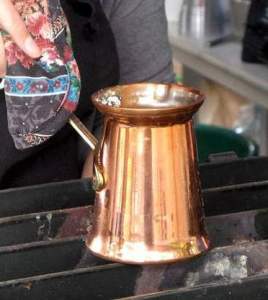
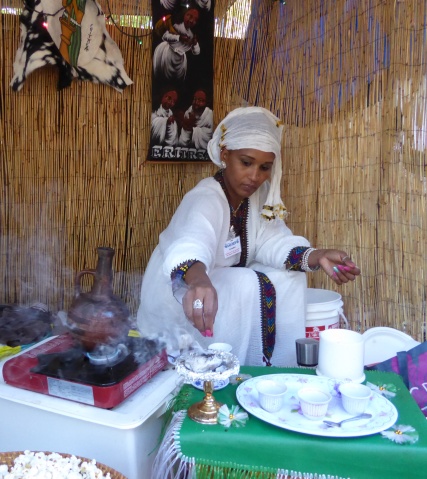
It was time for Vespers, which was the perfect thing to restore the soul that might be weary. After that I was looking around for a particular old friend I wanted to talk to, and I discovered her in the Eritrean tea and coffee tent, which I didn’t even know existed, maybe because it was tucked in a corner behind the main Eritrean booth.

GGL P1010684 Eritrean tea-coffee 2015

The woman who made tea for me was burning frankincense while she told another customer that this event is the thing she most looks forward to all year. Her colleague explained that the whole reason we make this offering of our time and effort is to express the harmony that we in our church share.

That is just what I was feeling.

Love is real and it maintains.

mrg&G 5-11 yellow Butte lgFather Alexis Trader in another article on grief, excerpted and linked below, discusses not just the memories we hold of those who are departed, but the love that binds us to them even after our former connection is gone forever. Notice that it is not the loved one who is gone forever, but the nature of the relationship.

That the relationship one has with those who have died can continue to change is something I haven’t given much thought to in my own case, though I have heard of a person asking or offering forgiveness at the gravesite of someone with whom they didn’t have “closure.” Not knowing back then that it would pertain so closely or so soon to my experience, a few months ago I printed out an article from the Internet on the subject of “Dostoevsky and Memory Eternal” but didn’t read it until after my husband died.

I always love the hymn “Memory Eternal” that is sung at the end of every Orthodox funeral service, and I was eager to read what conjunction the writer Donald Sheehan found between it and The Brothers Karamazov, a novel that I also find very meaningful. About half of his article discusses the theology of Fr. Pavel Florensky and conditions of personhood, but it was the second half that most affected me so far, where Sheehan describes the events of his life and how they led to him becoming Orthodox. His father had been the cause of chaos and suffering for his family, but after he died, seemingly in response to his son’s own efforts at reconciliation, the father gives him a great gift.

Thanks be to God, I could not relate to the kind of pain that Sheehan lived with, between me and anyone I’ve known. It was the love he had for his father, of a kind that would not give up even after death, that resonated with me in the first days after my husband died. In his article on Grief and Human Bonds Fr. Alexis quotes two church fathers on this topic:

As Saint John Chrysostom once wrote to a widow, “For such is the power of love, it embraces, and unites, and fastens together not only those who are present, and near, and visible but also those who are far distant; and neither length of time, nor separation in space, nor anything else of that kind can break up and sunder in pieces the affection of the soul” (Letter to a Young Widow). That love was real, is real, and leaving it free to maintain a bond with the beloved is a healthy, real response to grief.

When Saint Ambrose of Milan’s brother died, he wrote “My relationship with you is not lost, but changed; before we were inseparable in the body, now we are undivided in affection; for you remain with me, and will always be with me” (Book 1 on the Decease of his Brother Satyrus). In the same spirit, Saint John Chrysostom once consoled a parent who had lost his son, “I beg you, do not say ‘I am no longer called father,’ for why would you not be so called while your son remains? For you surely have not parted with your child or lost your son, but rather obtained him and have him safe.”

At the cemetery this week Fr. Michael exhorted us about the ways we can continue to love those who are no longer present in body. His words, “Do good deeds in their name,” reminded me of the broader concept of living the kind of life that honors the one who has died, and that will keep me on the road that leads to the great rendezvous at the end time. (The thought of that meeting causes me to wonder: Do you suppose we will hug with our new bodies?)

In the words of St. John Chrysostom, I may have my husband safe, but does he have me safe? I am still on my journey, and my love for him will help me to stay on track.

“For I am persuaded, that neither death, nor life, nor angels, nor principalities, nor powers, nor things present, nor things to come, nor height, nor depth, nor any other creature, shall be able to separate us from the love of God, which is in Christ Jesus our Lord.” (Romans 8)


(Photo credit: Pippin)

Lazarus and Flowers

In the West it is the end of Good Friday as I write, but this year for us Orthodox it issymp white roses the beginning of Lazarus Saturday, when we remember an event that starts out very poignantly, with Jesus’s friends lamenting the death of their brother, and Jesus Himself weeping.

This story of a death and of friends and family sorrowing is timely in my own life right now, and of course I have done some weeping lately – but mostly I wanted to write about the flowers that have come to me, and I may be stretching a bit to connect all these thoughts together.

Flowers have been coming into our house nearly every day for more than two weeks. They are beautiful bouquets and arrangements and plants, and when the first one arrived, before my husband died and on our wedding anniversary, the circumstances made it obvious that God had sent it by the hand of an angel, to convey His love and to assure me that Hebouquet CMc 2 will be my Husband, as it says in Isaiah 54: “For your Maker is your husband; the LORD of hosts is his name; and your Redeemer the Holy One of Israel….” I cried a good deal over that bouquet, and as the florist delivery man and I became better acquainted day by day, I received every new gift with joy.

We know flowers not just as symbols, but primarily as real and exquisite works of art, lovely in themselves. I think the florist noticed the repeated name on each order and tried to make every creation a little different; we have been enjoying dozens of varieties and species of blooms, ferns, branches of shrubs, succulents in ever-changing combinations, all gorgeous.

Other friends brought their own original and unique arrangements, or sometimes just a contribution to a nosegay. Each was given a place in the house where it could minister to the crowd of family who were coming and going for a fortnight and often sleeping here (One night 15 of us slept under this roof.), but I think I was the symp mix w lupinemost nourished of anyone by all the sweet flower-love. These real and aromatic things helped to keep me aware of God’s presence as much as did the kind messages in cards, and the care packages of fruit and candy.

They also gave me a job to do. While my children took over the more difficult practical matters of phone calls, shopping, cooking and organizing a funeral, I was able to wander about tending my flowers, trimming the stems, changing the water, removing spent ones and recombining the longer-lasting blooms (Carnations win the prize for aging well.). It was and is an easy sort of gardening, and very soothing.

People have given our family flowers and other kindnesses because they love us; that makes them feel our sorrow with us. We don’t really need any more explanation than that, but there is another aspect to our sorrowing. I find what Fr. Alexander Schmemannsymp azalea says about Jesus’s tears to be helpful:

He weeps because He contemplates the miserable state of the world, created by God, and the miserable state of man, the king of creation… “It stinketh,” say the Jews trying to prevent Jesus from approaching the corpse, and this “it stinketh” can be applied to the whole of creation. God is Life and He called the man into this Divine reality of life and “he stinketh.” At the grave of Lazarus Jesus encounters Death — the power of sin and destruction, of hatred and despair. He meets the enemy of God. And we who follow Him are now introduced into the very heart of this hour of Jesus, the hour, which He so often mentioned. The forthcoming darkness of the Cross, its necessity, its universal meaning, all this is given in the shortest verse of the Gospel — “and Jesus wept.”
….

symp tulips The power of Resurrection is not a Divine “power in itself,” but the power of love, or rather, love as power. God is Love, and it is love that creates life; it is love that weeps at the grave and it is, therefore, love that restores life… This is the meaning of these Divine tears. They are tears of love and, therefore, in them is the power of life.

Perhaps Mary and Martha didn’t have as many flowers as I do when Lazarus died. They likely did have flower essences in the ointment they would have used to prepare their brother’s body for burial.

And they had the Lord, not just weeping with them for the wrongness of death, but in His love giving the ultimate gift, His own Self. Without the knowledge of that Love and the assurance of a coming Resurrection, what flowers can give wouldn’t be very satisfying. But while my husband walked this earth he and I shared Christ’s life-creating Love, and we still do. Flowers are one more reminder of that reality to my still-weeping heart.

symp w carnation

Do you ask what the birds say?

April is National Poetry Month. I like celebrating that.
Here’s a happy-making poem from my files:

ANSWER TO A CHILD’S QUESTION

Do you ask what the birds say? The Sparrow, the Dove,
The Linnet, and Thrush say, “I love and I love!”
In the winter they’re silent — the wind is so strong;
What it says I don’t know, but it sings a loud song.
But green leaves, and blossoms, and sunny warm weather,
And singing, and loving — all come back together.
Then the Lark is so brimful of gladness and love,
The green fields below him, the blue sky above,
That he sings, and he sings, and for ever sings he —
“I love my Love, and my Love loves me.”

~ Samuel Taylor Coleridge