Category Archives: love

May the pots never grow cold.

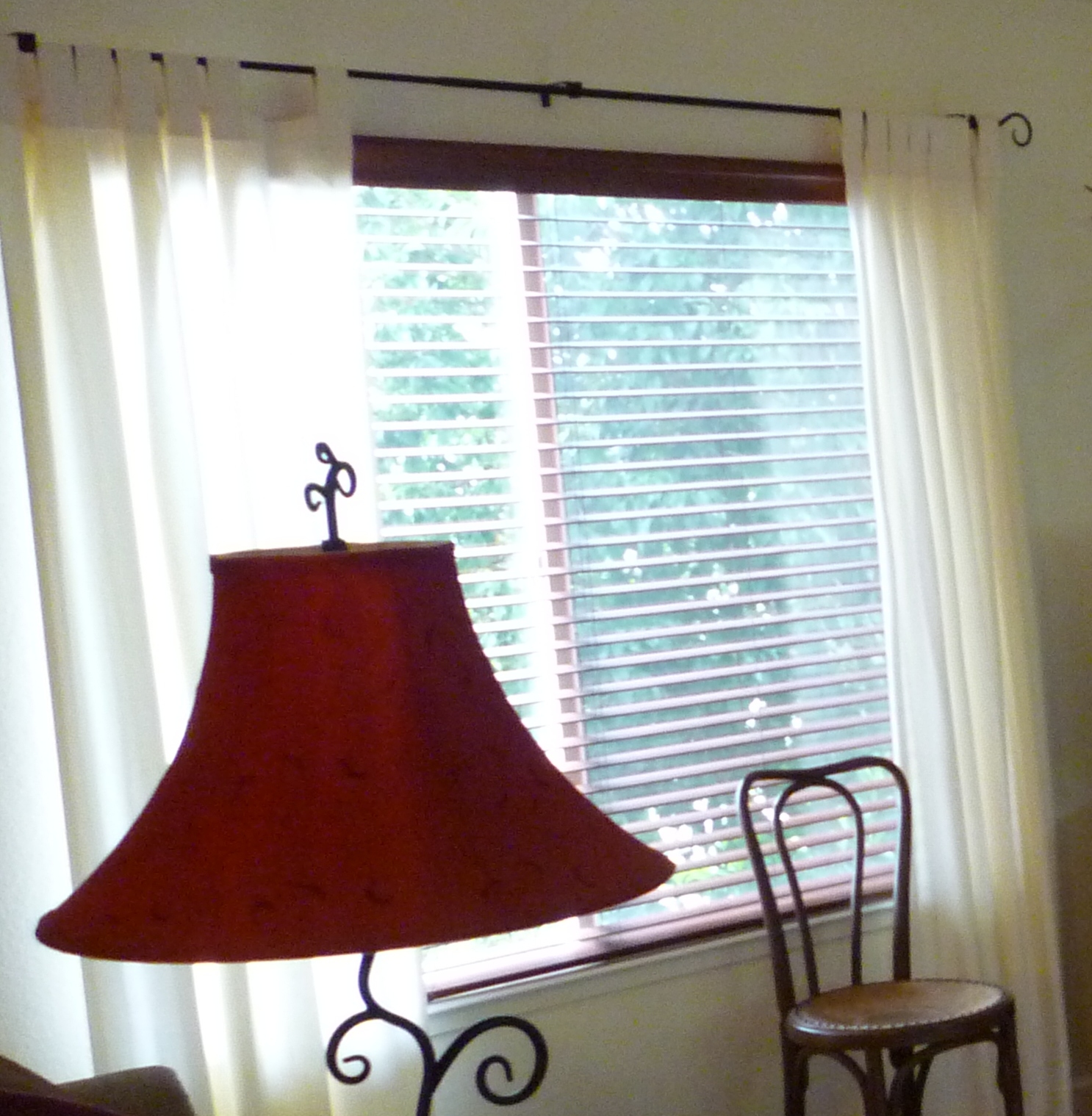
About 30 years ago we owned a modular house whose many large windows were covered by the original fancy draperies, so that when the curtains were closed they covered most of the expanse of three walls with nubby gold curves. The walls were thin particle board painted to look like wood, as you can see in the photo – but I didn’t mind those as much as the drapes. I would have preferred something more rustic and casual and of another color to go with the country setting, but even if we’d had the money we couldn’t have justified spending it to replace Perfectly Good high-quality drapes.

It was a recurring temptation to me, though, to stew over how ugly and Not Me they were. This was tiresome, and eventually my better self convinced my offended self to stop, using this argument:

What is your purpose in life? To love God and be useful to Him.

What is the most important way for you to do that? To love people.

Do you need pretty and tasteful drapes in order to love people? No, I answered. If someone who comes to my house sees my drapes and not me, I can’t help that. If they need my hospitality and friendship they need it from me personally, and God will just have to use me in spite of this ugliness in the room. (Which of course was not a universally recognized ugliness anyway.)

Those of us who have read any of Edith Schaeffer’s other books know that she by her life and words demonstrated the importance of love and hospitality. Her book The Hidden Art of Homemaking, which is the subject of a book club hosted at Ordo Amoris, I do not take as contrary to the rest of her life and work, but complementary to it. Some of you may not have read the other books like What is a Family? Partly from reading it I am pretty sure that if she had to choose, she would herself rather have been a resident or guest in a plain and even ugly house run by a warmhearted woman than in an artistically decorated dwelling with an unkind or angry soul. We’ve all heard of and perhaps had the experience of going into a house where the decor was shabby or messy but you wanted to be there because it felt like home — welcoming and nurturing. Mother Teresa’s saying fits here: “Love begins at home, and it is not how much we do… but how much love we put in that action.”

I think Edith’s own houses were like this, because she was that kind of woman, and likely much more than I myself am. But I have it as a vision to be like that, and am inspired by quotes that speak of a woman being able to make a home wherever she finds herself, of a woman herself being the heart of her home….but I can’t find any of those at the moment. The line that has intrigued me for years now is from the Santana song “You’ve Got to Change Your Evil Ways,” from the perspective of a man who is dismayed by his woman who’s gadding about all the time:

When I come home, Baby,
My house is dark and my pots are cold.

These are just signs to the poet that there is no woman at home to welcome him.  The verse reminds me of advice I read to housewives who haven’t figured out what to make for dinner, but who want to do something to give their husbands a good feeling when they come in the door after work: While you are getting your act together put an onion in the oven to bake so that he will get a hopeful olfactory signal.

A message I get here: A woman conveys her love and hospitality by these simple modifications to the environment: opening the drapes or turning on the lights, cooking something in the kitchen, and in both ways warming up the sensory atmosphere. If she has a kiss and a smile for her family and guests all the better.

The last few years when my husband and I live here alone, I notice that I am the one who thinks about light control. In that photo above you can see all the light that came into the humble house with the gold drapes. It was the best feature of the house, as I was later to discover, when I wanted our new house to have as much light — it was not to be. The photo was likely taken in the winter, when we would open the drapes wide and let in all the warming sun.

In our area we can get along pretty well in summertime without air conditioning, if we manage the windows and window coverings: At night open all the windows to let the cool air in; in the morning close everything up to shut out the sun’s rays, and leave them that way (and the house kind of dark!) until the air inside gets as warm as outdoors — then you may as well get any breeze that might stir, and be ready for the coolness to enter as soon as it arrives.
In Spring or Fall our present house doesn’t get very hot, so in the mornings I like to open the blinds and let the sun in as soon as I come downstairs — but my man never thinks of doing this. For my mind, sunlight is the very loveliest decoration. And at night, I like to close the curtains or blinds so as to feel sheltered against the world. This also seems to be, in my experience, a homemaker’s impulse.

I have learned to do many artful things in my houses over the decades; I have arranged and painted furniture, swept the floor, bought bedspreads and embroidered Bible verses to hang on walls that I painted, but those things aren’t more important than the light-monitoring I do. I also tend the fire in the stove, and light candles, and keep the pots warm.

While you’re working on the outward appearance of your home, attend also to your heart and keep it warm with prayer. If the family members are getting snappy or sulky, take a prayer break together and ask God’s help – then sing something to warm up the atmosphere. I like this quote that Debbie posted, by Laura Ingalls Wilder:

Let’s be cheerful! We have no more right to steal the brightness out of the day for our own family than we have to steal the purse of a stranger. Let us be as careful that our homes are furnished with pleasant & happy thoughts as we are that the rugs are the right color and texture and the furniture comfortable and beautiful.

Thank God for making Edith Schaeffer the kind of woman who could pass on to us a bright homemaking heritage.
It’s not about feeling balanced.

From another site:

No frail human morality can ever hope to contain the overflowing fullness of life with which Christ desires to rejuvenate the faithful.

…The world will not be saved by optimistic humanism that believes human progress and morality will eventually save the world. For Dostoevsky and the church fathers, man’s deepest problems are not moral, nor even psychological, but ultimately existential and ontological. It’s not about following the rules or feeling balanced. It is a matter of choice and it is a matter of human nature being touched by the hand of God Himself.

Only by daring to leap towards God in spite of the good and evil that exist in the heart can the believer hope to get beyond the contradiction of the human condition. In order to avoid descending into nihilism, Dostoevsky offers his readers another path: the acceptance of suffering and affliction in the context of a relationship with God. It is only in this context that man is able to recognize a path out of his fallen condition. It is only this Love that is able to transform suffering into salvific joy.

Read more here: Ancient Christian Wisdom blog


Snow falls but I am warmed.

On the plane to Philadelphia I got halfway through Metropolitan Anthony Bloom’s God and Man. It helped to calm my jitters that had developed since the initial excitement and decision to go to my last remaining aunt’s memorial service. I was about to arrive at an event and to enter a house and family where every person was a stranger.

Eeek! What was I getting into? Metropolitan Anthony encouraged me with words about love and life, and before I knew it a first cousin once-removed was hugging me at the airport and driving me to a houseful of other huggers and gracious people. I stayed up with them later and later every night sharing stories of our grandparents and parents, digging up memories and laughing with happiness over all the many connections we have by way of genetics and family traditions.

The realities of The Kingdom I had been reading about are certainly pertinent to the activity in my heart last weekend, but I’m still debriefing myself about what happened. I may never figure it out enough to put it down in words, but it was exciting and glorious.

What I am able to do is share some photographic images of the little bit of Philadelphia I experienced. Cousin #1 put me in The Nursery at her house, which is decorated in the most comforting and cozy way, with pictures of the Teddy Bears having their picnic, and Babar, and more pictures and items that probably helped me feel that I was falling asleep with the Sandman’s help as when I was a child. Stuffed animals sat around on the stuffed chair and on the extra bed, and green leaves were painted on the creamy yellow wood floor.

In the kitchen Revere Ware pots had been hung on the wall – hey! just the way Grandfather used to do! – and science “experiments” I won’t describe sat on a shelf all ready for the grandchildren, my first cousins twice-removed. Flowers filled the air with sweetness – We would soon load them in the back of the car to drive to the memorial service and reception.

See that orange towel on the kitchen counter above? I brought it with its citrus-y design as a gift to remind my cousin of the boxes of oranges my father sent across the country to their family every Christmas in bygone days.

Out back, raised beds were awaiting spring planting, and pussy willows budded right off the kitchen porch. I sat on the steps going down to the garden to talk on the phone to Mr. Glad who was still back in California missing me.

The morning of the memorial service we walked a block to the train station to meet daughter Kate who had come from D.C. to be with me. She had never even met her great-aunt whose life we were honoring that day, but she was happy to get acquainted with the cousins, and she slept in The Nursery in the bed next to me.

One night Cousin #3 cooked dinner for the two of us at her place, a very “vertical” row house in South Philly, narrow and rising five levels. She honored the first owners with a photo on the wall showing a very sober and Italian wedding party featuring the bride-and-groom owners. It’s a pretty old house of the sort that has (newly refurbished) rosettes on the ceiling in some rooms.

All the long weekend, all the folk I met were amazed at how much I resemble my late aunt; the cousins in our branch of the family haven’t been together in a long time, and for most of their lives they had been daily surrounded by people related to my aunt’s former husband. I was happy to provide a facial link to her instead. We pored over all the old photos we had assembled, staring at the faces as though trying to penetrate the souls of our ancestors to understand who we are.

I woke up the morning of my departure to see the ground all white, and snow falling. The birds arrived at the feeders, and I even saw a female Cardinal for the first time. I’ve never lived where this classic red bird does.

After I was dropped at the airport, I wandered around waiting for a flight that was delayed for weather, and wondered at how fast I had made a fast friend of my cousin. Someone told me before I set off on my adventure that a cousin is sort of like a sister, but better in that you don’t have the tension that can happen between siblings.

So it seems at this point, and I’m grateful for the gifts of God. He is everywhere, of course, even in the middle of a bunch of strangers. We don’t have any love that doesn’t come from Him. But that provides plenty.

Athanasius – God in sensible things

A young woman we know is trying to love people in San Francisco for the sake of Christ. In a recent prayer letter she wrote:

The hardest part of doing ministry in San Francisco is the cost of living factor. My rent is $1975 for my two bedroom apartment, which many in the city will tell you is a good deal. Because of the high cost of living most pastors and missionaries don’t live here. The problem is that you can’t relate to the people and become effective at reaching the city for Christ if you don’t really live among them.

San Francisco downtown

People think that if they just have some fancy strategy they will see people come to Christ. These programs become like the welfare system; people just learn how to work the system, and there are so many that the homeless get to pick what they want at different meals.

They get used to sitting and allowing the word of God to come in one ear and out the other…rarely do you see any lives change. The old fashioned way of living among the people is gone from many Christians’ concept of what a missionary does. The majority of pastors live outside the city because it is cheaper. They then drive into the city where they have a reserved parking place and never spend time out in the community.

But this woman meets people on the bus and the playground, and they get to know and trust her as their lives interweave with hers. The words of her letter came back to me as I was reading On the Incarnation by St. Athanasius:

The Saviour of us all, the Word of God, in His great love took to Himself a body and moved as Man among men, meeting their senses, so to speak, half way. He became Himself an object for the senses, so that those who were seeking God in sensible things might apprehend the Father through the works which He, the Word of God, did in the body. Human and human-minded as men were, therefore, to whichever side they looked in the sensible world they found themselves taught the truth….For this reason was He both born and manifested as Man, for this he died and rose, in order that, eclipsing by His works all other human deeds, He might recall men from all the paths of error to Know the Father. As He says Himself, “I came to seek and to save that which was lost.”

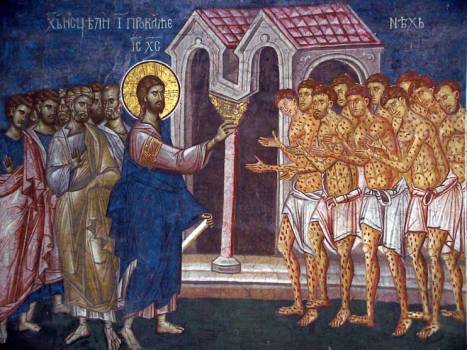
Christ heals the lepers.