Category Archives: my garden

Bees and good-byes.

Bee on yerba buena.

Good-byes not to you, Dear Readers, but to the beautiful friends that are the trees and flowers, bees and blooms of my garden, as I prepare to set out on my travels. Most of the days of the year I am home and can tend to their needs, even if it is often less than optimal care and attention I give. Now, in May, the most flowery and gorgeous of my local botanical world, to leave it all…

I keep reminding myself that it will be okay. There is an automatic irrigation system, there are friends and neighbors and landscapers and possibly even a daughter, to caretake in my absence. Yesterday morning it must have been God Who woke me up at 4:00 a.m. so that I found myself in the garden before the sun rose, and witnessed a leaky irrigation hose spraying against the pine tree instead of giving drink to the plants on down the line. I turned off the system and later on Trusty Alejandro was able to come and repair that, and another leak that he discovered by testing the whole system. If I hadn’t quite unusually been out to witness that (and to bathe in the heavenly and oh-so-earthly atmosphere at that time of day), it likely would have wasted that precious water several times a week, and many plants would have suffered before I got back. For anyone who is not aware of the fact, our summer season in California is typically rainless.

In my pre-trip melancholy I keep going out to peruse the little kingdom that God has made me a steward and a lover of, and I see new and amazing things every time. I also find more little weeds to pull, or yellowed leaves to pinch off. There will probably be dirty dishes in the sink when I depart, but I hope no spent irises or Iceland poppy stems standing tall and naked.

I was surprised by the blossoms on the yerba buena ground cover under the pine tree, though I know I’ve seen it in bloom before. The bees are crazy about those tiny flowers. I know the one photo of the bumblebee is blurry, but it was cute the way he was hugging the cup of nectar while drinking…

…or losing his head entirely in his delight:

Two sides of my garden have tall dodonaea or hopbushes providing a backdrop of ever-changing colors for the other plants, and a sort of screen that makes the garden more cozy. Right now a couple of the bushes have changed into their pink outfits.

Today the new Landscaper Dan is coming very belatedly to make a plan for things he might finish up while I’m gone. It gives me extra comfort to know that a person who appreciates the garden needs even more than I do will be paying attention. The area by the front door that we planted together in November makes me feel that I am in the middle of the prairie. Those droopy-petaled pink flowers are echinacea pallida. I’d tried growing them from seed several times without success, but Dan got three plants which have been very happy, and happy to bloom.

My arborist friend A. came and pruned the pineapple guava (feijoa) a few weeks ago. It is so big now, in its tenth year in the garden, and covered with those blooms that are so delicious to eat in themselves. I wish you could come over and have a taste.

I can’t stop swooning over the penstemon — that color!

Soon I plan to be back with stories while exploring in Greece,
but for now, God bless and keep you, Dear Garden!

Blue-eyed grass can’t hide from me.

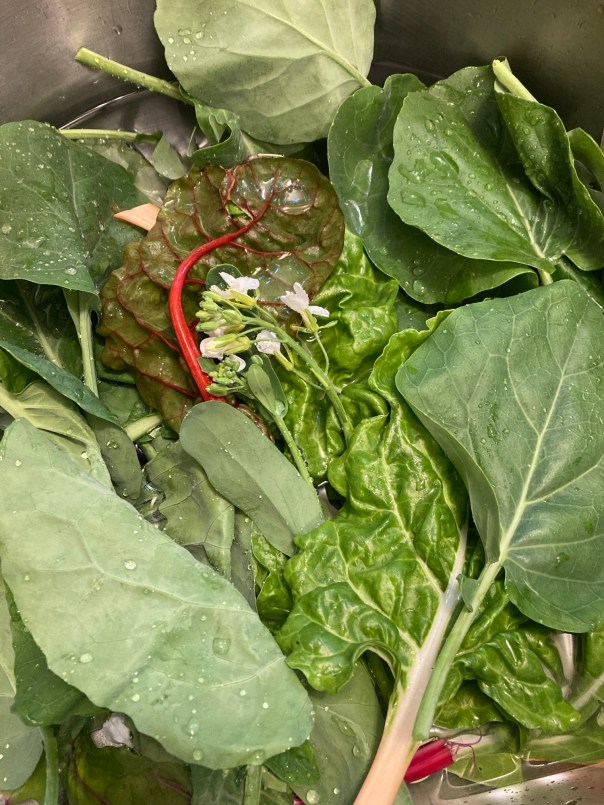
If I hadn’t been benignly neglecting my planter boxes, I’d have butternut squashes or snow peas growing on the trellis, and zucchini as well. As it is, volunteer sweet peas have flourished, because those boxes are irrigated on a timer that gives them a little water every day. This week I pulled out all the burr clover and aphid-infested collards and Swiss chard, to make room for the flowers, and to plant more seeds.

We cut the snowball bush viburnum down to stumps, because it needs to be given a fresh start. I promise I will give it water during dry spells as well. In former days we put the hose on it in summer, and I don’t know why I stopped.

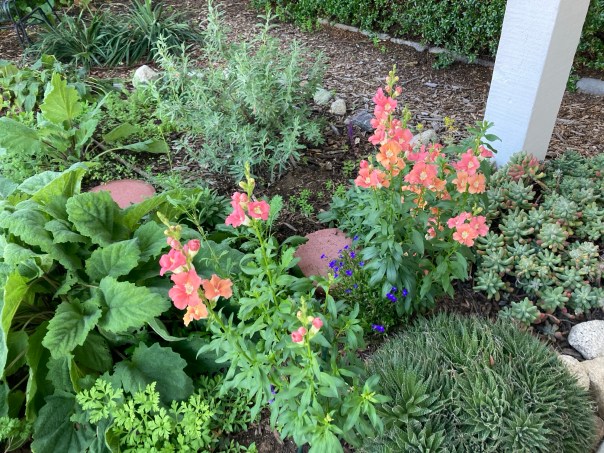
Bursts of purples meet the eye all over the back garden, from the lobelia…

…to the penstemon…

…to the Blue-Eyed Grass hiding behind a pomegranate bush:

I know that when I go on my trip next week, I won’t be thinking of my garden. But right now, I am reluctant to say good-bye, and I’m thinking of all the changes that will happen without me seeing them. Probably by the time I return the sweet peas will be a little crisp.

But more blossoms might have emerged on the lemon tree.

You know I’ll be sure to let you know.

A May afternoon with friends.

cistus

After church on Sunday I had twelve friends over for a little party. Half of them were children under ten, and all of those had been in my house before; they fell to right away playing with my dress-up clothes, dolls, and matchbox cars. At one point the squirming baby let me remove her to the armchair in the play area where we read a couple of stories together, so that in the other room her mother might drink tea with both hands.

dwarf pomegranate and helianthemum

The weather had warmed up just enough between Saturday and Sunday to make it pleasant for eating outside, and for the children to enjoy organizing the playhouse. I had spent more time cleaning that little hut in preparation than I did the real house — but I still have not sewn new curtains for its window, in these ten years since it became mine.

May is in many ways the perfect month for a garden party, because of the variety of blooms — and what a joy to have other people soaking up the beauty with me. This spring, since I “lifted the skirt” on the pomegranates, the orange helianthemums are bursting with more flowers than ever before; the wisteria is in its prime, and the bees are buzzing all over it. The snowballs on the viburnum are at their best. And we have the possibility of temperate and sunny afternoons. I always think it should be easy to host more such gatherings, but just finding a date that works for everyone takes a lot of effort; in this case I’d begun that process seven weeks ahead.

snowball bush

I’d started planning the menu, too — it needed to be items that wouldn’t need fussing over that day. One thing I made the evening before was this favorite quinoa salad that is tweakable to what one has on hand, which I found on the New York Times cooking site. I am unlocking the recipe for you, and you can access it through the link: Quinoa and Broccoli Spoon Salad.

A warning about the quantity of salad that came from one of the cooks who joked about it supposedly serving 4-6: “…it serves 4 to 6 distance swimmers during an Olympic training camp.” I used two cups of quinoa and ended up with plenty left over for my guests to take home plus more than I can eat staying here. I don’t like mustard so I left that out, and I used dried California cherries instead of cranberries, toasted walnuts instead of pecans. I like these NYT recipes because the cooks who try them share things they learned when making them according to the original instructions, or after they alter various ingredients or procedures.

figs in the fall

Few people like raw broccoli, but as I have learned and other cooks testified, the dressing in this dish quickly marinates the small pieces of broccoli and removes the unpleasant rawness, while retaining a little crispness.

In an effort to use up foods from my freezer and pantry, I made one dessert using plums from my trees that I’d put by last summer, and another dessert using figs that I had tried freezing raw for the first time. Both worked well and were heartily eaten. Plum and Cream Scone Cobbler from Smitten Kitchen I’ve made before with peaches, but this time I had enough plums to use them.

It was delicious, but I will change some things if I make it again. The scones that make the cobbler topping are just too rich, with a whole stick of butter and a cup of cream in the dough. At least, they are too rich combined with the amount of fruit called for. Maybe I would decrease the butter by half next time, and use at least 50% more fruit. (Ha! I see that last time I made it I told myself to make those very changes next time, and forgot.) I also seem to have cut my scones too large…

My guests and I didn’t only talk about books over the course of our leisurely afternoon, but many book titles popped up in our conversation, more than I even know about. A few that I can recall just from our last hour together were: The Ethics of Beauty; St. Ephrem the Syrian: Hymns On Paradise; The Hidden Rainbow; Christ the Conqueror of Hell; The Little Liar; and Orthodoxy and the Religion of the Future.

At one point I ran upstairs to get this book to show the others, my latest deep read. They all had a good laugh with me. It’s not just goofy, but is actually a very thought-provoking book! Maybe I will tell about here it sometime: How to Talk About Books You Haven’t Read. I do a lot of that already, but I’m sure there’s room for improving my skills.

Usually when children play in the playhouse, they like to prepare salads or other halfway-pretend dishes made of all the edibles I give them permission to pick from the garden, including flowers as well as vegetables.

collard flowers

I meant to point my younger guests to my exuberantly flowering kale, parsley and who-knows-what in the planter boxes I am not cultivating right now, but I never got around to it. After everyone had gone home I checked out the back garden to see if there was the sort of happy mess I’m used to in and around the playhouse. There was no evidence that anyone had done any “cooking,” but rather a lot of setting in order, with the dish soap by the sink and a lavish bouquet completing the scene. It was symbolic of all that I had received from my guests who gave me an afternoon in spring.

We survive neglect.

Helianthemum Henfield Brilliant

I use “we” in the title to show solidarity with my beloved garden. Several times a year, a complaint is lodged against Gardener Gretchen for failing to live up to her vision. I guess it’s just the reality of Life Right Now. Tomorrow will be a big gardening day, a day of improvement, but today is when I had a few minutes to stroll about taking stock, taking pictures. All the plants are calling me to come out and admire them, and to notice how they thrive; they don’t want me to feel bad about how much I ignore them.

Lithodora with nigella and weeds.

Lithodora is one of my favorites. This week I’m going to pull out all the Love-in-a-Mist sprouts that are growing through and around it and under the fruit trees. In the front I already did as Gardener Dan advised me: I “edited” (thinned) the nigella, which he says will help them produce larger blooms. I think I reduced the number of plants in that bed from roughly 1,000 to 100.

Let me get the rather sad picture below out of the way now, the planter boxes where I typically grow squash and tomatoes. I’m at a loss as to what to do there, as my travels will take me away at just the wrong time for summer vegetables. Maybe the earth will have to lie fallow until August, when I can plant winter greens.

The native Pacific Coast Iris is now blooming in my very own garden (below). I am completely thrilled. This plant is so popular on the West Coast — not just near the ocean but up into the mountains — that it has its own fan club, the Society for Pacific Coast Native Iris.

In native plant nurseries one can find many colors and species of this type, Iris subsect. Californicae, which is in the same family as the Siberian irises. The Flora of North America site says, “Series Californicae presents some of the most complex taxonomic problems in all of our American irises.” In the wild a specimen can be difficult to identify as to which of the three main groups it is in because of “their willingness to cross pollinate whenever their ranges overlap.”

Pacific Coast Iris

When I was offered a choice by Dan, I knew I wanted the white. But maybe I will find a place to plant other colors in the future. One plant site explained, “If the tall bearded iris is the queen of the garden, the natives are the pixies.” My queens are nearby, in the front garden, rising up tall and elegant, with the pale yellow California poppies (and lots of weeds) for contrast.

Back by the lemon tree, I had a sort of iris dumping ground for a few years, where I planted whatever extra corms came my way, usually gifted by iris sellers who threw a few odd ones into the shipment. The colors or the quantities didn’t fit in with the others, so I saved them in that corner, where they never did well. Last fall I put them in a double row behind a plum tree, where they are surprisingly starting to bloom. Yes, I saw that milk thistle — I just need gloves before I will tackle it!

This spring, I bought exactly one plant on my own, without any idea of where I might install it. I will wander tomorrow and find a setting for a foxglove plant.

For a few years, back when my garden was newly landscaped, I had three native currant bushes (ribes) with their showy flowers and intoxicating scented leaves.

Ribes, March 2017

They grew so large that they engulfed the bench in front of them, making it impossible to sit there:

Ribes, May 2019

After I pruned them, they bloomed again …. and then one by one they died. No one could figure out why. Now we are trying some new ones, which don’t look like the same plant exactly, but they are blooming very prettily right now:

Last fall I made it to the hardware store after most of the bulbs were already bought up. All they had of muscari were these “special” ones below. I bought a big bag, and then regretted it, thinking they might turn out to be just weird. So instead of planting them near the front door, I put them in various places in the back garden, where they are blooming late… and I do think they are odd.

Revived survivors from last year.

The heuchera are covered with their bells already, and you can see my little cyclamen plantation behind. The soil is very shallow because of tree roots, but they come back year after year; recently I added two more to their family.

I will close with a cheery calendula group. They are brighter than ever because of all the rain they got, and will never look this good again until next winter or spring, if they get a good winter watering. It’s just too dry in my garden for them to thrive, but they are like many of us that way, right? Rarely are all the conditions optimal for our looking and feeling our best. The calendulas are surrounded by tall, pushy, more drought-tolerant “tares” that don’t seem to bother them at all. I hope to follow their example and cultivate more hardiness, and cheeriness too. Or — merriment.

Because this morning I was reading a Psalm not in my usual translation, and it went like this:

And let the righteous be glad;
Let them greatly rejoice before God;
Let them be glad with merriment.