Category Archives: nature

On the Way to Red Hill

The Russian River

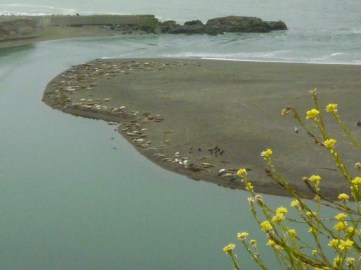
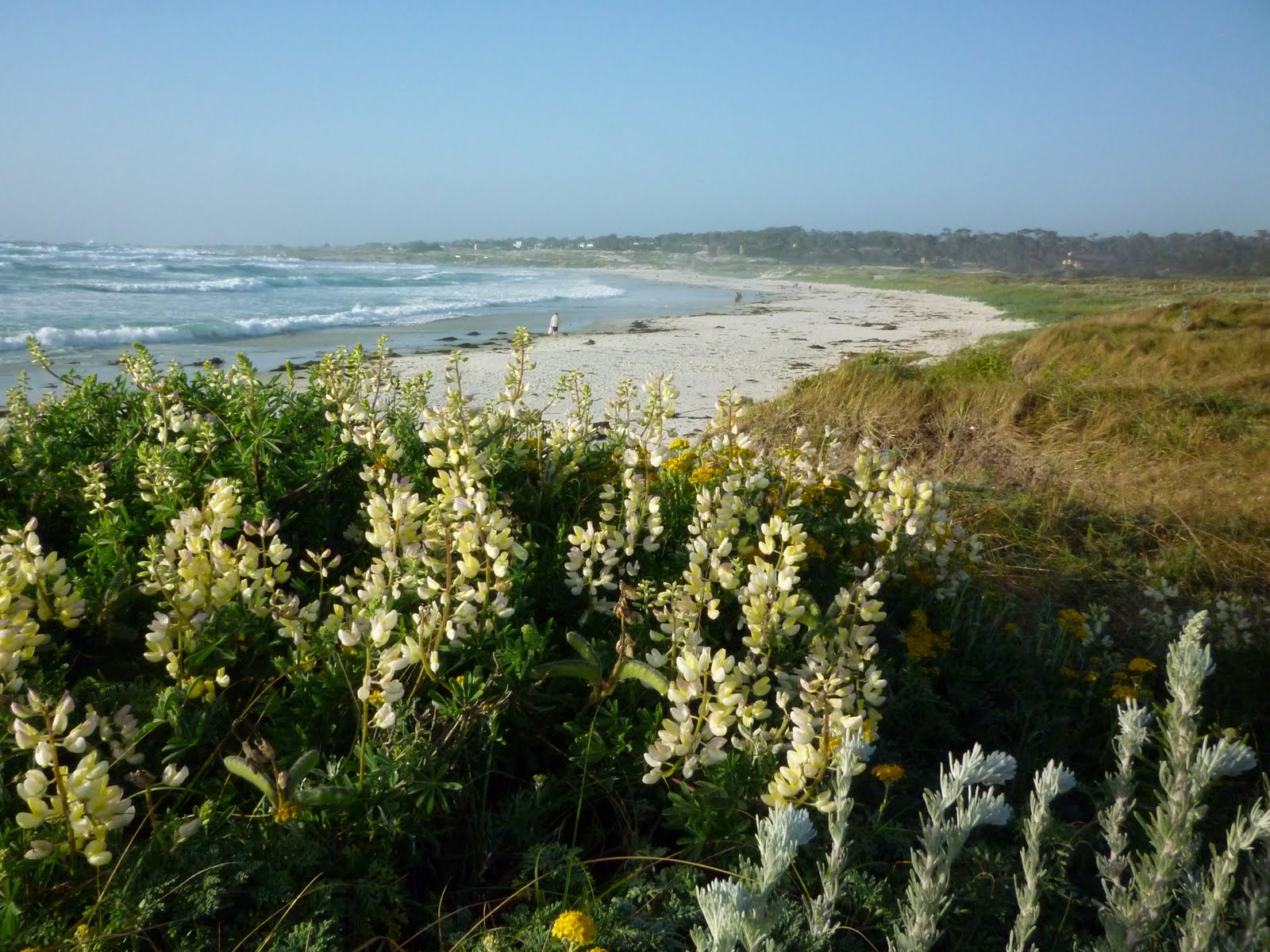
Mr. Glad and I took our friend from college days on a hike at the coast. Up from Shell Beach, near where the Russian River flows into the ocean and sea lions sleep in clusters on the sand, a trail winds toward Red Hill. We didn’t make it to the top of anything, and the fog would have obscured our view anyway. But the overcast skies made it easy to photograph flowers.


Before we got to the trailhead we stopped on the bluff north of the river and looked down on the pale shapes of the sea lions, with a bunch of dark birds nearby, cormorants perhaps.

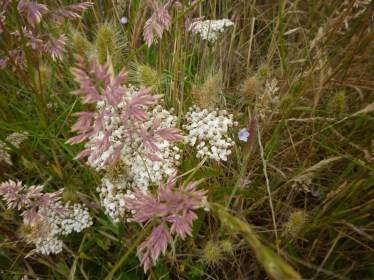
The slopes were covered with lovely pink grass, which contrasted nicely with white yarrow, and with yellow and blue flowers, too.
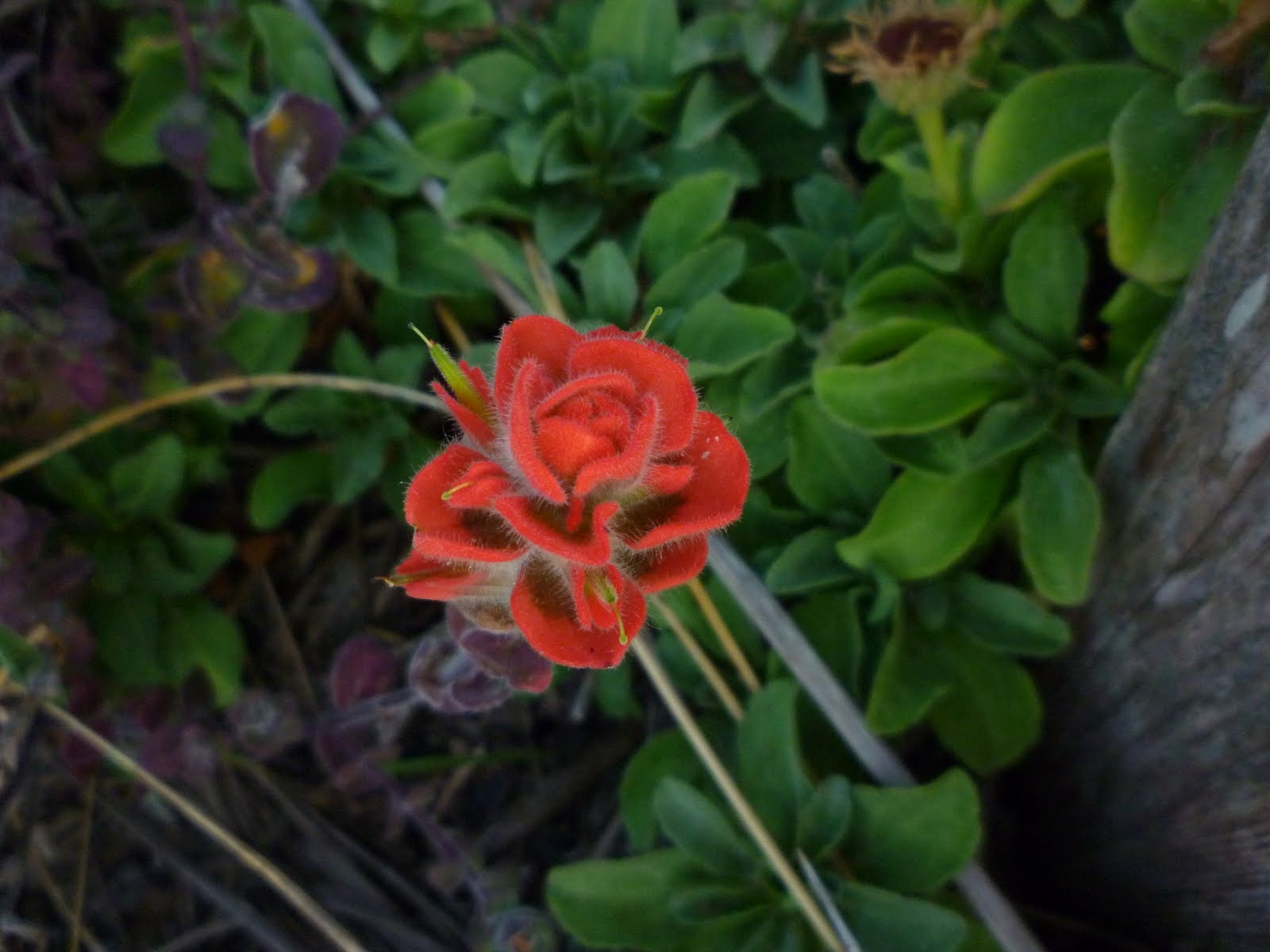
The blooms of this unknown plant remind me of a bouquet of fat and curling pipecleaners. It liked to grow in the poison oak and brambles.
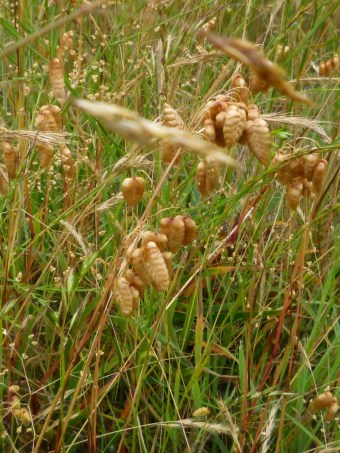

Rattlesnake Grass – Briza maximaRattlesnake Grass is darling. Plantations of the stuff hid in the pink grass. It occurred to me to take some home and send it in a box to a grandchild, and as it didn’t look endangered I had no qualms about stealing.  Indeed, just now I found that it’s not even native to California, and is on the list of invasive plants, though its invasion is termed “limited.”

The giant yellow lupine bushes that one often sees near the coast weren’t in bloom, but smaller and mostly blue ones
dotted the sides of the trail.

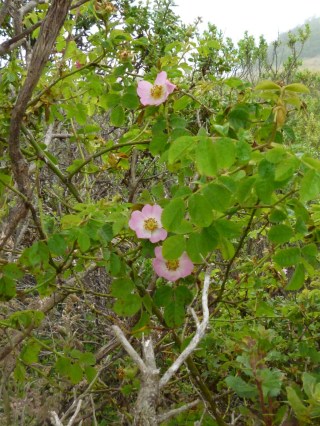
As we trotted along comfortably, the breeze blew warm, though the sun was obscured. Noises from the highway down below were muffled, and the wild rose hid herself among some dead branches.

Fast Trip South

Soldier and Doll welcomed me to stay at their place overnight so that I could be at my son’s graduation from a 16-month course at the Defense Language Institute in Monterey early in the morning.

lupines and more

As I backed out of our driveway at the beginning of my trip, the car thermometer registered 91°. On the Golden Gate Bridge it was 61°, in Santa Clara County 94°, and by the time I got to Monterey, back into the low 60’s. I kept busy putting the car windows up and down and the A.C. on and off.


After dinner that night we walked on the boardwalk at Asilomar Beach, and took pictures. We definitely needed sweaters out there.

Some of the large Presidio herd of deer were relaxing near the gate next morning… …and did not pay much attention to our important event.

Soldier graduated with honors from his program, and after the ceremony and picture-taking with teachers we went out for omelettes and waffles. Before I knew it, it was time for me to pack my sleeping bag in the car and drive through the bands of warm and cool again to come home!

Today I’ll be back at my usual tasks — I mostly wanted to put up a few pictures to remember my fast trip.

The Hungry Soul – How Science Disappoints

Previous posts on this book:

In the Introduction to his book, Leon Kass writes of his purposes: “I hope to provide evidence that the modern corporealists — those who deprecate or deny the soul — and their modern rationalist or humanist opponents –those who deprecate or deny the body — are both mistaken, both about living nature and about man. I seek such evidence in an examination of eating.”

Here the author conveys an understanding of reality that is more in line with orthodox Christianity than that of many who profess Christ, for he sees that we are unified creatures; our bodies are essential to who we are, not just shells that we hope to escape. He even goes further than what I would assent to, stating that his meaning of “soul” is “primarily not a theological but a biological notion!” (Yes, he put that exclamation point there himself.)

“You should know at the outset, however, that I use the term [soul] advisedly and without apology, even though I know that it will cause most scientists to snicker and many others knowingly to smile. These skeptics need to learn that it is only because they in fact have a soul that they are able to find such (or any) speech intelligible, amusing, or absurd. Indeed, only the ensouled — the animate, the animal — can even experience hunger, can know appetite, desire, longing.”

It is not, then, only the scientists who are giving us only part of the picture, but also the teachers of humanities (I don’t want to call them humanists, as their vision is too stunted), whom Kass and his wife would call colleagues, as they both are themselves university professors in the humanities.

“…the humanities have long been in retreat from the pursuit of wisdom. Analytical clarity, logical consistency, demystification, and refutation; source criticism, philology, and the explication of thinkers solely in terms of their historical and cultural contexts; and the devotion to theoretical dogmas – formerly romanticism and historicism, nowadays Marxism, deconstructionism, multiculturalism, feminism, and many other “isms” – all these preoccupations keep humanists busy with everything but the pursuit of wisdom about our own humanity.”

James Le Fanu

While I was in the middle of thinking about Kass’s book, I heard another writer on scientific topics interviewed on Mars Hill Audio. James Le Fanu is a physician and author whose book The Rise and Fall of Modern Medicine won the Los Angeles Prize Book Award in 2001. He was speaking in the interview about his recent book Why Us?: How Science Rediscovered the Mystery of Ourselves.

Le Fanu is also concerned about the reductionist and unsatisfying science that purports to tell us all there is to know. Before the notion of science appeared in the early 19th century the idea of the metaphysical was part of the common sense of mankind. Galileo and Newton and Kepler had an instinctive recognition that whatever science couldn’t explain, there was “something beyond.” Their study of Natural Philosophy was encompassed in the larger whole of the love of wisdom.

Nowadays, says Le Fanu, science is boring, and “to be a career scientist is to be in a very small hole,” as they are so specialized in their work, and in their education there is nothing like the older biology textbooks that were “full of awe and wonder and astonishment.” Le Fanu said that in the scientific journals he reads and in his talks with scientists, he has not noticed that any individual scientists are fully appreciating the mystery and glory of the human being.

But we assume that at least some of those scientists leave their holes each night and go home to prune the roses, eat a tasty dinner and play with their children, showing what Kass calls “the disquieting disjunction between the vibrant living world we live in and enjoy as human beings and the limited, artificial, lifeless, objectified, representation of that world we learn about from modern biology.”

As Kass is seeing the non-material aspects of our humanity demonstrated through the very material and natural activity of eating, so Le Fanu sees them revealed ever more obviously by the recent discoveries of science. Everything we learn seems to show how amazingly complex and unknowable by scientific study is “the most important part of the human experience…the nonmaterial thoughts and ideas and feelings and relationships..all the sorts of things we do the whole time….”

I loved listening to someone who is knowledgeable about the latest breakthroughs in the world of science talk about the “five cardinal mysteries” of the human experience. I ordered his book and have been relishing it on every level. Here is another man whose own soul is well-rounded and developed enough that he is a good writer, a practicing physician, and a person who can wonder at the Creation.

If we had a few more men like Kass and Le Fanu, true Natural Philosophers who don’t reduce life and reality to systems and ideologies, but who are willing to be open to that Something Beyond, the world would be a better place. Perhaps some of the upcoming homeschoolers who are getting a foundation in the kind of Poetic Knowledge that Charlotte Mason and James S. Taylor teach will have the ability to benefit from their scientific studies and to find them not boring but joyful.
 

The Hungry Soul – Why I Love This Book

Any self-conscious emotional eater might take notice of a title like The Hungry Soul: Eating and the Perfecting of our Nature. I had the added attraction to the book that came from having heard the author’s warm and thoughtful voice on the Mars Hill Audio Journal as he was being interviewed on an altogether different topic.

Leon R. Kass, currently a professor at the University of Chicago, was appointed to chair the controversial President’s Council on Bioethics at its creation in 2001 and remained on the council until 2007, during which time he wrote Life, Liberty, and the Defense of Dignity: The Challenge for Bioethics. Though he is naturally called a bioethicist, he prefers the term humanist, because it better conveys the breadth of his concerns. Kass is also a medical doctor, but this is not a book about eating disorders any more than it is a cookbook — rather, it is a pondering of “the truth about our human situation.”

At the outset I must submit that there is no way Kass can tell us the whole truth, because he ignores Jesus Christ who is The Truth. Christ reveals the Father to us, being His “express image,” and He was the only fully human person who ever lived on earth, showing us as He did what man can be when he lives in constant communion with His Father as humans were meant to do.

Given this severe omission, one might wonder how I could find such treasures in Kass; I have to admit that this book has to be one of my ten favorites, at least of non-fiction, and the numerous notes and underlinings I’ve made in pencil and in red and blue ball point show how much I am still interacting with the material. Each time I read a section (with a different writing implement at hand) I find morsels of bread on the path leading in the direction the author wants me to go, and also see other lanes he probably isn’t even aware of. As I walk along I eat the tasty bits that have been laid out with care, wanting to race ahead to whatever is at the end of the trail, but resisting that urge for a while so I can savor the food and enjoy the stroll, all the while making note of the forks in the road and the byways I need to explore later on a return trip.

I really think I could come back to The Hungry Soul again and again and find more philosophical paths to explore, but if I wait to share my discoveries I’m afraid the tale will never be told. So I will begin the telling, even though I’m pretty sure I haven’t chewed on these ideas enough to do justice to what the most eminent reviewers hail as “an intellectual feast” and “a profound and brilliant exploration.”

Kass is Jewish and does reveal his belief in a Creator. He wrote this book to demonstrate through the human activity of eating that man has a soul, refuting the claims of corporealists that we are only material beings and that all our thoughts are nothing but electro-chemical events. 

This introductory post is a good place to list the chapter titles or topics that I may draw from in future posts, though just the foreword, preface and introduction are the kind of appetizers from which one could make a full meal.

1. The Primacy of Form
2. The Human Form
3. Host and Cannibal
4. Civilized Eating
5. From Eating to Dining
6. Sanctified Eating

I can’t help but notice how the sights along this philosophical journey are related to other trails and books I’ve encountered, and of course I’ll have to mention those, too, in postings to follow.

As an example of humankind who are the crown of God’s creation, Kass himself is proof of his thesis. The fine mind and heart that are expressed in his writing testify to the fact that men were made in God’s image. And the reasoned and well-written arguments he makes, or even the questions he gently asks, are clear and flowing. It’s a pleasure to follow him when all the paths seem to lead me to God.

Part 2 – Struggle to Stand
Part 3 – How Science Disappoints
Part 4 – From Eating to Dining