Category Archives: nature

I remember the Hoh.

“Where the trees thicken into a wood, the fragrance of the wet earth and rotting leaves kicked up by the horses’ hoofs fills my soul with delight. I particularly love that smell, — it brings before me the entire benevolence of Nature, for ever working death and decay, so piteous in themselves, into the means of fresh life and glory, and sending up sweet odours as she works.”

―Elizabeth von Arnim, Elizabeth and Her German Garden
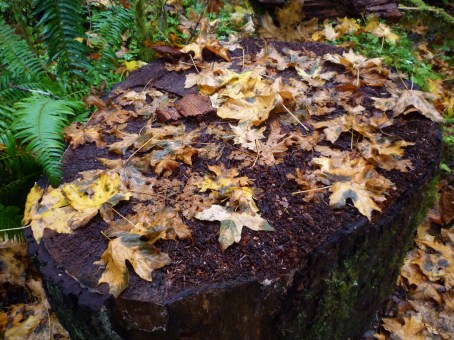
It was in the fall that my late husband and I once visited the Hoh Forest, on the Olympic Peninsula in Washington State. That is where I took this picture, and where I obsessed about how to describe the fragrance that was of the same sort as what von Arnim loves. The climate is very different, between the Hoh and Germany, and no doubt every locale’s casserole of rotting things, combined with the humidity and who knows what else, makes for a sensory experience unique to each place. If a dog or a horse is alongside you or under you, kicking up the stuff, its scent would be included in the recipe. Though I typically have only my two feet to walk with through woodsy places, these thoughts and memories are making me look forward to some autumn outings.

Such absences!

ABSENCES

Rain patters on a sea that tilts and sighs.
Fast-running floors, collapsing into hollows,
Tower suddenly, spray-haired. Contrariwise,
A wave drops like a wall: another follows,
Wilting and scrambling, tirelessly at play
Where there are no ships and no shallows.

Above the sea, the yet more shoreless day,
Riddled by wind, trails lit-up galleries:
They shift to giant ribbing, sift away.

Such attics cleared of me! Such absences!

-Philip Larkin

Andrew Swarbrick of the Philip Larkin Society tells us:

“Larkin claimed a special affection for ‘Absences’, perhaps because he knew that in matter and manner it works in ways which might take his readers, and himself, slightly by surprise: ‘I fancy it sounds like a different, better poet than myself,’ he wrote of it. ‘Absences’ was one of the poems from The Less Deceived that we O level schoolboys of the early 1970s didn’t much bother with; not when there were so many other poems which seeemed to say so much more. Now, the poem’s not-saying, the absorption in emptiness, the thrill of self-forgetting seem more fundamental to Larkin’s imagination as a kind of half-submerged, almost-secret longing.”

Autumn Idleness

I heard this last fall on The Daily Poem podcast and listened again and again…. Unfortunately that reading seems not to be online any longer. Note: The repetition of “lost hours” is not a typo.

It’s a beautiful description of a quiet woodland scene in autumn, contrasted with the poet’s indecision and restlessness. He inserts his own feelings into the drama of sunlight and dead leaves, thirst and rest. While in nature nothing is lost, and renewal always comes, it’s not easy for humans, with our conflicted souls, to receive the blessing.

AUTUMN IDLENESS

This sunlight shames November where he grieves
In dead red leaves, and will not let him shun
The day, though bough with bough be over-run.
But with a blessing every glade receives
High salutation; while from hillock-eaves
The deer gaze calling, dappled white and dun,
As if, foresters of old, the sun
Had marked them with the shade of forest-leaves.

Here dawn to-day unveiled her magic glass;
Here noon now gives the thirst and takes the dew;
Till eve bring rest when other good things pass.
And here the lost hours the lost hours renew
While I lead my shadow o’er the grass,
Nor know, for longing, that which I should do.

-Dante Gabriel Rossetti