 We got a little rain today, but it was pretty much over by early afternoon, and while driving home from an errand I was feasting on the fantastic cloud formations spread all over the sky.
It might have been nice to go to a hilltop to capture them with my camera, but what turned out to be good about staying on the flats, standing in the middle of the street or in the back yard, was that I didn’t have to take all the pictures at once. I shot a dozen, did some laundry and kitchen work, and then it occurred to me that the clouds would have changed, and I could get different views, so I went outdoors again (also noticing flowers).
 Several times I did this and out of the batch I kept a few that are sort of interesting, but really, what is a cloud if you can only experience it out of time, flat and tepid and in the still air of another place not its own?
I took Annie Dillard’s For the Time Being off the shelf so I could look up all the sections labeled “CLOUDS” that are scattered throughout the book. The first one is this:
CLOUDS – We people possess records, like gravestones, of individual clouds and the dates on which they flourished.
In 1824, John Con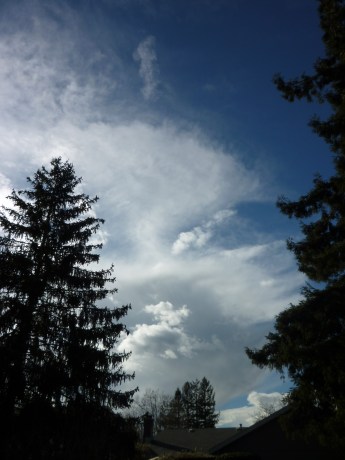 stable took his beloved and tubercular wife, Maria, to Brighton beach. They hoped the sea air would cure her. On June 12 he sketched, in oils, squally clouds over Brighton beach. The gray clouds lowered over the water in failing light. They swirled from a central black snarl.
In 1828, as Maria Constable lay dying in Putney, John Constable went to Brighton to gather some of their children. On May 22 he recorded one oblique bluish cloud riding high and messy over a wan sun. Two thin red clouds streaked below. Below the clouds he painted disconnected people splashed and dotted over an open, wide coast.
Maria Constable died that November. We still have these dated clouds.
I don’t think so. Maria and John were made in the image of God; they were from the beginning, and I believe they remain, more Real than clouds, the paintings of which are paltry substitutes for what the real things so briefly were.
On another page Dillard quotes John Muir, who while exploring the Sierra Nevada in California in 1869 wrote about several cloud formations he saw, and mused,
“What can poor mor tals say about clouds?” While people describe them, they vanish. “Nevertheless, these fleeting sky mountains are as substantial and significant as the more lasting upheavals of granite beneath them. Both alike are built up and die, and in God’s calendar, difference of duration is nothing.”
The poor mortal John Muir certainly did say something about clouds when he made that striking comparison…and some things about God and the nature of earthly and heavenly materials — it’s too crazy much for me to think about at the moment.
But if you like to look at clouds such as Muir would have seen in Yosemite, you can do as I have and visit the Yosemite Conservancy page that features several webcams with frequent gorgeous cloud shows. The Park Service also has these cameras. It’s best to visit when you know a storm is brewing up there, not like today with its view (below) of drifty vapors.

I liked what my godmother said about clouds when I told her about my cloud pictures. She had just read a Lenten meditation by Elder Nektary of Optina, who was speaking of how on the Last Day we will be “carried on the clouds.” We read the same thing in the Bible in I Thessalonians 4:
…For the Lord Himself will descend from heaven with a shout, with the voice of the archangel and with the trumpet of God, and the dead in Christ will rise first. Then we who are alive and remain will be caught up together with them in the clouds to meet the Lord in the air, and so we shall always be with the Lord. Therefore comfort one another with these words.
I will indeed comfort myself with this word from the Father, so that in the future the cloud shows I see will not only be thrilling but remind me that as fleeting as this life may be, at the 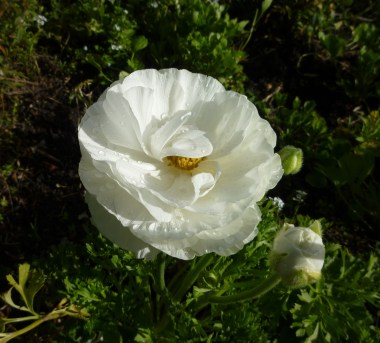 Resurrection of the Dead I will be transported splendidly to my permanent and eternal and most substantial home.
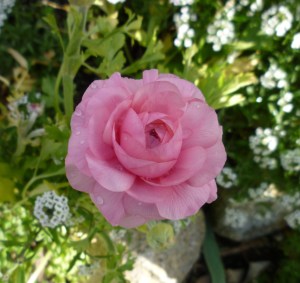
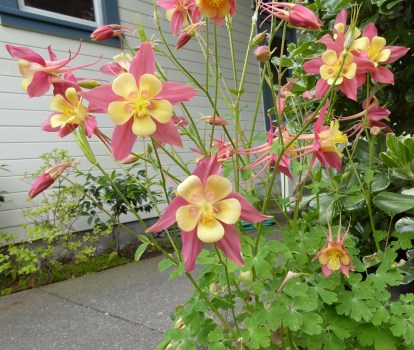
Flowers last a tiny bit longer than clouds (but not nearly as long as granite). This afternoon I “recorded” some of them as well, still sparkling with raindrops.
It turns out that Kim was spending her afternoon in a similar fashion but she was speedier than I at filing her records of blooms and clouds. I hope you all get to enjoy your own living, breathing shows of earth and sky whether or not you try to memorialize them.



 Gladsome Lights