Sally Thomas’s book of poems was published just in time for me to get a copy and read it during Advent. The title is Brief Light: Sonnets and Other Small Poems, and these poems are so illuminating, they fit right in with this season when the Light of the World first shined upon us.
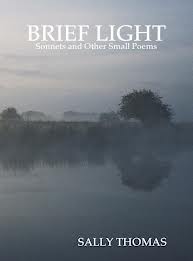 Various sorts of light, or the lack of it, are an important aspect of many of the selections. The title brings to mind wintry light that is brief and thin – and there are several poems for this darker season of the year we have entered, with titles and subjects including Christmas, New Year’s, Advent, frost and snow.
I like the “small poem” aspect of the collection, seeing as I am eternally poetry-challenged and usually put off by the ones with very many stanzas. “Snow Weather” is the shortest in the book, and manages, and partly through its very brevity, to capture a dramatic moment that grabs at my own heart.
Snow Weather
A falcon on a wire
Against the laden sky
Scanned his brown empire
With a black-ice eye.Nothing beneath him stirred
In that sunless instant,
But my heart, for a keen-eyed bird
Blind to me, or indifferent.
The light that Thomas shines on this event reveals something in her own soul, and searches out even the falcon’s impulses.
Birds abound in the poems: a wren in “Tornado Watch,” and the “Mourning Dove” whose being she “felt in the small of my back/The soft clattering updraft of wings.” But the starlings in “Poem in Advent” are the most glorious. This is the first poem I’ve read about the birds that she so aptly describes in couplets beginning with these:
At twilight the poplars, upright and naked,
Wear starlings like restless leaves. Unafflicted
By the cold, they come and go in noisy shifts,
Filling the trees, free-falling into updrafts….
And going on to relate how the starling flock, though “harbinger of every nightfall,” is not only unafflicted by the cold but is a hopeful reminder to us of where we have come from, and “never mournful.”
This reminds me of the prayer read at every Orthodox Vespers, “Thou appointest the darkness and there was the night.” It was after years of hearing this line that it began to sink into my being that God Himself fills the night that He created, and is to us like the black night into which Thomas’s starlings settle. “Darkness, careful, cups them in its hand.”
The subject matter of the collection ranges far and wide and shows how rich a life is lived by this woman interested in everything. Many poems about children and family, her motherly concerns — and marriage, and depression, boats, a snake, depression. But all with a ray of light revealing the transcendent quality of our existence, the interconnectedness of everything.
This is the first time I’ve been so bold as to review a book of poetry, and I don’t know that I’ve read many such reviews, either. I don’t know where to stop, when most of the poems are a pleasure from the first reading and also promise a greater reward if I will spend more time with them.
But let me mention another one or two: “Introvert” is chilling in its description of forced narcissus, “all sweetness, winter-white” alongside a man’s desire to break into his woman’s inwardness, even to “prise her open, bone from hinging bone….” And “Lamplight” is a favorite of mine so far, in which the poet shares the simple event and startling perspective of looking in instead of out at her bedroom window one night, where
…the room shone privately
As with a happiness, a mystery to me.
I stood outside and wondered at that glow.
There is plenty of wisdom shining from the poems in Brief Light, gifts that will go on giving. I am soaking up the glow.