Category Archives: poetry

Never look straight up at the sun.

I traveled north several hours to my daughter’s for Thanksgiving last week, and home again three days later. Through rural areas mostly, my favorite views were of the forests and orchards, oaks and maples and almonds, many of the trees with their leaves glowing yellow and red as the light caught them just right, against a dark green conifer background. The sun was, as this poem says, the artist.

THE SUN

All colors come from the sun. And it does not have
Any particular color, for it contains them all.
And the whole Earth is like a poem
While the sun above represents the artist.

Whoever wants to paint the variegated world
Let him never look straight up at the sun
Or he will lose the memory of things he has seen.
Only burning tears will stay in his eyes.

Let him kneel down, lower his face to the grass,
And look at the light reflected by the ground.
There he will find everything we have lost:
The stars and the roses, the dusks and the dawns.

Warsaw, 1943

―Czesław Miłosz
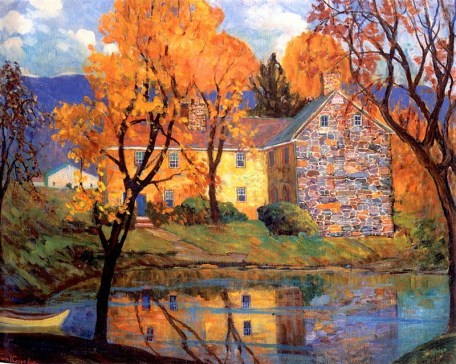
Fern Coppedge, Autumn


Everything falls back to coldness.

THE READER

All night I sat reading a book,
Sat reading as if in a book
Of sombre pages.

It was autumn and falling stars
Covered the shrivelled forms
Crouched in the moonlight.

No lamp was burning as I read,
A voice was mumbling, “Everything
Falls back to coldness,

Even the musky muscadines,
The melons, the vermilion pears
Of the leafless garden.”

The sombre pages bore no print
Except the trace of burning stars
In the frosty heaven.

-Wallace Stevens


In each minim mote.

OPENING WORDS

I believe the earth
exists, and
in each minim mote
of its dust the holy
glow of thy candle.
Thou
unknown I know,
thou spirit,
giver,
lover of making, of the
wrought letter,
wrought flower,
iron, deed, dream.
Dust of the earth,
help thou my
unbelief. Drift
gray become gold, in the beam of
vision. I believe with
doubt. I doubt and
interrupt my doubt with belief. Be,
beloved, threatened world.
Each minim
mote.
Not the poisonous
luminescence forced
out of its privacy,
The sacred lock of its cell
broken. No,
the ordinary glow
of common dust in ancient sunlight.
Be, that I may believe. Amen.

-Denise Levertov

Our silence tries but fails.

On Remembrance Day in Britain, many people join in two minutes of silence to memorialize the dead. When Malcolm Guite did that, it prompted this response:

“There was something extraordinarily powerful about that deep silence from a ‘live’ radio, a sense that, alone in my kitchen, I was sharing the silence with millions. I stood for the two minutes, and then, suddenly, swiftly, almost involuntarily, wrote this sonnet.” 

SILENCE

November pierces with its bleak remembrance
Of all the bitterness and waste of war.
Our silence tries but fails to make a semblance
Of that lost peace they thought worth fighting for.
Our silence seethes instead with wraiths and whispers,
And all the restless rumour of new wars,
The shells are falling all around our vespers,
No moment is unscarred, there is no pause,
In every instant bloodied innocence
Falls to the weary earth, and whilst we stand
Quiescence ends again in acquiescence,
And Abel’s blood still cries in every land.
One silence only might redeem that blood —
Only the silence of a dying God.

-Malcolm Guite

Please hear Fr. Guite read his sonnet here: “Silence”

Silent Cross, by Margot Krebs Neale