Tag Archives: war

All the men die unjustly.

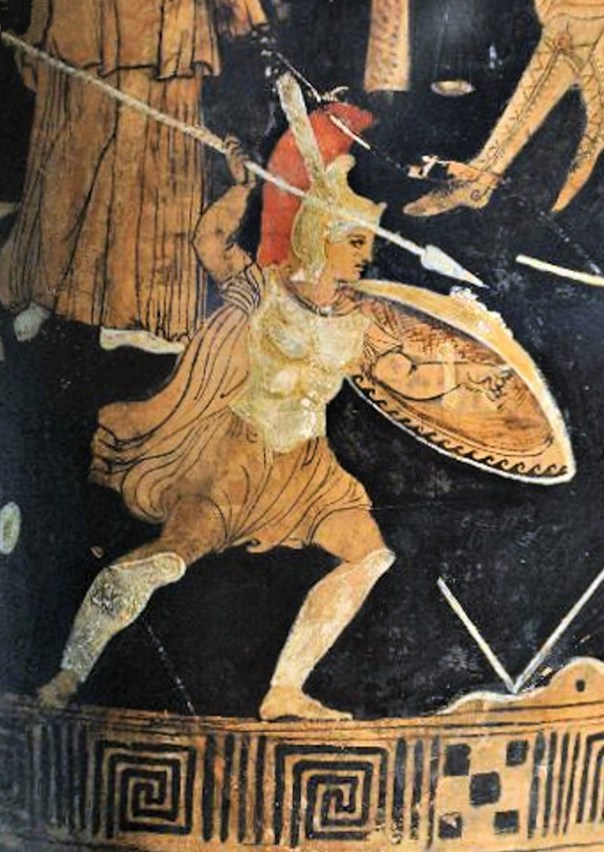
“The Iliad has no “truth” in it, no facts not clothed in a mystical and sacramental glory. Rather, it is theophany in dark relief. The hearer of the Iliad becomes Panaghia [Mary] at the foot of the cross, gazing upon Christ’s unjust crucifixion. For the fact is that all the men in the Iliad die unjustly, Simone Weil tells us, in the sense that they are all trapped within the same world of blind might where they must kill or be killed. And the poetry, the language, and the spirituality of the Iliad are all superb.”

-Timothy Patitsas

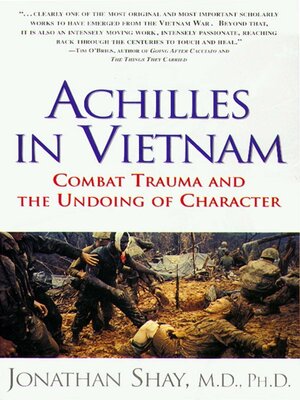
Jonathan Shay

Reading The Iliad requires of me a certain focus of mind that I don’t always have, which is why it’s taking a while. I listen to the audio version of the Fagles translation, and I have the same in the print edition, which I like better. I am listening to Elizabeth Vandiver’s Teaching Company series of lectures, and I read Rosemary Sutcliff’s retelling for children, Black Ships Before Troy.

But the first impetus for this recent interest probably came from Timothy Patitsas, by way of his book The Ethics of Beauty, which in turn was prompted by his reading of Jonathan Shay’s Achilles in Vietnam. On the occasion of Veterans Day, Patitsas has shared on his Substack site an excerpt from the introduction to his own book, which relates how a study of Homer is meaningful for soldiers in this modern era. Another excerpt from his post:

“That act of listening to the recitation of the Iliad from someone who knew it by heart over days or weeks worked because it took place in a communal setting among other veterans and it showed a kind of universal compassion to all the soldiers equally. Since in the Iliad there are no good guys or bad guys, its performance helps you to renounce resentment and villainization….  the wind of hate (the spiritual shock of realizing that another human being hates you enough to want to kill you) is itself the villain. It is a force and everyone is the victim of the empire of naked force.”

You can read the whole Substack piece here: “How The Iliad Heals”

Musings on war and death.

AN IRISH AIRMAN FORESEES HIS DEATH

I know that I shall meet my fate
Somewhere among the clouds above;
Those that I fight I do not hate,
Those that I guard I do not love;
My country is Kiltartan Cross,
My countrymen Kiltartan’s poor,
No likely end could bring them loss
Or leave them happier than before.
Nor law, nor duty bade me fight,
Nor public men, nor cheering crowds,
A lonely impulse of delight
Drove to this tumult in the clouds;
I balanced all, brought all to mind,
The years to come seemed waste of breath,
A waste of breath the years behind
In balance with this life, this death.

-W.B. Yeats

Kiltartan Castle


He is nothing but war.

Alongside my reading of The Iliad itself, I have collected a few books from the library that are commentary or retellings. When I think about how many people have translated, interpreted and commented on Homer over the centuries, I realize I can only hope to scratch the surface layer of their insights, and of the poem — or poems, if I go ahead and read The Odyssey as well.

I am really enjoying The Iliad, but at this point in my life I don’t expect to gain enough knowledge to put together a whole essay. I will, however, feel free to share little bits related to that epic that are interesting to me. One of these is from a “Bloom’s Guide,” in which the literary critic Harold Bloom gives an introduction, and assembles a few articles by various other scholars. Bloom is known for his bold statements about culture and literature, and I appreciate that style, which is often refreshingly clarifying. This is an excerpt from the introduction to his guide to The Iliad:

“The heroes of the Hebrew Bible — Abraham, Jacob, Joseph, David — have no affinities whatsoever with Achilles. Even David, the only professional warrior among them, carries on their blessing from Yahweh and so is in a position beyond tragedy, despite his many griefs that terminate in the death of his beloved son, Absalom. You can make a covenant with Yahweh and then trust in the covenant, but no one can trust Zeus. Achilles is half a god, and he says that ‘who trusts himself to the gods will gain their hearing,’ but he knows that the response to such a hearing is likely to be equivocal, and they cannot free him from war, since despite his disillusion he is war and nothing but war. The poetic strength of Achilles is that he is a man. No other purely literary figure is nearly as heroic, or is aesthetically satisfying to us, but Achilles’ otherness, in relation to us, is now his dominant characteristic.”

-Harold Bloom

Whispered to a child.

This poem reminds me of “Life is Beautiful,” the Italian movie by Roberto Benigni, released in 1997. Do you remember it? I thought it was very good, but some people who watched with me did not like the way the father in the movie dealt with his truly heartrending dilemma.

WORDS WHISPERED TO A CHILD UNDER SIEGE

No, we are not going to die.
The sounds you hear
knocking the windows and chipping the paint
from the ceiling, that is a game
the world is playing.
Our task is to crouch in the dark as long as we can
and count the beats of our own hearts.
Good. Like that. Lay your hand
on my heart and I’ll lay mine on yours.
Which one of us wins
is the one who loves the game the most
while it lasts.
Yes, it is going to last.
You can use your ear instead of your hand.
Here, on my heart.
Why is it beating faster? For you. That’s all.
I always wanted you to be born
and so did the world.
No, those aren’t a stranger’s bootsteps in the house.
Yes, I’m here. We’re safe.
Remember chess? Remember
hide-and-seek?
The song your mother sang? Let’s sing that one.
She’s still with us, yes. But you have to sing
without making a sound. She’d like that.
No, those aren’t bootsteps.
Sing. Sing louder.
Those aren’t bootsteps.
Let me show you how I cried when you were born.
Those aren’t bootsteps.
Those aren’t sirens.
Those aren’t flames.
Close your eyes. Like chess. Like hide-and-seek.
When the game is done you get another life.

-Joseph Fasano

From the movie “Life is Beautiful.”