Alongside my reading of The Iliad itself, I have collected a few books from the library that are commentary or retellings. When I think about how many people have translated, interpreted and commented on Homer over the centuries, I realize I can only hope to scratch the surface layer of their insights, and of the poem — or poems, if I go ahead and read The Odyssey as well.
I am really enjoying The Iliad, but at this point in my life I don’t expect to gain enough knowledge to put together a whole essay. I will, however, feel free to share little bits related to that epic that are interesting to me. One of these is from a “Bloom’s Guide,” in which the literary critic Harold Bloom gives an introduction, and assembles a few articles by various other scholars. Bloom is known for his bold statements about culture and literature, and I appreciate that style, which is often refreshingly clarifying. This is an excerpt from the introduction to his guide to The Iliad:
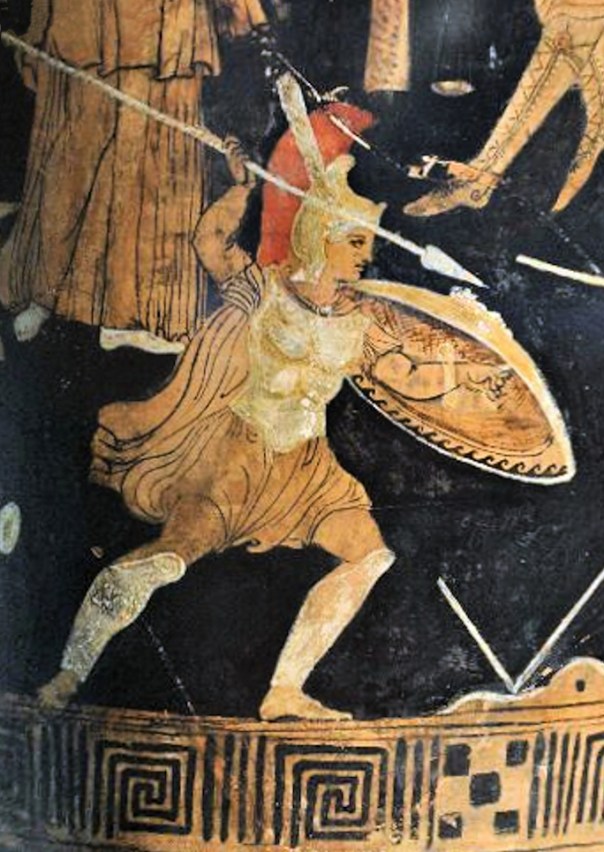 “The heroes of the Hebrew Bible — Abraham, Jacob, Joseph, David — have no affinities whatsoever with Achilles. Even David, the only professional warrior among them, carries on their blessing from Yahweh and so is in a position beyond tragedy, despite his many griefs that terminate in the death of his beloved son, Absalom. You can make a covenant with Yahweh and then trust in the covenant, but no one can trust Zeus. Achilles is half a god, and he says that ‘who trusts himself to the gods will gain their hearing,’ but he knows that the response to such a hearing is likely to be equivocal, and they cannot free him from war, since despite his disillusion he is war and nothing but war. The poetic strength of Achilles is that he is a man. No other purely literary figure is nearly as heroic, or is aesthetically satisfying to us, but Achilles’ otherness, in relation to us, is now his dominant characteristic.”
-Harold Bloom
 “What do I need? I need nothing on earth, except for the indispensable. What do I need? I need the Lord, I need His grace, His kingdom within me. On earth, the place of my pilgrimage, my temporary instruction, I have nothing belonging to me: everything is God’s, everything is transitory, indicated for temporary use. Whatever I have in excess belongs not to me, but to my poorer brothers.