Category Archives: poetry

Mael Mhedha of the dark brows.

Just now I read a newsletter from a Touchstone Magazine editor, on the subject of marriage. He included this quite old poem which conveys the feelings that a person might have, after the death of one’s spouse. Having lived that way of existence, the state of being one flesh with one’s spouse, as the Bible describes it, and then losing it… The poet graphically describes, in the most evocative metaphors, what the loss means, from his crown to his feet. He’s lost his grip on his own body.

ELEGY ON MAEL MHEDHA, HIS WIFE

My soul parted from me last night.
In the grave, a pure dear body.
A kind, refined soul was taken
from me, a linen shroud about her….

Mael Mhedha of the dark brows,
my cask of mead at my side;
my heart, my shadow split from me,
flowers’ crown, planted, now bowed down.

My body’s gone from my grip
and has fallen to her share,
my body’s splintered in two,
since she’s gone, soft, fine and fair.

One of my feet she was, one side—
like the whitethorn was her face—
our goods were never ‘hers’ and ‘mine’—
one of my hands, one of my eyes.

Half my body, that young candle—
it’s harsh, what I’ve been dealt, Lord.
I’m weary speaking of it:
she was half my very soul.

My first love, her great soft eye,
ivory-white and curved her breast,
neither her fair flesh nor her side
lay near another man but me.

We were twenty years together.
Our speech grew sweeter each year.
She bore me eleven children,
the tall young long-fingered tree.

Though I am, I do not thrive
since my proud hazel-nut fell,
Since my great love parted from me,
the dark world’s empty and bare.

Dear the soft hand which was here,
King of the churches and bells.
Och! that hand never swore false oath.
Sore, that it’s not under my head.

—Muireadhach Albanach O Dalaigh, c. 1224
Translated from Gaelic in The Triumph Tree 
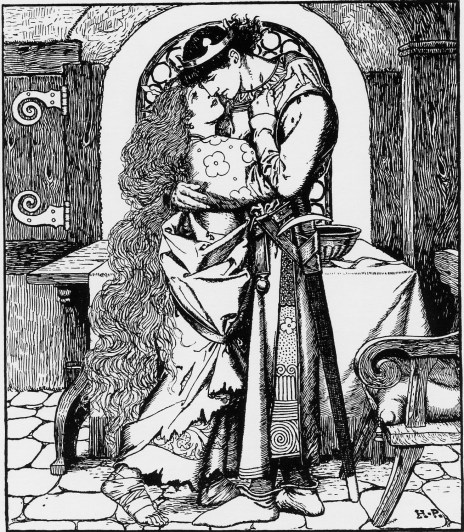
Howard Pyle, The Wonder Clock

The Plain Sense of Things

THE PLAIN SENSE OF THINGS

After the leaves have fallen, we return
To a plain sense of things. It is as if
We had come to an end of the imagination,
Inanimate in an inert savoir.

It is difficult even to choose the adjective
For this blank cold, this sadness without cause.
The great structure has become a minor house.
No turban walks across the lessened floors.

The greenhouse never so badly needed paint.
The chimney is fifty years old and slants to one side.
A fantastic effort has failed, a repetition
In a repetitiousness of men and flies.

Yet the absence of the imagination had
Itself to be imagined. The great pond,
The plain sense of it, without reflections, leaves,
Mud, water like dirty glass, expressing silence

Of a sort, silence of a rat come out to see,
The great pond and its waste of the lilies, all this
Had to be imagined as an inevitable knowledge,
Required, as a necessity requires.

-Wallace Stevens

By Oksana Berda

The Voice of the Rain

THE VOICE OF THE RAIN

And who art thou? said I to the soft-falling shower,
Which, strange to tell, gave me an answer, as here translated:
I am the Poem of Earth, said the voice of the rain,
Eternal I rise impalpable out of the land and the bottomless sea,
Upward to heaven, whence, vaguely form’d, altogether changed,
….and yet the same,
I descend to lave the drouths, atomies*, dust-layers of the globe,
And all that in them without me were seeds only, latent, unborn;
And forever, by day and night, I give back life to my own origin,
….and make pure and beautify it;
(For song, issuing from its birth-place, after fulfilment, wandering,
Reck’d or unreck’d, duly with love returns.)

-Walt Whitman

A fateful winter morning.

I GO BACK TO THE HOUSE FOR A BOOK

I turn around on the gravel
and go back to the house for a book,
something to read at the doctor’s office,
and while I am inside, running the finger
of inquisition along a shelf,
another me that did not bother
to go back to the house for a book
heads out on his own,
rolls down the driveway,
and swings left toward town,
a ghost in his ghost car,
another knot in the string of time,
a good three minutes ahead of me—
a spacing that will now continue
for the rest of my life.
Sometimes I think I see him
a few people in front of me on a line
or getting up from a table
to leave the restaurant just before I do,
slipping into his coat on the way out the door.
But there is no catching him,
no way to slow him down
and put us back in sync,
unless one day he decides to go back
to the house for something,
but I cannot imagine
for the life of me what that might be.
He is out there always before me,
blazing my trail, invisible scout,
hound that pulls me along,
shade I am doomed to follow,
my perfect double,
only bumped an inch into the future,
and not nearly as well-versed as I
in the love poems of Ovid—
I who went back to the house
that fateful winter morning and got the book.

by Billy Collins

Winter Road by Barbel Smith