Category Archives: quotes

The beginning of a true newness

I am somewhat apologetically writing already another post on The Hidden Art of Homemaking, because it is the philosophy and theology, the heavenly underpinnings perhaps, that inspire me and give me the energy to carry out the practical details. From looking at the chapter titles it seems that this introductory chapter might be the one about which I have the most musings.

As to the oddness of me taking my inspiration from yet another man, when it is we women who traditionally do the homemaking and who are discussing a woman‘s book, I will just say that, Christ who enables us also was a man, and the Life of The Holy Trinity is something greater than our gender roles. The reality of the Holy Spirit operating in the world through us is our means of living out our humanity. Homemaking is one of the many facets of our calling and our life in God, and this particular pastor always encourages me in the fact of “Christ in you, the hope of glory.”

The passages from Metropolitan Anthony are from a talk on Genesis given in June, 1986, from the book Metropolitan Anthony of Sourozh: Essential Writings by Gillian Crow.

Creativeness, however, is something more complex than the ability to call out new forms, to shape one’s surroundings or even to determine to a certain extent…our destiny. It begins with the ability to change — to change intentionally. Creativeness begins with the ability a being has…to become what he is not yet, to start at the point at which he was created and then grow into a fullness that he did not possess before: from image to likeness, if you will — having begun to be, as it were, a reflection, to become the reality itself; having begun to be in the image of the invisible Creator, to become the image of God incarnate.

…And this process is a creative process. It is not an organic one; it is not something that must develop inevitably; it is something that we must choose and that we must achieve with the grace of God.

Amy mentioned the possibility that we might, contrary to our calling, create ugly or bad things, and even sometimes express not craftsmanship but craftiness. Other and various sinful impulses can also rob us of our creative strength. On the other hand, many times just creating something can give us a boost in the right direction. For example, I am learning not to be discouraged by the disorder of my messy house. Instead I can take joy from the chance to create order and space to replace — or at least reduce! — the chaos that so easily develops. But creating order out of chaos is huge. That seems like a good description of one aspect of the creative work God is always doing in our lives.

Met. Anthony says that the creative work he is primarily talking about is not the art and music and literature that we tend to think of right away,

…both of heart and intelligence, of skill and of hand, but is much more essential and also much more important because all the rest can flow from this basic source of creativeness but cannot derive from anything else.

So that here we are confronted with man, whom God has called and loved into existence, endowed with His image, launched into life, and when on the seventh day the Lord rested from his works, the seventh day will be seen as all the span of time that extends from the last act of creation on the part of God to the last day, the eighth day, the coming of the Lord, when all things will be fulfilled, all things will come to an end, reach their goal, and blossom out in glory. It is within this seventh day, which is the whole span of history, that the creativeness of man is to find its scope and its place.

And this is a wonderful call to us because each of us can be a creator within his own realm, within his mind and his soul, by making them pure and transparent to God, within his actions and life, and become what Christ said we are called to be: a light to the world, a light that dispels darkness, a light that, as in the beginning of creation is the beginning of a new day — that is, the beginning of a true newness and a new unfolding of the potentialities that are within us and around us.
(Cindy was hosting a discussion of Edith Schaeffer’s The Hidden Art of Homemaking, and this post was written as a contribution.)

I can be a jovial sweeper.

For the sake of discussion of the late Edith Schaeffer’s The Hidden Art of Homemaking, which Cindy is hosting at Ordo Amoris, I am re-posting a book review I wrote last year. Paul Johnson mentions the foundation for our creativity as Schaeffer does in her first chapter on The Artist: it is God Himself from whom our creativity derives.

This topic is dear to my heart and one I’ve mulled over year after year, so I’d like to contribute to the discussion even though I am at a very busy time of the year, as you can see on my sidebar. It’s a time of being creative in other ways than writing.

So I’ll start by using this old material, and note that Johnson, though not a homemaker or writing about homemaking, still manages to convey the wide range of activities by which we can express and demonstrate the fact of our being made in God’s image. The last paragraph I quote can easily be applied to our housekeeping duties!

More recently I have been reading transcribed lectures of Metropolitan Anthony Bloom in England, in which he touches on the subject of the creative process in and through us, and I hope to pass on some of his thought-provoking words soon.

Creating Jokes and Clean Streets


I picked up Paul’s Johnson’s book Creators the other day and am enjoying it three years after my first encounter. This is from the opening page:

Creativity, I believe, is inherent in all of us. We are the progeny of almighty God…. He created the universe, and those who inhabit it; and, in creating us, he made us in his own image, so that his personality and capacities, however feebly, are reflected in our minds, bodies, and immortal spirits. So we are, by our nature, creators as well. All of us can, and most of us do, create in one way or another. We are undoubtedly at our happiest when creating, however humbly and inconspicuously. 

Johnson mentions some of the many creations humans produce, such as written works, farms, and businesses. Some of these wonderful works are not lasting, though they are valuable for as short as a season or as long as centuries.

Some forms of creativity, no less important, are immaterial as well as transient. One of the most important is to make people laugh. We live in a vale of tears, which begins with the crying of a babe and does not become any less doleful as we age. Humor, which lifts our spirits for a spell, is one of the most valuable of human solaces, and the gift of inciting it rare and inestimable. Whoever makes a new joke, which circulates, translates, globalizes itself, and lives on through generations, perhaps millennia, is a creative genius, and a benefactor of humankind almost without compare.

I transcribed the above about jokes because that form of creativity is worlds removed from anything I can imagine drumming up. I am fascinated by the art of making or even telling jokes; the chapter in Annie Dillard’s An American Childhood in which she relates how her parents worked their art of joke-telling describes an exotic land to which I could never go.

I’m more familiar — quite familiar — with the type of art Johnson also appreciates in this account:

I sometimes talk to a jovial sweeper, who does my street, and who comes from Isfahan, in Persia, wherein lies the grandest and most beautiful square in the world, the work of many architects and craftsmen over centuries, but chiefly of the sixteenth. I asked him if he felt himself creative, and he said, “Oh, yes. Each day they give me a dirty street, and I make it into a clean one, thanks be to God.”

St. George

From Everywhere Present by Fr. Stephen Freeman:

“The body of Christ is one Body. There is only One Church — not divided between those who have fallen asleep in Christ and those who remain behind. Whether we are here or in the hand of God, the struggle is the struggle of the whole Church. My success or failure in my spiritual life is not my private business, but the concern of a great cloud of witnesses. Neither are they watching only as disinterested bystanders. They urge us on and support us with their prayers. Were they to watch us without participating at the same time in our struggles, the watching would be like torture. As it is, their watching is prayer and participation of the deepest sort.

“It is for this reason (among many) that many services in the Eastern Church contain the phrase, ‘Lord Jesus Christ, through the prayers of our holy fathers, have mercy on us and save us.’ It is a humility of sorts, a demurring to the prayers of greater Christians — but it is also calling on a reality that abides. We are not alone. The great cloud of witnesses stands with me and in me in prayer.

“Every prayer we ourselves offer is a participation in the life of the world. We have a participation in the great cloud of witnesses, but we also have a participation in everyone who is. The prayer of a righteous few has an amazing salvific impact on the life of the world. If they’d had but a few more righteous men, Sodom and Gomorrah would still be standing. To this day we do not know how many or how few, in their righteous prayers, preserve us before God”.

Today, April 23, we remember Holy Greatmartyr, Victorybearer and Wonderworker George, and ask him to also remember us to God.

Some things about the Day and the Earth

In truth, I have never paid much attention to what is called Earth Day. But as someone just pointed out to me, every day is God’s day. That made me think of how “The earth is the Lord’s, and the fullness thereof.” And how He created the earth, to be a home for us people who are made in His image. He is so good to us. And in the beginning he looked over everything that He had made and called it Good.

Yes, we selfish people have done a lot to wreck things. We do damage even when we try to fix the situation, because our motives are not often pure and we are filled with pride that makes us stumble. It’s a very complicated and complex earth and task, too, like a lot of situations we or other people create. More often than not, tricky to repair. And is it possible to really love the earth if you despise its Creator? I could get more excited about Creation Day.

“This is the day that the Lord has made. Let us rejoice and be glad in it.” It was a good day for that here, and I thought about Earth Day more than usual because I walked around outside taking pictures of some things sprouting out of the ground, the earth. Dirt Day would get me excited, too, I bet.

This is our lonely — so far — foxglove. Notice how foxglove has love in it? They are the loveliest, I think. In many places in Northern California they self-sow, but not here. I planted three last fall, and snails ate at least one of the buds.

I neglected the foxgloves for weeks and when I finally noticed the flower stem it was curving around on the ground. I rescued it and propped it on the fence. Many people who keep Earth Day are trying to rescue the beautiful things God made.

We and the neighbor rescued the fence that divides our yards last week. I had to detach the Cécile Brunner rose from that fence and tie half of it to another fence temporarily. I think it will be o.k. Today I took this picture of one of the roses.

The first California Poppies of the season have come out! They are our state flower, blooming from perennial roots next to a salvia, across the sidewalk from the lavender pincushion flowers.

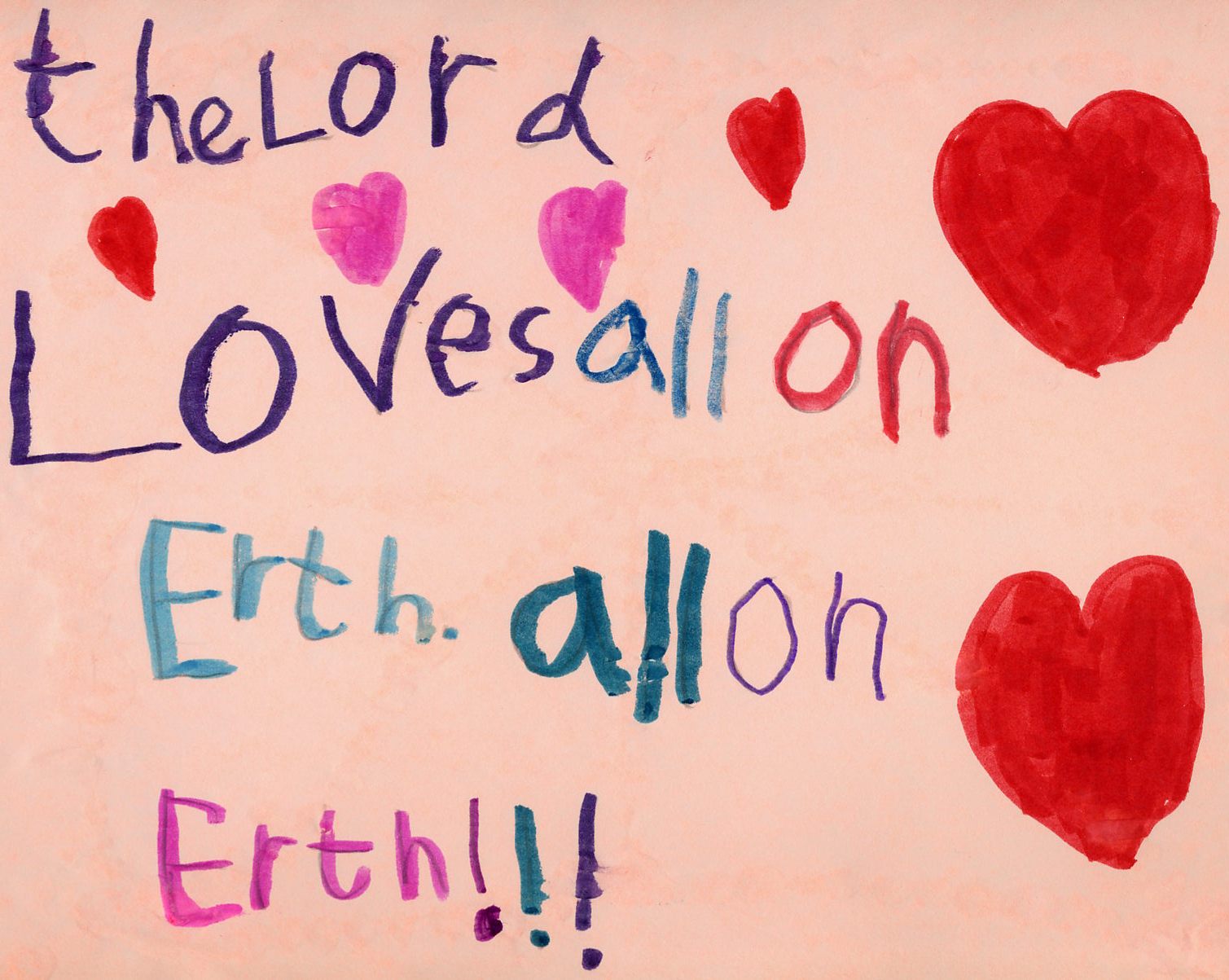
When I thought about Earth Day, now when it is already tomorrow for most of you, I also remembered this announcement (below) that Kate penned in her childhood. And it’s the most important thing I know on this subject. I hope you had a good (Earth) Day. It was a gift from the Creator.