Category Archives: quotes

Theophany

It’s the Feast of Theophany. Special services for the commemoration of the Baptism of Christ began yesterday and culminate tomorrow. I was so happy to be able to have a fairly contemplative day, morning and evening.

In the middle of the day we celebrated at church with a Vesperal Liturgy, after which nuns from a nearby monastery (a different monastery from the one where I got the big squash) brought food for us who had been fasting: warming vegetable soup, salad with lots of trimmings, bread and spreads, and even halvah for dessert.

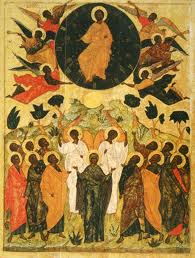
Last year I wrote a bit more about Theophany. This year I don’t have anything new to say about the feast; I am trying to just soak it up and be changed by it, though I feel too dull to follow Father Stephen very far on the topic. I do want to share an icon I found on http://www.icon-art.info where I spent a while browsing. This mosaic is from 11th-century Greece.

Here’s a teaser clip from Fr. Stephen’s post that I linked to above:

     The world and all that is in it is given to us as icon – not because it has no value in itself – but because the value it has in itself is the gift of God – and this is seen in its iconicity.

At Theophany, the waters of the world are revealed to be both Hades and the gate of Paradise…. Love alone reveals things for what they are, and transforms them into what they were always intended to be. It is the gift of God.


Feasting in Time and Timelessness

Seeing as how I was determined to bask restfully in the light of Christmas for another week or so, attending the local monastery for a midweek communion service seemed the perfect sort of activity. The Body and Blood of the Savior is the best food, one of the limitless Holy Mysteries God has given for our life and salvation.

At the monastery they are on the Old Calendar, so the Nativity Feast is still more than a week in the future. But our parish church, to which they are attached, is New Calendar, and we are all used to the differing dates for these feasts and commemorations. The nuns are happy to greet us general parish folk with “Christ is born!” even though they are waiting a bit longer to say it among themselves. And we are happy to step back thirteen days and be with them in the Lord who is timeless.

My godmother sent me an online Advent calendar, which I opened on December 24th or so. She said the Nativity is timeless. And I got that feeling during my visit among the mixed calendarists. As Father Stephen says here, “He is the Feast of Feasts,” and the substance of our faith, no matter what age we live in. I’m glad I happened to see Fr. Stephen’s blog before publishing my little report on the monastery visit, because he says so many things clearly that I barely grasp with my mind, but am experiencing in the Church.

Like this:

To speak of ourselves as living “in-between” [the Resurrection and the Second Coming] is to place history in the primary position, relegating the Kingdom of God to a lower status. It is the essence of secularism. The Kingdom of God is not denied – it is simply placed beyond our reach (as we are placed beyond its reach). The Kingdom, like God Himself, is reduced to an idea.

Living “in-between” is part of the loneliness and alienation of the modern Christian. Things are merely things, time is inexorable and impenetrable. There is an anxiety that accompanies all of this that is marked by doubt, argument and opinion. Faith is directed towards things past or things that have not yet happened.

….

In earlier postings on faith, I have noted that faith is more than an intellectual or volitional exercise. It is an actual participation (koinonia) with the object (or subject) of faith.

In the Eucharist we all were partaking of Him Who is our Faith, and were experiencing in Him the Nativity, the Cross, the Resurrection, the Second Coming — our whole salvation history — even as we know that at the level of earthly time, the Second Coming is still ahead. That is definitely a Mystery.

After the service many of us pilgrims stayed for a lenten lunch. I remarked about some bright orange squash on the sideboard and the nuns told me how it volunteered itself in service to them last summer. Ordinarily they like to have a big garden, but not many young women live there and it is increasingly hard for the community to do the physical work; this year they didn’t get much planted, though they have plenty of space.

Behold, a squash plant sprouted and spread its vines vast and wide, bearing several giant fruits, which we agreed look like a cross between a Hubbard and a Butternut. For the meal they cooked part of one, and then split another open to send pieces home with several of us. I started this blog post mostly to tell about the amazing squash, but I got carried away as is common.

Last week Kate made a wonderful Curried Butternut Squash Bisque the day after she flew in for the holidays. I might cook it again with this blessed squash — it was very tasty served plain — and if I do, I’ll post the recipe.

Christ is born!

Demigods and Monsters

Hermes was really the one who thought of the Internet. I just learned that fact, which should have been a no-brainer, from the book I’m reading, one of a series that Philosopher grandson recommended to me. He finished all five books before he even told me about this new interest, and that he’d moved on from The Magic Tree House and The Cats (Warriors), so I have to get busy and read at least one book or he’ll be on to something else and I’ll be left too far behind to have good talks about the story.

The series is Percy Jackson and the Olympians. The only one on the shelf at my local library was The Sea of Monsters, so I took it home and found that it has been read enough times that it will stay propped open on the bookledge that my treadmill at the gym provides. Three times I’ve been so engrossed that 45 minutes passed almost painlessly.

Rick Riordan wrote these stories, which are a marvel of creativity and imagination. In the world he has created, Greek gods still live and procreate with humans, “siring” a slew of Half-Bloods who face numerous challenges of two kinds. They have to navigate everyday life in middle school while keeping their ancestry secret, even though their senses clue them in to the real identities and purposes of some of their classmates. The bullies from out of town who cause a brawl in the gym, for example: most people don’t realize that they were actually Laistrygonian giants bent on destroying our hero, a son of Poseidon.

The second type of challenge is fighting the wars and solving the problems that are caused by their parents’ shenanigans. It’s good that the special kids have a camp just for their kind, where everyone understands the true reality of things and they can learn what they need to know about the players in this game they didn’t ask to join. But the campers and directors are as prone to bicker and fight as those in the more traditional tales we might be familiar with.

Or we might not be familiar with them. No doubt very few middle-schoolers these days have parents who know the Greek myths well enough to teach this part of the canon of Western Civilization, if they had time for that sort of thing. I can say this with confidence because even I, a homeschooling mother with great motivation to teach the classics, had to let some things slip through the cracks, and mostly for reasons beyond my control.

Speaking of control, one of the hard parts of being a child is that so many of the things that make you suffer are not in your power to change. How many children have absentee fathers, or parents who generally don’t take responsibility for their actions and leave the children feeling abandoned? Such children could relate to our tribe of half-bloods, many of whom also suffer from dyslexia, by the way. This fact I suspect was thrown into the story to encourage readers who are victims of whatever complex of modern phenomena causes that difficulty. But then I wonder, would dyslexics read books like this for fun? Maybe the author just wants to teach us not to dismiss those who are challenged by traditional school.

I can think of quite a few popular books with similar themes of children solving mysteries or just getting along when parents and sometimes all adults are absent. The Boxcar Children is the most elementary in every way, one of the first “chapter books” that my children read, about young children who manage to take care of each other and feed themselves, living in a boxcar.

The Railway Children is more advanced, and though its protagonists don’t find themselves with both parents literally absent, wartime circumstances force them to be on their own most of the time and even help solve their parents’ problems. Harry Potter doesn’t have parents who can help him navigate the magical world he has been born into.

Barely halfway through Sea of Monsters I was prodded to start looking further into stories of the Olympians, as the characters are packed into the book pretty cleverly in their modern forms. The Grey Sisters drive Percy wildly through the streets of New York City while fighting over who gets their one eye, which falls on the floor. Percy has befriended the school “weird guy” who turns out to be an infant Cyclops and very endearing–so far.

Old-style Hermes

Hermes gets several pages’ worth of contemporary fleshing-out. When Percy is sitting on the beach and lamenting his latest predicament, Hermes approaches as a jogger saying, “I haven’t sat down in ages.” His cell phone is constantly ringing, with urgent calls about many things, and as Percy listens he realizes who the jogger is. His phone antenna is actually his caduceus staff in a shrunken form, with the snakes as small as worms. They chatter incessantly, like a duo of phone operators, until Hermes threatens to put them on vibrate.

When a satyr who is a captive of the Cyclops Polyphemus sends a dream to Percy, we see the monster’s cave with its sheep-themed decor, including a sheepskin-covered recliner and sheep action figures added to the piles of sheep bones one might expect. And on another battlefront, when slime from an exploded hydra sprays on her, the heroine is put off her game long enough to cry, “Gross!”, reminding us that she is only a 7th-grader after all.

These just-for-fun elements are easier to tell about than the interrelated analogies and symbols I find on every page, threatening to make me sprout philosophical blog posts like so many hydra heads. If I read more in this series will I be able to resist?

I can’t resist telling you that it is the fault of multiplying monster “life force” that franchise stores proliferate. For the purpose of trapping our heroes, a Monster Donut shop has appeared in the middle of a marshy woods. The heroine warns Percy as she asks if he hasn’t wondered himself at the phenomenon: “One day there’s nothing and then the next day — boom, there’s a new burger place or a coffee shop or whatever? First a single store, then two, then four — exact replicas spreading across the country?”

My ideas sprouting

It’s becoming clear that Mount Olympus stands for Western Civilization. And in the case of these half-bloods, it’s their family heritage. One argues: “Thalia got angry with her dad sometimes. So do you. Would you turn against Olympus because of that?”

Last spring Philosopher was dreading an Easter vacation trip to the Bahamas, because the planned route had the family flying through the Bermuda Triangle. I wondered at the time how he even knew about this area that is the subject of dispute as to whether mysterious things really do happen more often there. But now  I have read in Sea of Monsters this explanation: “Look, Percy, the Sea of Monsters is the sea all heroes sail through on their adventures. It used to be in the Mediterranean, yes. But like everything else, it shifts location as the West’s center of power shifts.” It is now The Bermuda Triangle.

There we have a hint as to the popularity of this type of story in its many re-tellings. Adolescence is a sea of adventures, for sure. Reading books like these might help kids keep their boats afloat, by means of encouragement or just diversion, getting away from the daily strain of here-and-now. Philosopher is fast approaching the shore of this swirling ocean, and I thank the gods God he has two responsible parents who in no way have abandoned him. As for the Bermuda Triangle, it was during that portion of the flight that he was delivered from trouble by a magical sleep.