Category Archives: saints

The Word came to Zachariah.

Not since I was a teenager have I given much attention to the message of the Prophet Zachariah. Our youth group studied the Minor Prophets of the Old Testament with the pastor of the Presbyterian Church in my little town. I remember nothing specific about Zachariah, and I doubt that our course material included learning that he is called “The Sickle-Seer.”

His feast day is today, so I read a little by and about this servant of God who was born in Babylon, was called to be prophet at a young age, and died around 520 B.C.

“The Book of the Prophet Zachariah contains inspired details about the coming of the Messiah (Zach 6:12); about the last days of the Savior’s earthly life, about the Entry of the Lord into Jerusalem on a young donkey (Zach 9:9); about the betrayal of the Lord for thirty pieces of silver and the purchase of the potter’s field with them (Zach 11:12-13); about the piercing of the Savior’s side (Zach 12:10); about the scattering of the apostles from the Garden of Gethsemane (Zach 13:7); about the eclipse of the sun at the time of the Crucifixion (Zach 14:6-7).” oca

He is known as the “Sickle-Seer” because of a vision described in the fifth chapter of the Book of Zachariah, in which he saw a sickle flying through the air, destroying thieves and liars. I notice that most translations call this not a sickle but a scroll, but it’s easy to see why the Septuagint text might be correct about the word, as a sickle would be more effective at destroying the sinners than a scroll, as this page explains.

Commenting on the first verse of the book, “In the eighth month of the second year of the reign of Darius, the word of the Lord came to Zechariah, son of Berechiah, son of Addo the prophet….,” the Orthodox Study Bible notes:

“The identity of the prophet and the time of the prophecy are not merely historical references, they are eternally significant because the revelation of God came to Zechariah at this time.

The word of the Lord is an action of God in His graceful self-disclosure. The word of the Lord comes to Zechariah veiled, but when the Messiah comes in Bethlehem of Judea five centuries later, He comes in the flesh. Indeed, the language of the LXX [The Greek Septuagint] here parallels the language used by John to describe the Incarnation (see Jn 1:1-18). The Word who comes to Zechariah is truly the eternal Son of God, the Word of God, the Second Person of the Holy Trinity who becomes flesh as Jesus Christ.”
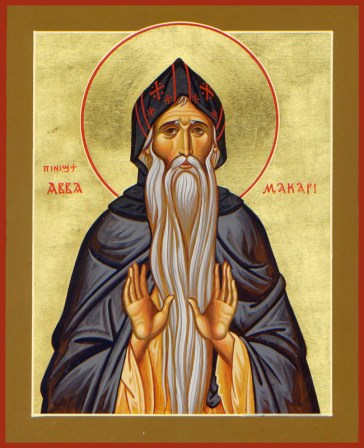
Wrestling and striving with his heart.

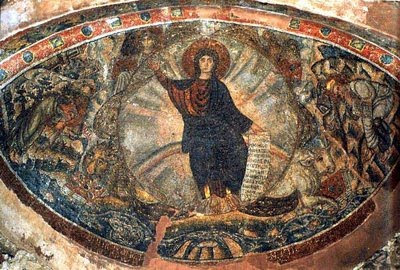
“The abode and resting-place of the Holy Spirit is humility, love, gentleness and the other holy commandments of Christ. If, therefore, a person desires to grow and to attain perfection by acquiring all these virtues, he must initially force himself to acquire and must establish himself in the first — that is to say, in prayer—wrestling and striving with his heart to make it receptive and obedient to God.”

-St. Makarios of Egypt

St. John’s faith in word and deed.

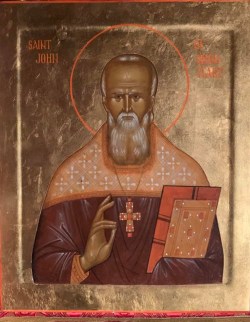
Earlier this month we were reminded of the popularity of St. Nicholas in the Orthodox Church around the world. If you took a vote for the favorite saint, he would win. Another, more modern saint, who lived in the 19th century, is also remembered in December: St. John of Kronstadt. I see that he had some of the same qualities as St. Nicholas. This article tells how generous he was to the poor. Here is a small excerpt:
He would shop for food, go to the pharmacy for prescriptions, to the doctor for help, many times giving the poor his last few coins. The inhabitants of Kronstadt would see him returning home barefoot and without his cassock. Often parishioners would bring shoes to his wife, saying to her, “Your husband has given away his shoes to someone, and will come home barefoot.”

He seems to have had the gift of exhortation; he truly loved people, whether the upper classes or the criminals who were exiled to Kronstadt at the time, and would spend hours at a time in the shacks of the latter, “talking, encouraging, comforting, crying, and rejoicing together with them.”

His popularity has not waned, judging from the fact that between 1990 and 2016, “more than 60 new churches or altars in Russia alone were dedicated to him,” his flat in Kronstadt became a registered museum, his biography was published in a highly respected series, and monuments to St. John have been placed in cities not only in Russia and gifted to Orthodox communities around the world, including in Washington, D.C., in 2019.

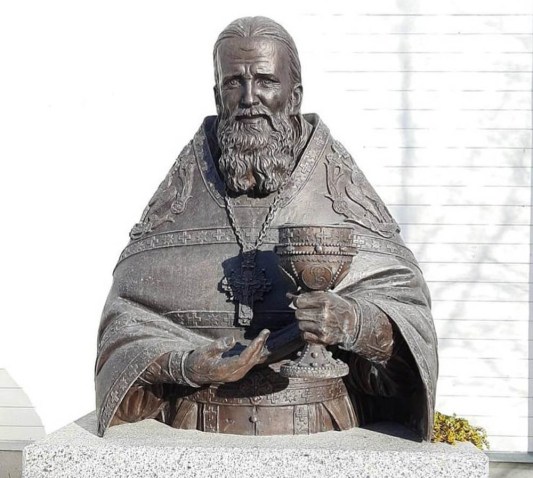
This monument to him was installed last year in his home village of Sura, Arkhangelsk Province, in northwestern Russia, which in 2010 had a population of 727:

Because of his zealous love and spirit of encouragment, one can find many helpful quotes from the saint, and I have posted a few in the past. Here I pass on an exhortation from St. John that is a good reminder to us in the current era, of ultimate reality:

“There is nothing impossible unto those who believe; lively and unshaken faith can accomplish great miracles in the twinkling of an eye. Besides, even without our sincere and firm faith, miracles are accomplished, such as the miracles of the sacraments; for God’s Mystery is always accomplished, even though we were incredulous or unbelieving at the time of its celebration. ‘Shall their unbelief make the faith of God without effect?’ (Rom. 3:3). Our wickedness shall not overpower the unspeakable goodness and mercy of God; our dullness shall not overpower God’s wisdom, nor our infirmity God’s omnipotence.”

-St. John of Kronstadt

Missionary humility and splendor.

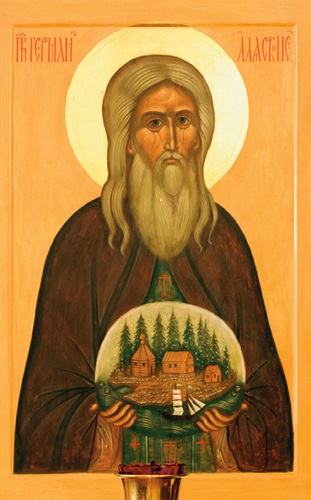
In December we Orthodox commemorate the repose in 1837 of Saint Herman of Alaska, who came as an Orthodox Christian missionary to America in 1793. When he was glorified as a saint in 1970, Fr. Alexander Schmemann was present for the ceremonies. He wrote a non-official account of the event, seemingly from an overflow of joy that compelled his “weak attempt to express to those who were not there that which I cannot call anything other than a miracle of the mercy of God.” You can read it here: Days of Light and Joy.

Of the last of the three days of services and celebrations, Fr. Alexander writes:

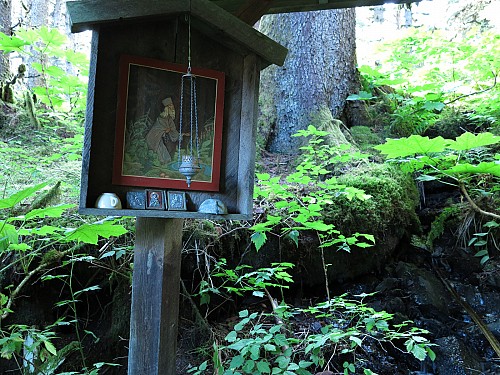
“… very early in the morning, five priests with Archbishop Kiprian go to Spruce Island where for almost thirty years the Elder Herman lived as a hermit. And I know that we have never in our lives experienced anything better, purer, more joyful than what we’ve experienced there that morning: the walk through the wooded paths along the towering evergreens keeping their eternal vigil before their Creator, to the little chapel over the cave of the elder, and the liturgy in that chapel. I served the liturgy; but to say this is totally inaccurate. The liturgy served itself. It was only necessary for us to give ourselves to it completely, to immerse ourselves in it, to enter into the thanksgiving without reservation. I know as well that we did not deserve this at all but that it was given to us as a gift. I can only pray that it will also be given to us to preserve but the smallest portion of this gift of grace.”

At Herman’s Spring, Kodiak

This was in August of 1970, and since then a steady stream of pilgrims from across the globe has visited St. Herman’s grave, including descendants of the Aleuts who knew and loved him before his repose. In 2020 for the 50th anniversary of his glorification there were many festivities and pilgrims there in Kodiak and on Spruce Island.

Father Herman’s repose was in December, so we commemorate him at this time of year as well. I leave you with the closing paragraph of Fr. Alexander’s report:

“In this light and in this joy, all of our human disagreements, accusations and condemnations become so petty, so human, so sinful. The whole time it seemed: If only we could give ourselves humbly to this joy we would understand without words in what and for what the Church exists, and the scales of our wickedness and suspicions and divisions would fall from us. There, at the tomb of Saint Herman, in the splendor of his humility, it was given to us to see that reality which alone gives authentic life to the Church, that reality which is indeed the only thing which the Church has to reveal to this world, that reality by which alone the Church will be able to overcome every power of evil in this world.

“Holy Father Herman, pray to God for us!”