Category Archives: women

Rigo

Some of you knew, and others of you maybe guessed, that I had come to visit Kate this month so that I’d be present for the birth of a grandchild. He has arrived, a little brother for Raj, and has expanded our family and our hearts. I have never been more blessed to share in this kind of history-making.

Back in the 70’s and 80’s when my friends and I were in our childbearing years, many of us decided that we wanted to give birth at home, where we could enjoy the miracle event in a warm and quiet environment surrounded by our dearest people. In hospitals in those days,  various inappropriate medical protocols were routinely applied to women and newborns, as they still are in some “modernizing” places in the world.

Most of my likeminded peers found doctors and lay midwives to attend births; a few did it without any outside help. One doctor in our county attended my first child’s birth in a hospital, and three at home. Kate was my last baby, born at home with a certified nurse-midwife in attendance. We usually liked to have two or more other women at hand to help with household or birth-related tasks as well. Maybe to watch older children, bake a birth day cake, fetch things for the midwife or make up the bed with clean sheets afterward.

I was one of these friends who was happy to be called, often as a sort of lay doula whose only training had been on-the-job, and from my own experience. The cultural setting of a certain time and place gave me special opportunities, and Providence enabled me to take advantage of them.

These blessings have continued as my own daughters have asked me to be with them in the hospital when they give birth. I’m aware that not every grandmother gets this kind of invitation; so often we are the ones who take care of older children when a younger sibling is coming into the family. Even in cases where we might fit into the birth plan more directly, it doesn’t always work out. Joy asked both her mother and mother-in-law, and it was impossible for either of us, four times.

I am supremely grateful for these experiences. To accompany a woman on her birth journey, to wait together as women have done since the beginning of time, feels like a sacred trust. Waiting on God and waiting for the process to unfold, from the first signs of labor until the child is placed in her arms… it is such a privilege. And it never gets old, seeing a child emerge from the womb.

For a long time now, the births I have waited for and witnessed have all been in hospitals. These days most of them are peaceful and geared to the needs of the families more than to hospital efficiency, and sometimes I even have a rocking chair to rock in while we wait and pray, or chat quietly. Or sleep, as Kate and both of us fellow-waiters did for a while before this child decided to get on with it.

And when he did push out and take his first breath, the momentous moment passed without a nod at its passing. The next moment was full of jubilance and awe. We laughed, and wept. Everyone admired the little round head. Soon he was snuggled up to Kate,  looking all around, and suckling. A human’s skin is never so soft as when he is fresh from the womb; then begins the lifelong drying-up process. But not to worry — there is plenty of softness at the totally out-of-this world level for a couple of months, and we are smooching him as though by our kisses we drink from the fountain of youth.

I’ve nicknamed the tiny guy “Amerigo,” or “Rigo” for short, for purposes of my blog, after the cartographer and explorer Amerigo Vespucci whose (latinized) name was given to the New World.

Welcome, little Rigo! God bless you as you begin your explorations!

Wooed by beauty and delight.

Just this morning I reread an old post in which I was musing on the Kasses’ research on young people who don’t fall in love the way previous generations did; I switched from there to my cup of tea and print copy of the current Touchstone Magazine, where Anthony Esolen happened to be exploring a related question in “Surprised by Delight: Divine Love and the Love of Man and Woman Surpass Mere Consent.” He skillfully brings together passages from Paradise Lost, John Donne, the Bible, and other sources to flesh out what he means by the delight of both types of love, and asks also, Why did our grandparents, in spite of hard lives full of suffering, retain a memory of delight in their relationships with the opposite sex? One excerpt, from a passage quoting Milton:

The “virgin majesty of Eve” needs no political program to protect or promote her. Virtue itself, embodied in distinctly feminine form, builds in her its lovely seat of authority, and guards her round about with awe. Eve, too, will acknowledge the superior power of Adam, when she describes her submission to his wooing, saying that from that moment on, she sees “how beauty is excelled by manly grace, / And wisdom, which alone is truly fair.”

So should we stress that each sex is for the other, raising boys and girls to be both separate from one another and destined to be united with one another; to use that separate development to endow each sex with peculiar gifts for the other, which the other will experience with surprise and gratitude. Common sense. Familiarity breeds contempt, and nobody ever said, “I love her, because I find nothing surprising in her.” We are swept away not by what we possess in ourselves, but by what we could never imagine in ourselves. If boys and girls are treated indifferently, should we expect them to treat one another as specifically members of the opposite sex with anything but indifference?

I’ve been wanting for a long time to post the poem below, trying and failing to find a painting to go with it. Maybe the descriptions from Esolen’s article (the whole article appears to be available: here) are better at placing the poem in a universal context of the delight of love and beauty and thankfulness, of which we all have our own concrete and sweet examples.

PART OF PLENTY

When she carries food to the table and stoops down
–Doing this out of love–and lays soup with its good
Tickling smell, or fry winking from the fire
And I look up, perhaps from a book I am reading
Or other work: there is an importance of beauty
Which can’t be accounted for by there and then,
And attacks me, but not separately from the welcome
Of the food, or the grace of her arms.
When she puts a sheaf of tulips in a jug
And pours in water and presses to one side
The upright stems and leaves that you hear creak,
Or loosens them, or holds them up to show me,
So that I see the tangle of their necks and cups
With the curls of her hair, and the body they are held
Against, and the stalk of the small waist rising
And flowering in the shape of breasts;
Whether in the bringing of the flowers or of the food
She offers plenty, and is part of plenty,
And whether I see her stooping, or leaning with the flowers,
What she does is ages old, and she is not simply,
No, but lovely in that way.

-Bernard Spencer

Hankies

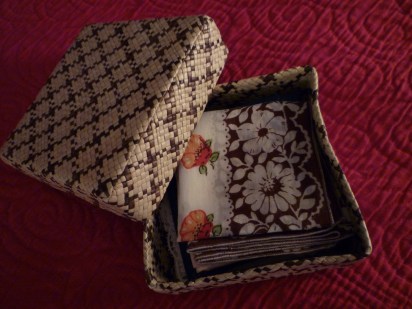
P1100171Once in Sunday School a missionary’s talk tugged at my ten-year-old heartstrings  and my eyes and nose started leaking. My own Sunday School teacher Mrs. Montgomery saw my predicament and pressed her clean hankie into my hand. I was initiated.
My grandmother probably owned quite a few handkerchiefs, but she liked modern conveniences like Kleenex, and I suspect that her cloth versions lay in a drawer, waiting to be passed on to me. Where I grew up on a farm, I never saw one.

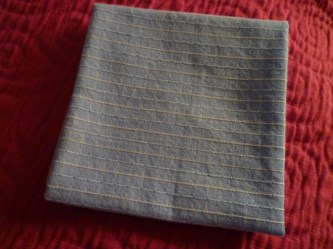
Until I inherited Grandma’s I might have owned just this one I had bought iP1100172n Turkey, the oddest handkerchief I have ever encountered. I must not have had much experience after that missionary talk, or I would have known better than to buy a handkerchief with a grid of heavy stitching all over it, seemingly designed to irritate a nose that might already be red and raw. I keep it now only as a memento.
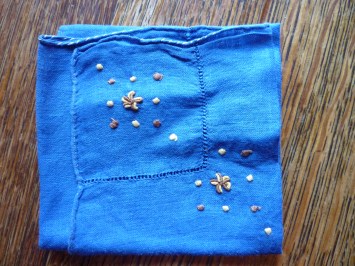
My mother-in-law also left many pretty examples, some of which look like they have been well used, but I think not by her. She likely inherited many from her mother and aunts, who were known to make things like this. I think this dark blue hankie must be a homemade one.

P1040901(1)

P1100170

I’ve been using hankies from all these womenfolk for at least fifteen years now, glad to stop having tissues in my pocket, because one would too frequently get into the washing machine and turn to shreds, making a mess on dark clothes. I’ve heard that the soft and sheer cloth that most of these are made from is easier on your skin than facial tissue – Do you think that is a myth?

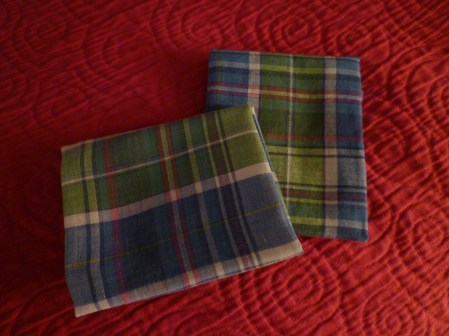
My husband wanted to sP1100167top using paper tissues so I made him quite a few of these plaid handkerchiefs out of an old skirt of mine. He typically had one sticking out of his back pocket, and now I’ve inherited this collection, too.

There may be dust bunnies on my floors and dishes in the sink, but I always take the time to iron my hankies and handkerchiefs, and to have a stack of them downstairs and handy for when I go out, especially on a walk or in cold weather when the cold front meets the warm front….

Jeans and hiking boots are often my style, and in the backpacking era I’d have had a bandanna along, but nowadays when I reach into my pocket on frosty mornings it will be to find a dainty hankie that is a most practical accessory, and serves the added purpose of keeping me in mind of my foremothers.

P1040898(1)

When Husbands Die

Soon after my husband’s death I read When Husbands Die by Shirley Reeser McNally. The author who was a widow herself surveyed a group of women who had been widowed within the previous ten or more years, and organized their responses into a book. 

It was what I needed to read at the time, a sort of controlled support group, where I didn’t have to interact in real time with anyone, but could glean comfort from hearing from women who were in the same situation and who knew what I was going through. It’s strange, when I think about it, that an experience that is so common to humanity, the death of one’s spouse, can be so outrageous and solitary and impossible to prepare for.

One reason for the solitary aspect is the uniqueness of every relationship, and of each griever. This collection of women’s stories was interesting in that the women were all educated and able to write articulate and thoughtful responses to the questions, whether they were in their first months of grieving or years down the road. Most of them did not have to struggle financially, even if their husbands had died fairly young.

Shortly after reading the book I told people that it was something like reading a sociology textbook, and a little dry, but now I think, wasn’t that what I needed? I certainly didn’t want to read anything dramatic about someone else’s trauma. C.S. Lewis’s A Grief Observed was not as helpful, partly because it was only one person’s story, and that of a man, one who hadn’t been married very long. I am a woman who had been married a long time.

I especially liked hearing from women who were at a later stage of grief, about how their lives had changed over the years since their husbands had died, and the ways in which they had built new lives that were good. I went back this week and reviewed the passages I’d highlighted on my Kindle. Here are a few of those favorites:

“…the shared stories indicate that women must work through three to five years of grief and change before they feel well on their way to a recovered, reinvented life. The hard work of grieving must be accomplished before healing takes place.”

“…disorientation, fatigue, loss of self-confidence, feelings of abandonment, shock, and bone-deep sadness.”

“…our culture…is not open to the commonality of death, and how important it is that we come to terms with it in our lifetime.”

“I think women are better able to cope. We are greater realists and more skilled at accepting change as part of life because of our biological natures: monthly changes, pregnancy, childbirth, etc. Widowers tend to remarry sooner. They don’t know how to nurture themselves.”

“Is it ever possible to have no regrets; to have accomplished all you wanted to do; to have said everything, done everything? No. Omissions you recall later may bring sadness, sometimes guilt, until you understand that it was important for you and your husband to do things in your own way. That’s the only way you and he had.”

“…dying is something each of us has to do alone, at least in a human sense? The moment must come when, in dying, we move beyond our surroundings into another space.”

“…it is a sudden time, when things must be left unsaid and undone.”