Category Archives: work

I feast on the garden and my cold dinner.

Today I spent most of the afternoon and evening working in my garden, happy to act out the quote from Elisabeth in the last post. Often on Mondays I end up trimming and weeding, because it’s tonight that I put out the garbage cans to be picked up in the morning, including the big green bin that is for all green waste.
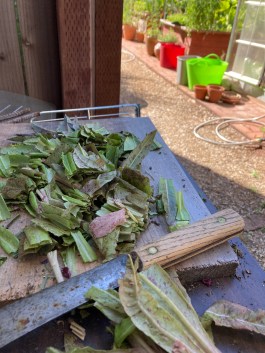
The lettuces that had bolted I chopped up and gave to my worms. Out there I set up a board by way of a chopping block just for this purpose. I probably have four times as many worms as I started with last fall, because the man who gave me my starter batch moved far away and couldn’t take his worm farm; he gave them all to me! He consolidated all three or four of his bins into one new one, before bringing it to my house, so I fear that they are overcrowded, and I plan to modify my set-up so that they have more room. But they seem to be doing well on the diet I provide.

I tied the new tomato stems to the long tree prunings I am using for stakes; I removed a lot of spindly new nigella sprouts that are still coming up everywhere even though the weather is not conducive to their health. And I picked lots of kale and Swiss chard.
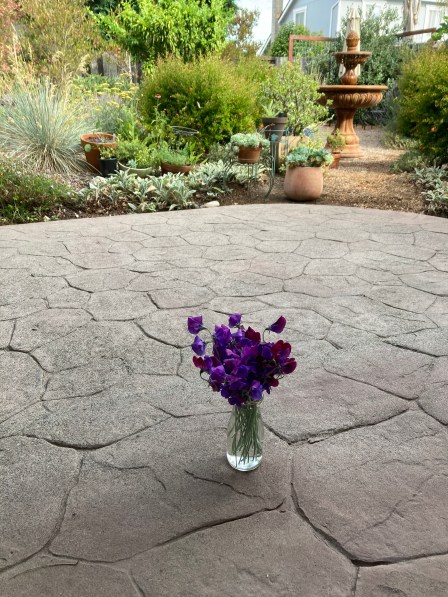
Last Saturday my patio got scrubbed and power-washed. I’d noticed only this spring how black it had turned over the winter; it hadn’t been cleaned since it was installed twenty years ago. While that was happening I picked a few of the sweet peas from the vines that are crisping up, as I pulled out the plants. The patio was left to dry and won’t be sealed until later this week, so in the meantime all my potted plants are waiting on the paths. I was watering them this morning when I noticed the manzanita’s bark curling as it does at this time of year. Here are new pictures of that artistry.
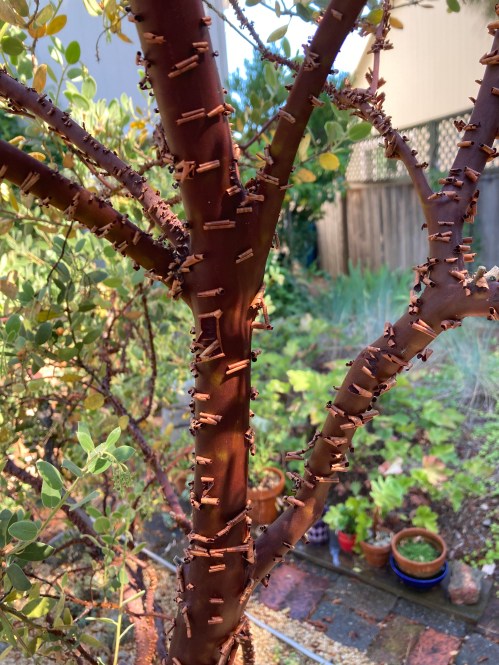
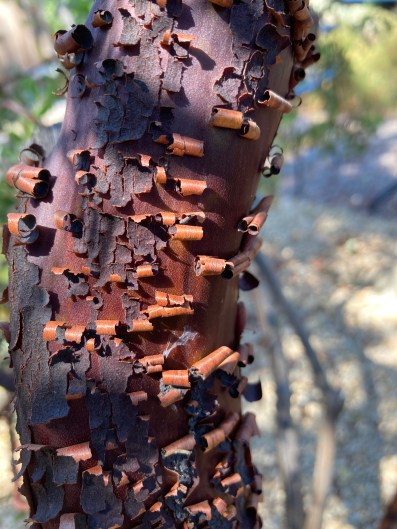
At six o’clock I was still going strong, and I didn’t want to stop and cook dinner, so I came in and just found cold things in the fridge to eat quickly — a lamb chop and a few roasted Brussels sprouts. There was cold tea as well, pretty fancy stuff that had just arrived today.

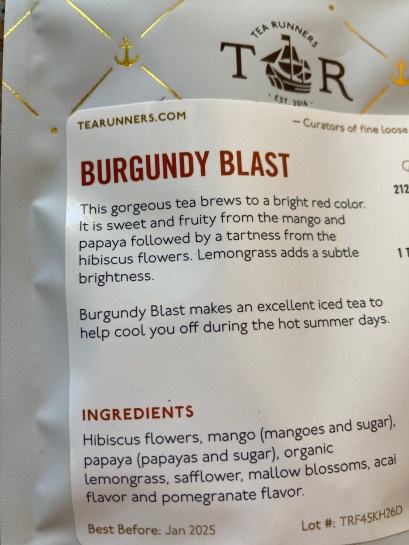
Last year I gave my grandson Scout a subscription to a few orders of Tea Runners blends of tea, and when I visited him recently he made tea for me from a flavor of my choice, from his collected packets. I was so impressed with the various flavors I decided to order a few for myself, and today I made Burgundy Blast as iced tea. Its color and flavor reminded me of the Kool-Aid that my siblings and I used to drink in the summers of my youth; I say that, quite glad not to have drunk Kool-Aid for many decades. But this was just barely sweet (I see from the ingredients list that the mangoes included were sweetened), and so fruity and yummy. And beautiful. This is what it looked like before the boiling water was poured over:

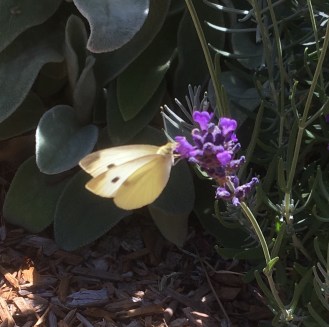
For several years I used to pick lavender flowers from my many plants, hoping to put them into sachets. I stored them in the freezer against the day I would have time for that project. But it never happened, and I stopped trying. This year I got the idea to make lavender simple syrup, but I didn’t pick the buds in time, and now they are fading. Oh, well, I gathered a cupful of blooms anyway, and maybe I will make lemon & lavender shortbread… maybe.

A lovely thing happened on this gardening day: I received in the mail this book The Fragrance of God, by Vigen Guroian (2006). I noticed it online when I was buying the new edition of Tending the Heart of Virtue: How Classic Stories Awaken a Child’s Moral Imagination. The Fragrance book seems to be on the same theme as the author’s previous book, Inheriting Paradise: Meditations on Gardening. I couldn’t help leafing through it right away, though I was too busy to give it proper attention. Just now I did take time to glean one quote with which to end my mostly garden post. I am reveling in my own heart’s portion of Paradise tonight.

“When Adam left it, he took a portion of Paradise with him. That piece of Paradise is more deeply etched in the human soul than all the memories of this impoverished world. Scratch beneath the skin of a genuine gardener, and you will find this memory of Paradise. When he looks into his backyard, Paradise is what he envisions. But Paradise is not just inside of every man and woman. In these regions of ‘sin and woe,’ William Cowper remarks, ‘Traces of Eden’  may still be seen, ‘where mountain, river, forest, field, and grove’
remind us of our ‘Maker’s power and love.'”
The clarity of early morning.

LATE RIPENESS

Not soon, as late as the approach of my ninetieth year,
I felt a door opening in me and I entered
the clarity of early morning.

One after another my former lives were departing,
like ships, together with their sorrow.

And the countries, cities, gardens, the bays of seas
assigned to my brush came closer,
ready now to be described better than they were before.

I was not separated from people,
grief and pity joined us.
We forget—I kept saying—that we are all children of the King.

For where we come from there is no division
into Yes and No, into is, was, and will be.

We were miserable, we used no more than a hundredth part
of the gift we received for our long journey.

Moments from yesterday and from centuries ago—
a sword blow, the painting of eyelashes before a mirror
of polished metal, a lethal musket shot, a caravel
staving its hull against a reef—they dwell in us,
waiting for a fulfillment.

I knew, always, that I would be a worker in the vineyard,
as are all men and women living at the same time,
whether they are aware of it or not.

-Czeslaw Milosz, 2004


Anyone can possess a poem.

“Why We No Longer But Still Could Have Beautiful Things” is something Anthony Esolen discusses in an article titled “The Ugly and the Good,”  which was first published in Touchstone in 2020. This month he republished it in his Substack newsletter.

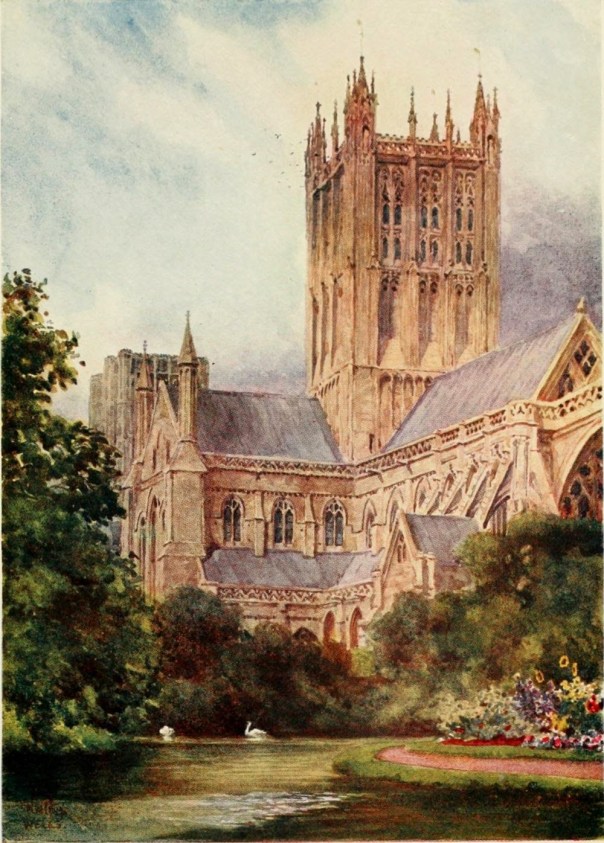
Wells Cathedral, England

Esolen begins by talking about beautiful cathedrals built in the Middle Ages:

“I’ve come to see the medieval cathedrals of Europe as the most glorious works of folk art the world has ever known…. They rose up as a lofty expression of the piety of ordinary people, the work of hundreds of men’s hands, digging the deep cavity for the foundation, hewing and setting delicate half-ton stones without mortar, mixing colors for paint or the glazing of windows, searching the forests for the tallest oaks to fell and to carve into beams to span a roof; far more kinds of work than I know and can name.

“They did it because they loved doing it. They were free.”

He contrasts freedom with license, using the example of Ebenezer Scrooge for the latter:

“To be free is not, O modern man, to be rid of all claims upon your love, your duty, your person, and your substance. If that were true, then Charles Dickens crafted a truly blithe and free spirit in the unregenerate Ebenezer Scrooge, crouching alone in his dismal flat and eating gruel gone sour. If you are talking about freedom and you are not talking about love and devotion, then you are not talking about freedom at all; you are talking about moral license, or a permission guaranteed by statutory law, that you may in some regard do exactly as you like, which may include gazing endlessly at evil pictures on your computer screen, and thus transforming yourself, cell by cell and pulse by pulse, into a thing, an automaton.”

Van Gogh, The Good Samaritan

His college students ask him for a definition of freedom, because, unfortunately, many of them are puzzled by his statements about what it is not. This is his answer:

“Freedom is the unimpeded capacity to attain to the perfection proper to the kind of creature you are. But since man is made in the image of the God who is a three-personed communion of love, his perfection, the enlargement of his soul, can only come by means of a gift, by the gift of grace from God, which enables him to make of himself a gift to others. There is no truly human freedom without grace, and the love that is its proper response.”

As to modern man’s failure to develop a love, or even a desire for beautiful things, Esolen proposes three reasons. If you’re interested enough that you’ve read this far, you can read them in the article: “The Ugly and the Good”

He also exhorts us to work on the restoration of the culture we have lost:

 “We must take back the heart, the chest, the seat of proper passions, which is to take back from Satan those commanding heights of the imagination, which is to reject the errors I have mentioned and to repair the harm they have done. We must not value the useful over the beautiful. We must not reduce beauty to a commodity. We must not forget that our experience of beauty should lead us back to the source of beauty, who is God.”

Esolen suggests that we spend more time cultivating an appreciation for art of every sort; and that we start with the beautiful things that are most accessible:

“Song and poetry are the most immediately available of all the arts, requiring only a human mind and a human voice. If you want a Rembrandt, you have to go see it, or carry a copy with you under your arm while you avert your eyes from the glare of the policeman. Grand pianos, with Van Cliburn sitting at them, are not to be found on every street corner. You cannot from your porch in New Hampshire gaze upon the great arms that Bernini conceived for St. Peter’s piazza, extending in the shape of a key to embrace the thousands who would come to worship there.

“But anyone can possess a song or a poem. If you have a voice, you can sing, and if you have a mind, you can remember what you sing. If you have a voice, you can utter a poem, and remember what you have uttered. In a way, you can best possess a song only by singing it, and a poem only by giving it the performance of your mind and heart and voice and body. Song and poetry should be the most democratic of the arts, more truly by the people, of the people, and for the people than anything else in our experience.”

That brings me to — Poetry Month! I have a little experience of what he’s talking about here, knowing by heart several poems from A Child’s Garden of Verses, which give me joy when I have occasion to recite them, usually to a grandchild, these days. How many songs do I know? Oh my, countless! After reading Esolen, I am extra grateful for all the songs and singing I have loved throughout my life. I am singing these days more than ever.

This short and beloved poem below, which I think I’ve shared here more than once — maybe I should compose a tune for it. Because of its simplicity and rhythm it embedded itself in my mind very easily, long ago, and years later it was right at hand to speak aloud, one night when my late husband and I were peering over a bridge into the dark, where with the help of a street light we could see ripples in the stream down below.

The tide in the river,
The tide in the river runs deep.
I saw a shiver
Pass over the river
As the tide turned in its sleep.

–Eleanor Farejon

May we nurture ever more beauty, music and poetry in our lives,
and offer the joy with thankfulness up to God.

by Jan Schmuckal