Originally I’d wanted to use my own and other local plums to make this cobbler recipe from Smitten Kitchen, and I wanted to take it to a party that mutual friends hosted, for my friend David’s name day a couple of months ago. Time did not permit, so I thought for at least a minute that night about doing it for his birthday instead, which I knew wasn’t too far off. But so many thoughts like that, representing good intentions, get lost forever in the chaotic ocean of my mind. And I didn’t know his exact birthday.
Last week when David agreed to stack my firewood, the idea of baking him something by way of a thank-you gift did not even occur to me. I was not operating in my preferred realm of the kitchen and the hearth united, but was thinking of a dozen householder tasks needing done, the sort I can’t confidently do anymore. So when David arrived, I had a couple more jobs for him before he could even start the real work.
The day before the wood-stacking event, I saw a picture on Elizabeth’s blog that puzzled me; it seemed to be a dessert. I asked her about it in a comment, and she responded right away telling me that it was a plum cake that she has made before. That formed a link in my mind to the remainder of a large package of plums from Costco sitting on my kitchen counter. I saw her reply the next morning and tracked the recipe down to the New York Times. And I realized that I had the exact number of plums I needed to make the cake. Only then did it occur to me that I could give it to David; he wasn’t coming until the late afternoon, so I had time to bake it.
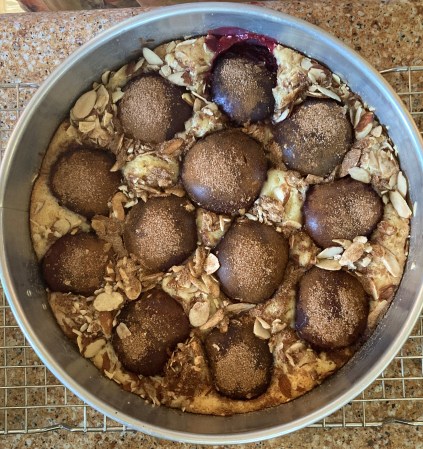
To the recipe as given I added some sliced almonds and a little almond extract, and used 3/4 cup of sugar. Elizabeth told me she uses only 1/2 cup. Mine was a 10-inch springform pan and the recipe called for 9-inch; I think the resulting shallowness made the cake want to fall apart when I was transferring it to a plate.
David came, he worked and worked, and was dripping with sweat by the time the job was done. Because of the way that my utility yard is crowded right now, he had to make two tallish stacks.


He took the cake home, after telling me that it was his birthday!
Many Years, David! And many logs!