“Of all tyrannies, a tyranny sincerely exercised for the good of its victims may be the most oppressive. It would be better to live under robber barons than under omnipotent moral busybodies. The robber baron’s cruelty may sometimes sleep, his cupidity may at some point be satiated; but those who torment us for our own good will torment us without end for they do so with the approval of their own conscience.”
I am blessed by the perfection of this summer’s day, the way the pleasant warm air pervades my body and presses contentment into my whole being. Here is a painting that conveys something of the feeling I have. Now I will go outside again to enjoy my personal version of The Summer Poppy Field ❤
When I woke today, a multitude of urgent tasks filled my mind and sent me off in the wrong direction. Eventually I was rescued by the Jesus Prayer, by Jesus Himself. As I calmed down I realized that a few of the tasks were not that urgent, and when I began to consolidate my lists, one task fell off altogether, being a completely unnecessary outing, and large project that would have followed. That was a drive to the apple ranch to get Gravenstein apples, a variety that I usually miss out on because they are so early. But it won’t hurt to miss out on them again — why change tradition?
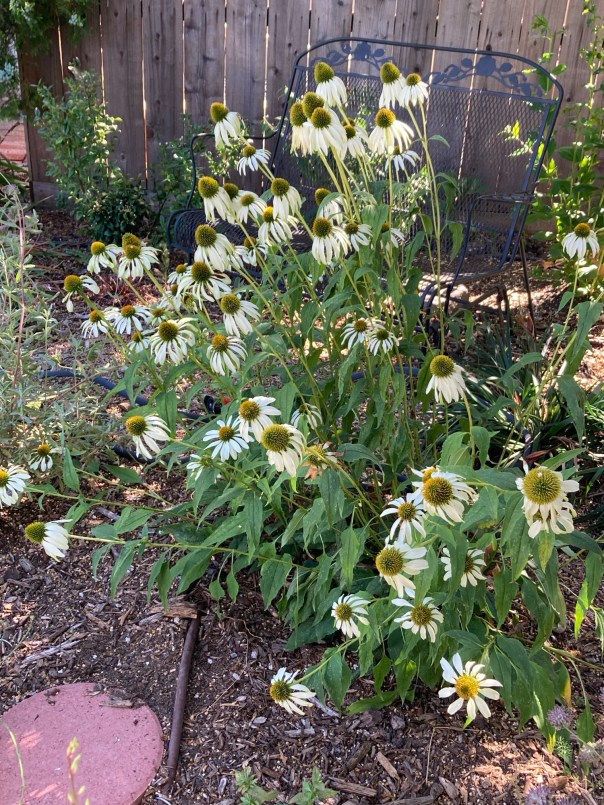
Volunteer Delta Sunflower
I’d wanted to water the garden early, but it ended up being not-so-early, and what do you know, that was not a disaster. Putting the hose on thirsty plants — or were they plants that merely look dry because it is August? — gave me so much joy, I could hardly bear it. I remember when my current garden went in, ten years ago, with its extensive automatic irrigation, my daughter Pearl was concerned and said, “But Mama, you love watering the garden!” Evidently that is true. It’s a great gift to have such work.
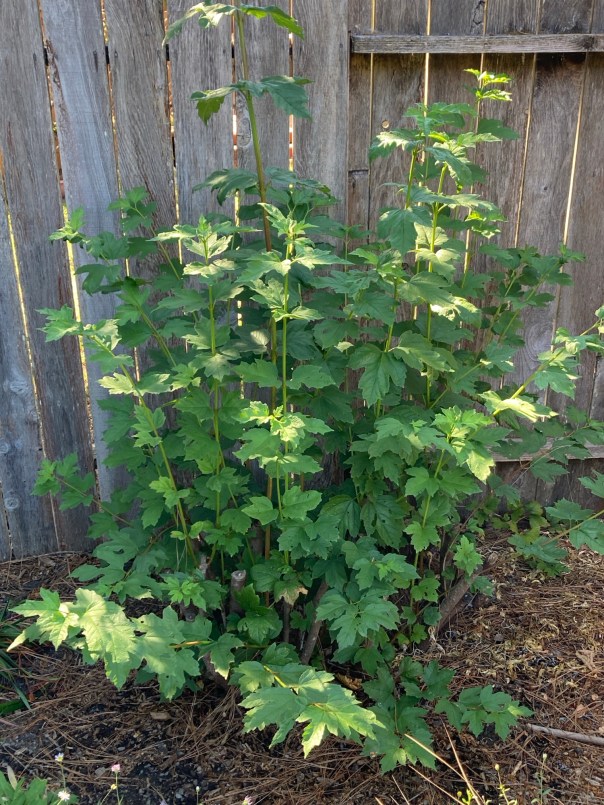
Viburnum coming along after hard pruning.
It seems to me that the irrigation system needs some adjusting; my thought is that as the plants are more in number and greater in size than when we first programmed it, and even since the last changes, I should customize it further. That job is a mental challenge for me, as there are six different valves/lines and three programs, for each of which one has to determine how many days per week and how many minutes of run time. As I have done so often, I will have to study the diagram and how to enter the settings via the dials and buttons, because it never sticks with me. If I just give some areas a little more water by hand, that will relieve my anxiety. It will be easier to tackle the problem if I am confident that nothing is dying of thirst right now.
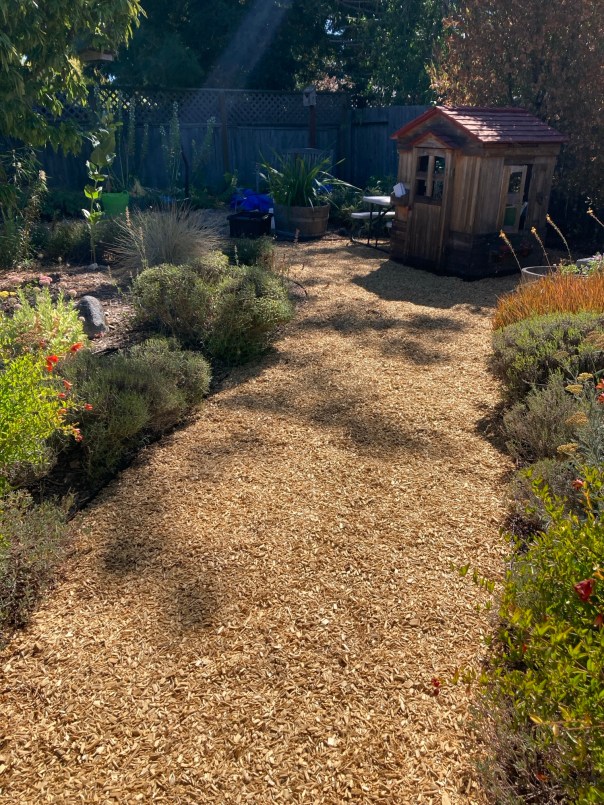
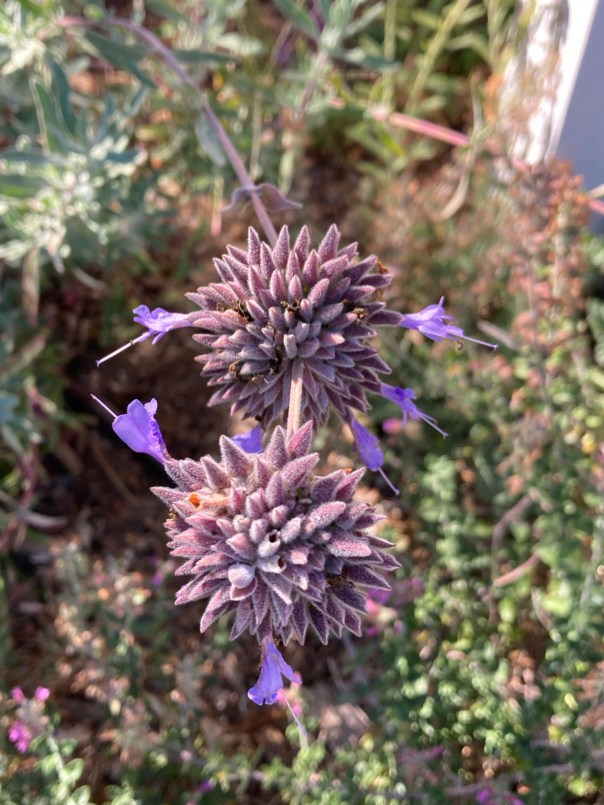
Path mulch reapplied after 9.5 years.Salvia clevelandii
As I walked around with the hose, noting how many things are alive and obviously growing, happiness filled me. The thoughts of J.R.R. Tolkien that Eugene Terekhin writes about recently in “Why Gardeners Will Save the World” make me think that my garden is helping me while I am tending it:
Quoting a letter Tolkien wrote to a friend: “I think the simple ‘rustic’ love of Sam and his Rosie (nowhere elaborated) is absolutely essential to the study of his (the chief hero’s) character, and to the theme of the relation of ordinary life (breathing, eating, working, begetting) and quests, sacrifice, causes, and the ‘longing for Elves’, and sheer beauty.”
Terekhin: “Mythically speaking, Sam [the character in Lord of the Rings] was ‘down to earth.’ He was a gardener who loved all things that grow — as all hobbits do.”
….
“The most important thing one can do in wartime is to grow a garden. Because when we grow things, they grow us. It takes a long time to grow something, and as we tend our garden we grow together with it.”
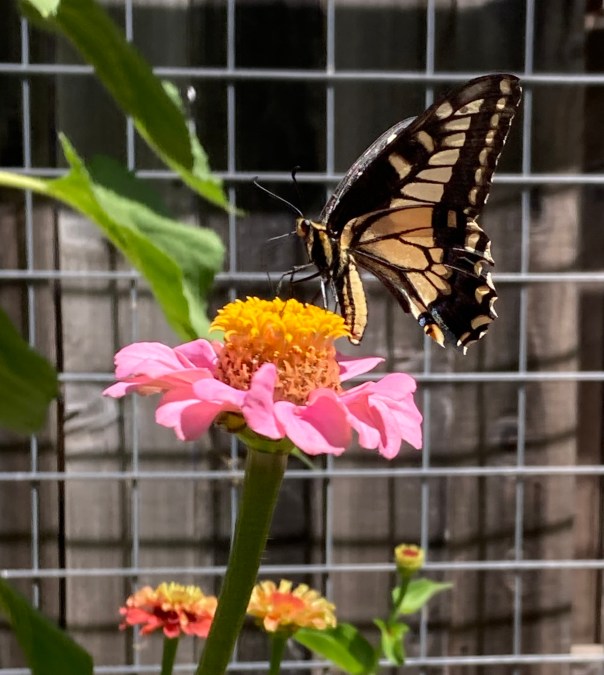
I know for sure that just being out there, soaking up the scents and the colors, watching the bees and butterflies drink from the flowers I tend on their behalf, is to me that most essential, ordinary life such as Tolkien shows us. For quite a while I followed this glorious, common swallowtail in all its glory, a creature that was drinking from just about every zinnia in the planter boxes. He and I were of the same mind about Being, and being down to earth.
Happiness is a butterfly, which, when pursued, is always just beyond your grasp, but which, if you sit down quietly, may alight upon you.
“3100 Christians were killed and 2830 were kidnapped in Nigeria in 2024.” In India, “Four to five pastors or churches are attacked every day.” These are some statistics representing great suffering in parts of the world that aren’t in our daily headlines. The constant wars and episodes of violence, the dysfunctional families and societal breakdown that do make the headlines can’t begin to tell the story of each individual human life wracked with pain and heartache. No doubt all of us know, and many of us are, cases in point. Is it not crass, under the circumstances, to write about being happy? Should we feel guilty for even being happy?
The words of Jesus about tribulation had been floating around in my mind a lot recently: “In the world you will have tribulation,” and, “I have overcome the world.” Last Sunday as I was driving to church and actually bringing those thoughts into focus, as hard as I tried I could not remember the clause that comes between those two, which I have known most of my life. I stopped on the way to pick up a friend, and while I was waiting for her to come out to the car I looked up the verse on my phone. It turned out to be a convenient case of forgetfulness because when I went to the Bible app, of course it had several translations, which gave a broader meaning to Christ’s encouraging words.
Our Lord had just been telling his disciples about many disturbing things that would happen in the future, and then generalized saying, “In the world you will have tribulation….” And his next words are startling, really. The way I knew the next part is: “…but be of good cheer, for I have overcome the world.” Other translations are “take heart,” or “have courage, for I have overcome the world.”
The poem below is about being happy, about meaning, and writing. I’ve written before about how in the most creative, happy times of my life, which were while I was with child, I completely forgot about my diary or journal and never wrote a word in it. At other times, just living at a normal level of happiness, I often have written in a journal. My problem with journaling is exactly what G.K. Chesterton alluded to on at least two occasions saying,
“I am a bad reporter because everything seems to me worth reporting; and a bad reviewer because every sentence in every book suggests a separate essay,” and,
“Once I planned to write a book of poems entirely about the things in my pocket. But I found it would be too long; and the age of the great epics is past.”
Did Chesterton ever keep a journal, I wonder? My guess is he didn’t, because writing about everything in a journal would leave him no time for gainful employment at writing in a more focused manner about many things.
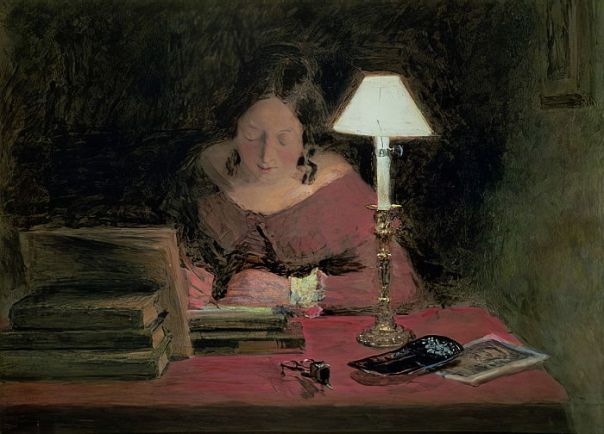
William Henry Hunt, Girl Writing by Lamplight
I seem to have given up on my journal to a greater degree than ever before, because there is just too much that I want to put in it. If I wrote in my journal the way I want to, I would never be done. I sense this, every time I try, and I start scribbling madly, racing against time, knowing that it’s hopeless: I will never be able to do a proper job. Journaling demands to be neverending.
A book I borrowed briefly from the library some years ago told the story of the author’s obsession with journaling, and then her obsession with thinking about her obsession. She asked, How could she have a life, if she journaled about everything? She feared she was ceasing to really live, because she was writing instead. I didn’t read very far in it, because if journaling was stealing time from living, using my precious hours to read her book was even worse theft.
Blogging is not the same at all, in my case. I have to be somewhat focused when I write for others to read, and I must bring every post to an end, so I can publish it. For a process-oriented person like me, each post is a manageable goal, one which I can abandon and no one will care. In the meantime, I’m able to include some of the things I would have journaled about, without getting lost in my thoroughness.
I could put myself into this poem, and I would be talking to God. Because I do write a lot, the whole thing may not seem to pertain to my situation. But it did make me think, and it made me happy.
MISSED TIME
My notebook has remained blank for months thanks to the light you shower around me. I have no use for my pen, which lies languorously without grief.
Nothing is better than to live a storyless life that needs no writing for meaning — when I am gone, let others say they lost a happy man, though no one can tell how happy I was.




 Gladsome Lights