Christmas trees and Christmas now.

gretchens-1st-xmas-marysville-50This was my first Christmas, in Marysville, California. I seem to be more interested in my toys than in the tree, but with the decided lack of bling on that scrawny evergreen I guess it’s no wonder. Now, though, the strings of popcorn please me very much. After that year, our trees were always decorated with tinsel in typical 50’s fashion, and sometimes plastic icicles.

Amazing, to see three dolls under that tree! All these things make me think that my First Christmas may have been more formative than one would imagine.

This year I put up my faux tree for the second time. Who would have dreamed, even three years ago, that I would ever have a faux, (a.k.a. fake), tree for any reason? (When I mentioned my faux tree to friend Mr. Bread, he burst out laughing.) But while we were shopping during my late husband’s last Christmas season, he looked at the faux trees on display and said, “Gretchen, next year you should get one of these.” I brushed him off and never gave it another thought until the following November when I realized I couldn’t manage getting a cut tree home, not to mention setting it up, and taking it down again in January.Christmas tree 2015

If you didn’t read the poem by Robert Frost about the Christmas trees he didn’t know he had, I put it up last year Here.

This year I decorated my tree all by myself one day when I was alone in the house. That was also a totally new experience for me, and I enjoyed it so much! I should not be surprised about that, either, knowing how I’m never at my best doing group projects.  In the past our whole family would take an evening to decorate while we drank eggnog and hot cider, and many times listened to a recording of “A Christmas Carol.” Seven people decorating one tree is a challenging group project, but it was our tradition that we loved.

I’m pretty sure that introverted decorating will be my new tradition. I will listen to carols while I make the tree into a work of art. As I try to remember who gave me which beloved ornament, I will thank God for Christmas Past and Christmas Now.

Christmas Joy by Soldier and Joy 14

Hear the cold splintering.

Those Winter Sundays

Sundays too my father got up early
and put his clothes on in the blueblack cold,
then with cracked hands that ached
from labor in the weekday weather made
banked fires blaze. No one ever thanked him.

I’d wake and hear the cold splintering, breaking.
When the rooms were warm, he’d call,
and slowly I would rise and dress,
fearing the chronic angers of that house,

Speaking indifferently to him,
who had driven out the cold
and polished my good shoes as well.
What did I know, what did I know
of love’s austere and lonely offices?

-Robert Hayden

Hear the poet reading his poem.

The story of the universe.

From Father Stephen Freeman:

The public narrative (news and history) is like watching actors in a play. However, the actors have stumbled into the notion that the play is reality. They react to each other and the narrative within the play, but the reality off-stage (which is the rest of the whole world) is nowhere in sight. We might easily conclude that the entire idea of a public narrative is absurd (and it is, largely).

But people are story-tellers. If you ask, “What’s happening?” the answer will take some sort of story form.  Apparently, God is a story-teller as well. In St. John’s gospel we read:

“No one has seen God at any time. The only begotten Son, who is in the bosom of the Father, He has declared Him.” (John 1:18)

The Latin translation of this verse says that the only-begotten Son “narrates” Him (enarravit). And this is precisely the case. The Christian claim is that Christ Himself is the story of the universe. He is the author and the protagonist. He is the meaning of the true story. Every sub-story (my life and yours) gains its meaning and purpose from the greater story of which they are a part.

Read the whole article here: World Story – The News and the Good News

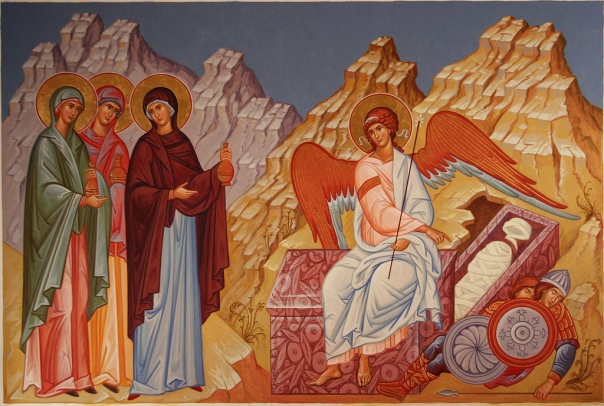
Myrrhbearing women at the tomb

At the dark dream of the year.

I am learning to live, glory to God — though I’d never thought of it just that way until reading this poem. Its allusions to giving birth I can relate to, though I’m thankful I was able to accomplish the material form of that work when I was in the “glory of the flesh,” young and strong. Now that I am in the autumn of my life, now is when as a widow I have to rise to the less tangible demands, which before I had thought of more as a re-creation than a rebirth.

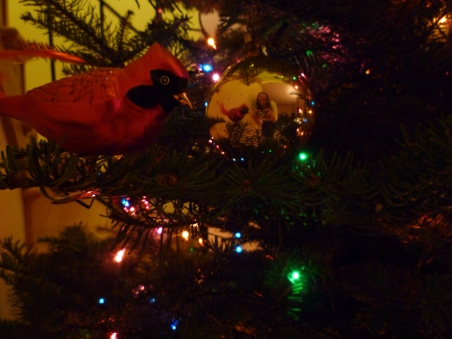
cardinal-ornament

It used to be that January was the dark dream of the year for me, but judging from the last few weeks, I think that in the years to come the ramp-up to Christmas might prove to be the season when it’s hardest to stay tuned to Christ’s birth in me, as He,

At the iron senseless time, comes
To force the glory into frozen veins…

Maybe it’s a stretch to apply these metaphors to my situation. But all the traditions of getting ready for Christmas — the planning for gifts, the shopping and cooking and decorating, Christmas caroling, all in a context of wood fires and sweeping of leaves and walks on brisk mornings — I have to learn to live on my own now. “Everything changes,” and I have been born into a new and strange existence. The natural impulse is to wish to sleep ever and to dream of springtimes past.

But as Christ is born in me moment by moment, I’m the farthest possible from “on my own.” If I could live in this reality, truly live in Him, instead of in the unreality of memories that are phantoms (human beings themselves can never fall into the category of Memories), it would be a constant breaking out in a glorious freedom that encompasses calm and warmth and joy, the fullness of God. I’m in the process — I am being born, ever so slowly:

To bear new life or learn to live is an exacting joy:
The whole self must waken; you cannot predict the way

It will happen, or master the responses beforehand.
For any birth makes an inconvenient demand…

I feel that I could feed off this rich poem for the next several months! It is a great gift to me; I hope you enjoy it, too. May your Advent waiting be fruitful.

scout-angel-chimes-12-14

CHRISTMAS AND COMMON BIRTH

Christmas declares the glory of the flesh:
And therefore a European might wish
To celebrate it not at midwinter but in spring,
When physical life is strong,
When the consent to live is forced even on the young,
Juice is in the soil, the leaf, the vein,
Sugar flows to movement in limbs and brain.
Also before a birth, nourishing the child
We turn again to the earth
With unusual longing—to what is rich, wild,
Substantial: scents that have been stored and strengthened
In apple lofts, the underwash of woods, and in barns;
Drawn through the lengthened root; pungent in cones
(While the fir wood stands waiting; the beech wood aspiring,
Each in a different silence), and breaking out in spring
With scent sight sound indivisible in song.

Yet if you think again
It is good that Christmas comes at the dark dream of the year
That might wish to sleep ever.
For birth is awaking, birth is effort and pain;
And now at midwinter are the hints, inklings
(Sodden primrose, honeysuckle greening)
That sleep must be broken.
To bear new life or learn to live is an exacting joy:
The whole self must waken; you cannot predict the way
It will happen, or master the responses beforehand.
For any birth makes an inconvenient demand;
Like all holy things
It is frequently a nuisance, and its needs never end;
Freedom it brings: We should welcome release
From its long merciless rehearsal of peace.

So Christ comes
At the iron senseless time, comes
To force the glory into frozen veins:
His warmth wakes
Green life glazed in the pool, wakes
All calm and crystal trance with the living pains.

And each year
In seasonal growth is good — year
That lacking love is a stale story at best
By God’s birth
Our common birth is holy; birth
Is all at Christmas time and wholly blest.

-Anne Ridler


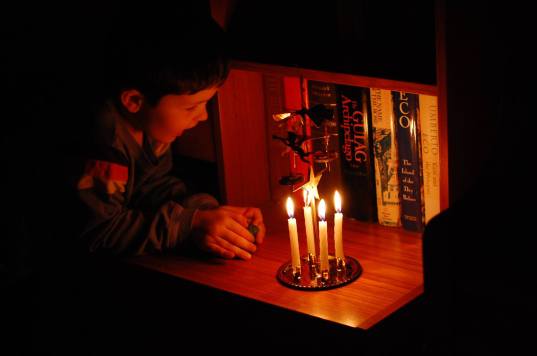
(Bottom photo by Pippin)