
40 Days

P1130350It is traditional in Orthodox churches to have a short memorial forty days after a death, and though my husband was not Orthodox, I am, and I am the one remembering and praying for him. Last week my priest generously held this service, called a panikhida, and I prepared the dish of boiled wheat called koliva for us all to eat together at the end of the service.

I’m sure that in homogeneous cultures women learn from other women how  to make this ceremonial food, as they work in the kitchen together. I learned from other women via the Internet, and it worked out fine.
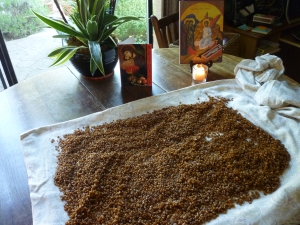
P1130314 boiled wheat dryingThe essential ingredient is boiled wheat – but actually, even that is not essential, because sometimes it is rice, or lacking wheat, barley or another grain can be substituted. But the image of a kernel of grain being buried endures, as in the Gospel of John Christ speaks of His own coming death, “Verily, verily, I say unto you, Except a corn of wheat fall into the ground and die, it abideth alone: but if it die, it bringeth forth much fruit.”

Below is a picture of the koliva at a one-year panikhida for someone else, which had been held the week before at my church. That one was decorated with gorgeous yellow roses.
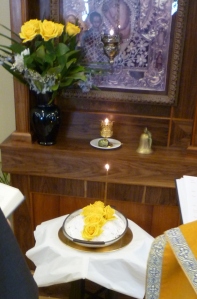
P1130207crp

I boiled the wheat, which was said to be enough for 40 small servings, and then laid it out on towels to dry for a couple of hours, as the Greeks in particular like to do. One Greek woman made a strong point about what she considered the superiority of this dry quality, contrasting it with the Romanian koliva which was said to be like pudding.

Most koliva that I had eaten was also more loose and dry, so that appealed to me. But I also read that the Romanians often decorate their wheat with chocolate, which custom I planned to imitate.P1130224 blanched almonds
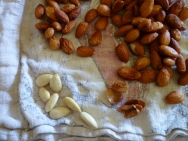
I included a small amount of cumin, cardamom, and cinnamon —  less of the cinnamon than most people do — golden raisins, almonds and walnuts, and orange zest. It was the first time I had tried blanching almonds, which was easy and fun. When after blanching I squeezed the skins off the nuts, one of the nuts shot across the room and into my open pots-and-pans drawer. I haven’t gone looking for it yet.P1130341
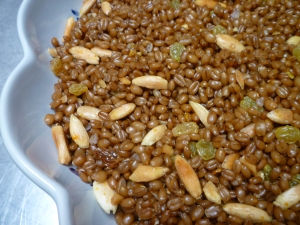
Some of these ingredients were mixed into the wheat as soon as it was dry, but the walnuts I chopped and spread on top, under a layer of graham cracker crumbs which is put there to keep the last layer of powdered sugar from dissolving and disappearing into the wheat. You want it to stay on top and be gleaming white. The usual technique for the top is to lay waxed paper on the powdered sugar to flatten it and make it smooth, bukoliva w graham crackerst I put the final layers of my dish together in the church kitchen where I could not find any waxed paper. My alternative method didn’t work so well, which is why the surface of my finished product has some flat areas, some imprints of my fingers, and some sugar untouched.P1130317 blue candies

I decorated the top with Jordan almonds and chocolate pastilles, and with some little blue baking decorations that I separated out of a color mixture.

The panikhida was held in the evening. Several people from my husband’s church came and stood with us near the Crucifixion icon and we all held candles for prayers and hymns and “Memory Eternal.” Then I scooped out portions of the koliva into little Dixie cups for people to eat together in honor of my dear husband. As it is spooned up everything gets mixed together and sweetened by the powdered sugar, and one tries to give everyone a bit oP1130350f chocolate or a candy. The koliva recipe was judged to be excellent.

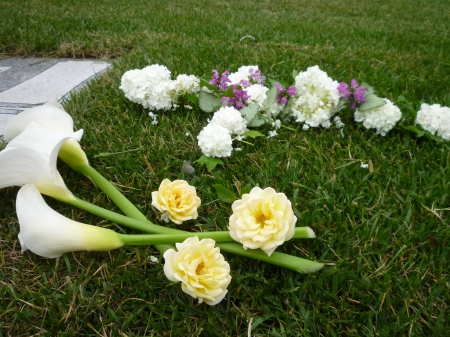
That morning of the 40th day I drove to the cemetery to see the grave marker that had been put in place, and to bring some flowers. There were barely enough nice blooms left on our snowball bush to make a cross on my husband’s grave, so I added some calla lilies and roses, and I sat for a while on the grass there. On the way over in the car I had listened to jazz on the radio, to feel him close to me, but at his grave I sang, “Christ is risen from the dead, trampling down death by death, and upon those in the tombs bestowing life.”P1130330
the mystery of his life

Braga quote joy OCN crp

from the Orthodox Christian Network

And this about Fr. Roman from the Touchstone newsletter:

Prisoner of the Redeemer   

Early this morning, about a four-hour drive east of Chicago’s Holy Name Cathedral, a new and much smaller church in the Michigan countryside sheltered the body of a recently departed priest-monk of the Orthodox Church, Fr. Roman Braga. His funeral was scheduled to begin at 9:30 AM.

While Fr. Roman held no office as elevated as the Archbishop of Chicago, it would not surprise me if in some ways he influenced nearly as many people over the years through his counsel, prayers, and service to the church–to all who spoke with him.

Fr. Roman moved to Michigan from Brazil the same year I moved from Michigan to Chicago (1972). Twenty-five years later, on October 7, 1997, I met him for the first time at Holy Dormition Orthodox Monastery in Michigan. I was privileged to have a several conversations with him over the years, including an interview published in Salvo Magazine (Solitary Refinement: How One Man Found Freedom Inside a Communist Prison. A former high school teacher, he *loved* Salvo and young people.) His counsel helped me in many ways.

Fr. Roman was expelled from his native Romania in 1968, where he had served as a priest of the Romanian Orthodox Church. He had spent 5 years in a labor camp digging the Black Sea Canal, and later served 6 years of a new 18-year sentence, including time in solitary confinement, before being released under a general amnesty in 1964. He began his priestly ministry, watched carefully by the secret police, who came one night in 1968 with a Brazilian passport in hand and expelled him.

Fr. Roman said he discovered Jesus Christ more deeply in the depths of his being in prison, especially in solitary confinement, where he came to experience true spiritual freedom. He spoke of prison with nostalgia.

The New Testament has many scenes in prison: John and Peter, then Peter, Paul and Silas, then Paul. How many of Paul’s epistles were written from prison?

Didn’t the new church of God began in a prison (phulake), with the first sermon preached (ekeruxen) to its prisoners by Pilate’s former Prisoner (1 Peter 3:19)? Here the “gates of hell” did not prevail against Christ and his new church as he burst those gates and led the captives free.

I could sense from the way Fr. Roman prayed and chanted the “Akathist Hymn to Jesus Christ” on Sundays before Divine Liturgy that I was witnessing a loving communion between the Lord and his servant. One stanza is an icon of his faith:

Jesus, true God.

Jesus, Son of David.

Jesus, glorious King.

Jesus, innocent Lamb.

Jesus, Shepherd most marvellous.

Jesus, Protector of mine infancy.

Jesus, Guide of my youth.

Jesus, Boast of mine old age.

Jesus, my Hope at death.

Jesus, my Life after death.

Jesus, my Comfort at Your judgment.

Jesus, my Desire, let me not then be ashamed.

He also praised Jesus Christ, “Redeemer of those below” and “Vanquisher of the nethermost powers.” Fr. Roman was singing a song to his Paschal Liberator. I will always think of him with a captivating twinkle in his eye, revealing an inner joy forged in the crucible of prison. He was, with St. Paul, a “prisoner of the Lord” and true servant.

Father Roman, I trust, beholds the face of his Beloved Savior in the mansions of the righteous. Christ is risen! Memory eternal!

Yours for Christ, Creed & Culture,

James M. Kushiner

Executive Director, The Fellowship of St. James

I hope I learned my lesson.

Last week I took some time to dig weeds out of my front yard flower beds. Just getting my hands in the dirt gave me visions of trailing butternut squash vines and sunflowers turning their sunny faces to the summer sky. Somehow I missed the other part of the picture that must come earlier in the sequence of events: me jumping on the shovel and sweating in the midday heat, kneeling over my tomato holes that had been custom-filled with various composts and manures and topsoils lugged home in bags from Home Depot.

P1130200

Before that hard work began, however, my first visions were expanded when I visited the plant sale I love, which happened almost the next day. Mrs. Bread went along with me and I came home with more kinds of plants than I had originally planned. Ha! No surprise, is that?

P1130201The timing of the sale seemed so convenient, but now as I think about it, it was unwise of me to buy plants before preparing the soil. It was the end of April and everything seemed urgent, especially once the baby plants were in my line of vision and begging to get out of their little pots. The pressure was on to make places for them, and I had to go against all good sense and nearly sacrifice myself trying to make good on my investment.

Yes, in my heart I do still know how to be a gardener. But in the flesh? My body is sending messages that we needed some help with the grunt work and I better never do that kind of thing again. Tonight I can barely walk, and am typing while soaking my feet, poor tender feet that were trying to make do with a shovel when I needed a post-hole digger. All the joints and sinews and head and muscles are crying, “Enough! More than enough!”

mystery salvia plant-1
my mystery salvia – mystery solved

This unusual degree of pain and suffering is a result of trying to do too many things in one summer. I should have just said, “This summer I want to take out the swimming pool. Next summer I can have a garden.” But oh, no, I have to do both. If the back yard is likely to become unavailable, I’ll just use the lawn area in the front (which was supposed to die last summer, but didn’t). If I had done as a widow woman should, and consulted with someone, anyone, before forging ahead, they might have reminded mP1130199e that I could buy very nice tomatoes at the farmers’ market, and that breaking sod is something one does with a plow.

Well, live and learn. I hope my plantings are successful, but even if they aren’t, a couple of good things have come from my recent escapades. I bought a cute little Garden Dump Cart today to haul things around the property. And when we were at the plant sale, I saw a salvia that strongly resembled my mystery salvia that I wrote about in this post. I took a picture of it and after researching at home I think it must truly be Indigo Woodland Sage. How satisfying to finally know the name of the stalwart perennial that graces my world.

The best thing about the plant sale day was not the vast nursery offerings we meandered through, but getting to tour around Mr. and Mrs. Bread’s beautiful and homey garden. And when we got back from the sale she cut our 6-packs of dill, cutting celery and Titan sunflowers in two, so we could share.

P1130203

At 9:00 p.m., it’s still 70° on my patio, and I have the windows open. I will feel better tomorrow, after a good sleep. Now there is nothing else making me hurry, and  I plan to slow down again and enjoy the springtime. Happy May!

Love is real and it maintains.

mrg&G 5-11 yellow Butte lgFather Alexis Trader in another article on grief, excerpted and linked below, discusses not just the memories we hold of those who are departed, but the love that binds us to them even after our former connection is gone forever. Notice that it is not the loved one who is gone forever, but the nature of the relationship.

That the relationship one has with those who have died can continue to change is something I haven’t given much thought to in my own case, though I have heard of a person asking or offering forgiveness at the gravesite of someone with whom they didn’t have “closure.” Not knowing back then that it would pertain so closely or so soon to my experience, a few months ago I printed out an article from the Internet on the subject of “Dostoevsky and Memory Eternal” but didn’t read it until after my husband died.

I always love the hymn “Memory Eternal” that is sung at the end of every Orthodox funeral service, and I was eager to read what conjunction the writer Donald Sheehan found between it and The Brothers Karamazov, a novel that I also find very meaningful. About half of his article discusses the theology of Fr. Pavel Florensky and conditions of personhood, but it was the second half that most affected me so far, where Sheehan describes the events of his life and how they led to him becoming Orthodox. His father had been the cause of chaos and suffering for his family, but after he died, seemingly in response to his son’s own efforts at reconciliation, the father gives him a great gift.

Thanks be to God, I could not relate to the kind of pain that Sheehan lived with, between me and anyone I’ve known. It was the love he had for his father, of a kind that would not give up even after death, that resonated with me in the first days after my husband died. In his article on Grief and Human Bonds Fr. Alexis quotes two church fathers on this topic:

As Saint John Chrysostom once wrote to a widow, “For such is the power of love, it embraces, and unites, and fastens together not only those who are present, and near, and visible but also those who are far distant; and neither length of time, nor separation in space, nor anything else of that kind can break up and sunder in pieces the affection of the soul” (Letter to a Young Widow). That love was real, is real, and leaving it free to maintain a bond with the beloved is a healthy, real response to grief.

When Saint Ambrose of Milan’s brother died, he wrote “My relationship with you is not lost, but changed; before we were inseparable in the body, now we are undivided in affection; for you remain with me, and will always be with me” (Book 1 on the Decease of his Brother Satyrus). In the same spirit, Saint John Chrysostom once consoled a parent who had lost his son, “I beg you, do not say ‘I am no longer called father,’ for why would you not be so called while your son remains? For you surely have not parted with your child or lost your son, but rather obtained him and have him safe.”

At the cemetery this week Fr. Michael exhorted us about the ways we can continue to love those who are no longer present in body. His words, “Do good deeds in their name,” reminded me of the broader concept of living the kind of life that honors the one who has died, and that will keep me on the road that leads to the great rendezvous at the end time. (The thought of that meeting causes me to wonder: Do you suppose we will hug with our new bodies?)

In the words of St. John Chrysostom, I may have my husband safe, but does he have me safe? I am still on my journey, and my love for him will help me to stay on track.

“For I am persuaded, that neither death, nor life, nor angels, nor principalities, nor powers, nor things present, nor things to come, nor height, nor depth, nor any other creature, shall be able to separate us from the love of God, which is in Christ Jesus our Lord.” (Romans 8)


(Photo credit: Pippin)