
It’s not even midmorning as I am beginning to write this post, and already my Name Day has bestowed several particular delights. One of the first was the ability to take an early walk — it seems so easy when all the conditions are right, and somehow that rarely happens anymore. Hmmm…. Note the passive phrase that flows from my mind, referring to a thing that happens, instead of an action I take. But truly, I am always choosing a direction for my heart to follow, moment by moment, as I respond to constant promptings. This morning I felt no prompting from tired bones to stay in bed, and no prompting from the fog to mope — that tipped the balance.

Much as I love the church calendar, and the abundance of events and people to remember and celebrate every day, I don’t always keep in sync with it, or the civil calendar for that matter. Others have told me that they also might miss their name day if someone didn’t remember it for them and wish them a “Happy Name Day!”
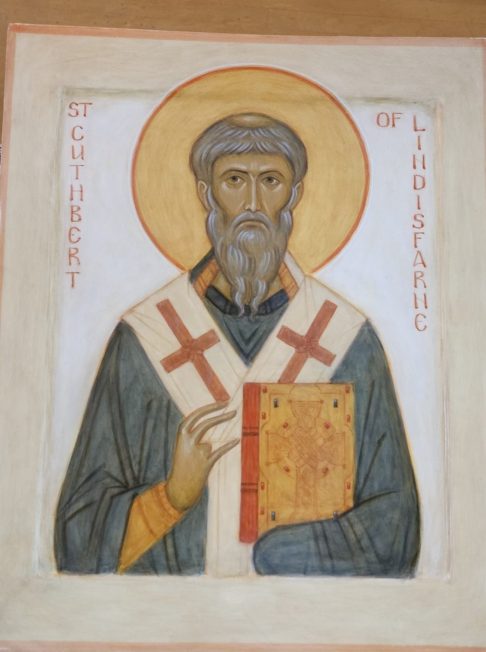
I received such a prompt pretty early this morning, as it came from Greece. And the next name-day greeter shared a photo of the icon above, which is by the hand of Janet Jaime, a contemporary iconographer who is new to me. The friend who wrote me from Greece included an encouraging article about holy elders and saints whose prophecies have been much discussed of late, an example being St. Paisios.

I do think about Current Events, of course. I wouldn’t want to close myself off from what my friends are thinking about, and right now I also have a personal reason to keep at least minimally informed, in that one of my own family members is living in the Middle East and very close to the recent action. Still, it’s important to detach from the stream of noise that is the news, for even half a day, or as long as possible. Because each of us has some work God has given us to do, whether washing the morning dishes or praying on your sick bed, managing a busy restaurant or walking across the street to check on a neighbor. We should be present wherever we physically are.
Today another thing “happened” that became a celebration of my name day, which was the long-awaited lunch together that my goddaughter and I have been trying to accomplish for two years. Naturally we had set the time and place, but without either of us realizing that it was the feast day of St. Joanna, until the day arrived. We spent half the afternoon catching up, and didn’t have a spare moment to talk about events outside of our realm of influence.
Father Stephen Freeman’s blog post for today just happened to be perfect for my name day and my mood: “Everything is in Motion”:
“God’s creation (as we should well know) is everywhere in motion. Every object in  the universe is moving (further apart we are told). Even the particles of matter that compose so-called stationary objects (such as rocks) are in motion. Nothing is completely at rest.”
“Everything is in motion, and everything has its direction. That direction is its purpose – its reason for existence and reason for continuing in existence. This reason is its logos. The Logos of all logoi (plural), is Christ Himself.
In the beginning was the Logos, and the Logos was with God and the Logos was God. All things were made through Him… (John 1:1)
“Each of us has a purpose and reason for existence. For human beings (and all creation), that purpose is union with God…. We move rightly towards the end for which we were created. Salvation, like all things in God’s creation, is dynamic and not static.”
Fr. Stephen goes on to mention how “dizzying” it can be, to live in the midst of this constant swirl that is our world, and our life. He relates how monasteries on Mount Athos will at times set chandeliers swinging during services, which has been described as “representing the dancing of the angels before God.” We often do this in my parish, with four of the six chandeliers that hold real candles turning and twirling while the flames dance.

When I first experienced this I had no idea I would one day enter the Orthodox Church at that parish. I was sitting on the floor during a Vespers service, having come primarily for a weekend food fair. So much was going on in that space, people coming out and going into the altar, other people bowing before the icons or lighting candles, the choir singing beautifully, and no pause in the hymns of praises going up — that is, a lot of movement! — when my gaze was lifted up to the huge chandelier above me — at that time there being just one — which was being pushed by an altar server in such a way that it began to swing into a wide and majestic arc. I thought at the time, These are serious Christians, to worship so extravagantly.
Over the many years since then, I should have known this tradition was symbolic of something, and not just a random act of jubilation. I found a short video that shows one such otherworldly occasion, where multiple chandeliers are in motion, on the Holy Mountain: The Dance of the Cherubim.
You may find it a little jarring, as I did, when phones and cameras other than the one making that video come into view. But I comforted myself knowing that since the angels are immaterial, they are not able to be seen in person or caught in a video unless they choose to take on a material form. But they are probably too busy doing their work of crying “Holy!”, carrying messages, and dancing, to bother about our devices — at least the material kind.

My day is now coming to an end, and it’s time to bring this post to a full stop. The universe is still in motion, I know, but my rational mind and my fingers will cease moving for a few hours. Thank you, St. Joanna, whose name I bear, for your example in actively following Christ in His earthly life, and for your prayers. Thanks be to God for the many ways I have felt His movement, pulling me in, and giving me the strength and will to respond. It feels very much as though I am in The Dance.


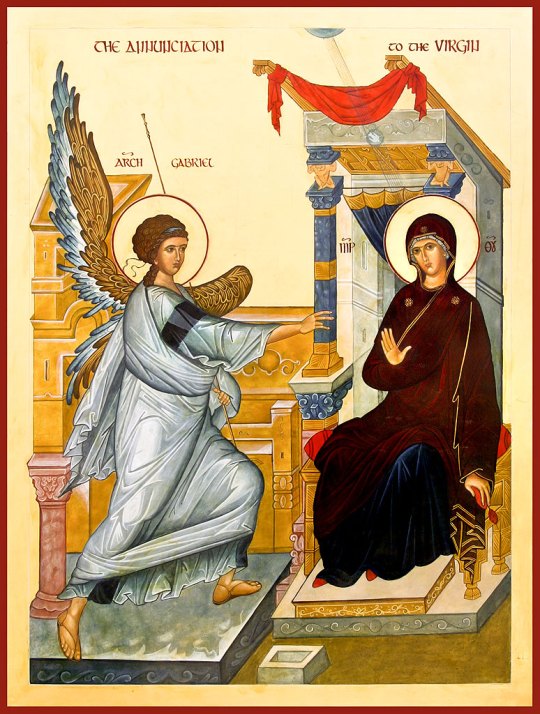
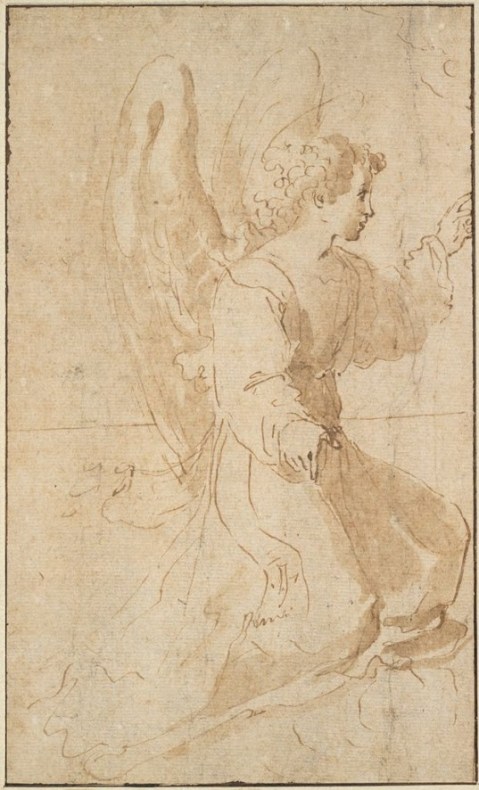
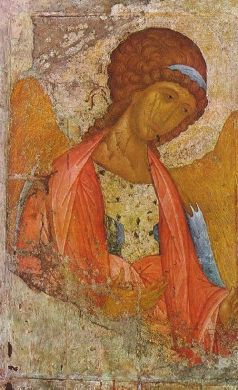 When the Holy Trinity said, “Let there be heaven and earth,” Thou, O Christ, didst serve as a Thought and a Tongue of the divine Trinity. Choirs of angels formed themselves on Thy voice, receiving their form from the multi-colored light; thereupon many armies, as multi-colored clouds, cried out as an echo of the divine glory and divine blessedness, and stood in ranks around Thee, their Leader, singing the triumphal hymn: Alleluia.

 Gladsome Lights