Tag Archives: Annie Dillard

Clouds rain and vanish.

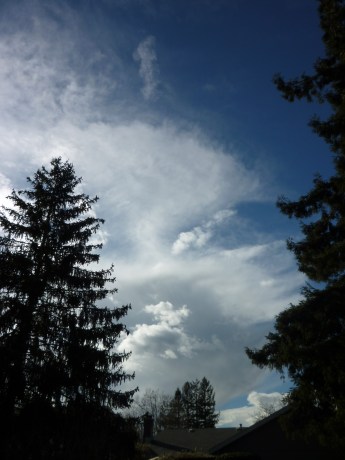
GLP1120486 explosion crpWe got a little rain today, but it was pretty much over by early afternoon, and while driving home from an errand I was feasting on the fantastic cloud formations spread all over the sky.

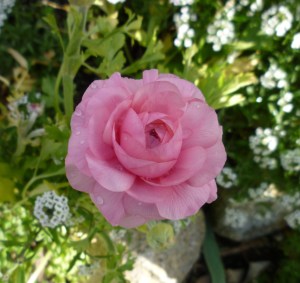
It might have been nice to go to a hilltop to capture them with my camera, but what turned out to be good about staying on the flats, standing in the middle of the street or in the back yard, was that I didn’t have to take all the pictures at once. I shot a dozen, did some laundry and kitchen work, and then it occurred to me that the clouds would have changed, and I could get different views, so I went outdoors again (also noticing flowers).
GLP1120492Several times I did this and out of the batch I kept a few that are sort of interesting, but really, what is a cloud if you can only experience it out of time, flat and tepid and in the still air of another place not its own?

I took Annie Dillard’s For the Time Being off the shelf so I could look up all the sections labeled “CLOUDS” that are scattered throughout the book. The first one is this:

CLOUDS – We people possess records, like gravestones, of individual clouds and the dates on which they flourished.

In 1824, John ConGL P1120493 cotton & treesstable took his beloved and tubercular wife, Maria, to Brighton beach. They hoped the sea air would cure her. On June 12 he sketched, in oils, squally clouds over Brighton beach. The gray clouds lowered over the water in failing light. They swirled from a central black snarl.
In 1828, as Maria Constable lay dying in Putney, John Constable went to Brighton to gather some of their children. On May 22 he recorded one oblique bluish cloud riding high and messy over a wan sun. Two thin red clouds streaked below. Below the clouds he painted disconnected people splashed and dotted over an open, wide coast.

Maria Constable died that November. We still have these dated clouds.GLP1120480 freesias rain

I don’t think so. Maria and John were made in the image of God; they were from the beginning, and I believe they remain, more Real than clouds, the paintings of which are paltry substitutes for what the real things so briefly were.

On another page Dillard quotes John Muir, who while exploring the Sierra Nevada in California in 1869 wrote about several cloud formations he saw, and mused,

“What can poor morGL-P1120516tunnel & peakstals say about clouds?” While people describe them, they vanish. “Nevertheless, these fleeting sky mountains are as substantial and significant as the more lasting upheavals of granite beneath them. Both alike are built up and die, and in God’s calendar, difference of duration is nothing.”

The poor mortal John Muir certainly did say something about clouds when he made that striking comparison…and some things about God and the nature of earthly and heavenly materials — it’s too crazy much for me to think about at the moment.

But if you like to look at clouds such as Muir would have seen in Yosemite, you can do as I have and visit the Yosemite Conservancy page that features several webcams with frequent gorgeous cloud shows. The Park Service also has these cameras. It’s best to visit when you know a storm is brewing up there, not like today with its view (below) of drifty vapors.

GL turtleback webcam 2-28-15

I liked what my godmother said about clouds when I told her about my cloud pictures. She had just read a Lenten meditation by Elder Nektary of Optina, who was speaking of how on the Last Day we will be “carried on the clouds.” We read the same thing in the Bible in I Thessalonians 4:

…For the Lord Himself will descend from heaven with a shout, with the voice of the archangel and with the trumpet of God, and the dead in Christ will rise first. Then we who are alive and remain will be caught up together with them in the clouds to meet the Lord in the air, and so we shall always be with the Lord. Therefore comfort one another with these words.

I will indeed comfort myself with this word from the Father, so that in the future the cloud shows I see will not only be thrilling but remind me that as fleeting as this life may be, at the GLP1120478 ranunculus rainResurrection of the Dead I will be transported splendidly to my permanent and eternal and most substantial home.
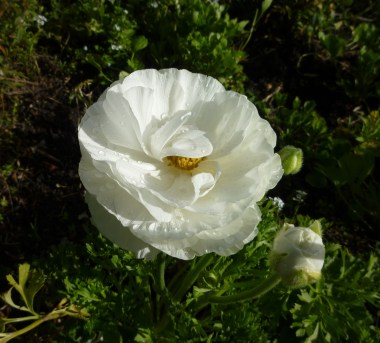
Flowers last a tiny bit longer than clouds (but not nearly as long as granite). This afternoon I “recorded” some of them as well, still sparkling with raindrops.

It turns out that Kim was spending her afternoon in a similar fashion but she was speedier than I at filing her records of blooms and clouds. I hope you all get to enjoy your own living, breathing shows of earth and sky whether or not you try to memorialize them.

GL P1120520 sky 2-28-15

Review: For the Time Being

Giacometti said, “The more I work, the more I see things differently, that is, everything gains a grandeur every day, becomes more and more unknown, more and more beautiful. The closer I come, the grander it is, the more remote it is.”

This clip from the book is as good an introduction to Annie Dillard’s book For the Time Being as anything I could write. I’ve been struggling for months now to write a simple review, but I’m not equal to the task. It occurred to me that I could let Dillard speak by transcribing some passages (in boldface) from the book. I hope they are not enough to be copyright-infringing.

There is always a lot of factual knowledge, especially of geography, history, and natural science, in her books. In this one you learn things about Mao Tse-tung, about the Aztecs, the Romans, and grotesque birth defects. Many statistics about natural things and about what percentage of us are dead, and many stories and sayings of Teilhard de Chardin, who I think is a kindred spirit to her: Do you suffer what a French paleontologist called “the distress that makes human wills founder daily under the crushing number of living things and stars?”

Annie Dillard does suffer this way, as many theologians may suffer from contemplating mankind, the universe, and the finite mind’s inability to take it all in, much less neatly organize it and find ultimate meaning. Augustine said to a group of people, “We are talking about God. What wonder is it that you do not understand. If you do understand, then it is not God.”

If the mystery of life makes you uncomfortable, if you like a good reductionist dogma, I don’t think you will enjoy Dillard in most of her writing. Even I tire of her eventually, as she sometimes appears to be a woman who could be described by II Timothy 3:7: “Ever learning, and never able to come to the knowledge of the truth.” She likes to see how everything is connected, and I agree, it all is connected, but we have been given the key to the mystery in Jesus Christ, who reveals the Holy Trinity to us, the Alpha and the Omega, the Beginning and the End.

Several Jewish theologians down the centuries figure in this particular compendium, her favorite being from the Ukraine in the 18th Century:…the Baal Shem Tov delighted in the spark, the God within. This is not pantheism, but pan-entheism: The one transcendent God made the universe, and his presence kindles every speck of it. Each clot of clay conceals a coal. A bird flies the house. A live spark heats a clay pot.

The thousands of wealth have fallen with wonders, said Rabbi Nathan of Nemirov. Do you find this unclear? It certainly sounds like the sort of thing thousands of wealth do.

And Buddhists: They say there is a Buddha in each grain of sand. It is this sort of pop wisdom that makes the greatness of Buddhism seem aggravating.

“God is in the details” might be Annie Dillard’s motto, as she does always bring all these bits and pieces to bear on a quest for the Ultimate. Every event, every piece of matter, can speak of God. But not in its specialness–rather, its ordinariness. However, It is literally sensible to deny that God exists.

These times of ours are ordinary times, a slice of life like any other. Who can bear to hear this, or who will consider it?

The closer we grow to death, the more closely we follow the news. Year after year, without ever reckoning the hours I wasted last week or last year, I read the morning paper. I buy mass psychotherapy in the form of the lie that this is a banner year.

So, we are not the center of the universe, but there is meaning, and it has something to do with a transcendent God, not foggy pop wisdom and not a gnostic sort of dualism. The thing to do is to engage, to plunge into life in all its materiality and chaos, and make yourself useful.

As Martin Buber saw it–writing at his best near the turn of the last century–the world of ordinary days “affords” us that precise association with God that redeems both us and our speck of the world.

[Teilhard] “Purity does not lie in a separation from the universe, but in a deeper penetration of it.”

[In an introduction to an account of birds mating in Galilee] Our lives come free; they’re on the house to all comers…. God decants the universe of time in a stream, and our best hope is, by our own awareness, to step into the stream and serve, empty as flumes, to keep it moving.

The first book I read by Dillard was An American Childhood, the story of her youth in the mid-20th Century, and I’d have to say that God used it to make me consider all the many details of my own childhood and how they combined in a significant story that God was writing. In all her books I have read I am impressed with her vision of the sacredness of matter, even while she can’t figure it all out. She accepts her own embodiment and relishes her sensate being, which of course feels more real than the intangible.

[Teilhard] “If I should lose faith in God, I think that I should continue to believe invincibly in the world.”

[when we who are alive now are dead] the living might well seem foolishly self-important and overexcited.

One reason I have spent a ridiculous number of hours trying to write about Annie Dillard, is that the quality of her writing seems to demand a comparable response. She doesn’t waste a word; there is no fluff, and I know that she has a reason for juxtaposing the paragraphs on sand and death and Chinese warriors just so. Surely I could study this one book like the Bible, and keep getting more out of it.

I would get not just philosophy and theology, but also whatever the evasive thing is that one learns from reading a lot of good writing. In The Writing Life she teaches by example, both by relating her attitude and ruthlessness toward second-best work, and in the way she respects the language and makes the most of its potential.

I still haven’t looked up all the words–at least 25 in 204 pages–that were completely new to me, including einkorn, heiratic, schleppernish, and geomantic. Saltate is one I will remember, as Dillard used it three times, first to describe the action of sand:

Mostly, the continents’ streams and rivers make sand. Streams, especially, and fast rivers bear bouncing rocks that knock the earth, and break themselves into sharp chips of sand. The sand grains leap–saltate–downstream.

Later she uses this word, which can also mean to dance, along with another new one, knap: Jerusalem….we have come saltating to worship here–to knap ourselves round.

I’m not sure I could come up with a good closing paragraph if I gave it another hour’s effort. My apologies for the inferior review that took me so long; I justify it on a principle I’m not sure Annie would agree with: Any job worth doing is worth doing poorly, at first while you practice.

So I will close with another snippet from the book, a thought that I’m confident is connected to everything else I’ve put down here. It’s mostly a quote from John Muir in 1869:

“What can poor mortals say about clouds?” While people describe them, they vanish. “Nevertheless, these fleeting sky mountains are as substantial and significant as the more lasting upheavals of granite beneath them. Both alike are built up and die, and in God’s calendar, difference of duration is nothing.” 

[a few more of my thoughts on Dillard here]

Ordinary Grace–and Two Books

I should have taken warning from these lines on the third page:

“Ordinary life does not interest me. I seek only the high moments. I am in accord with the surrealists, searching for the marvelous….But I am not always in what I call a state of grace. I have days of illuminations and fevers. I have days when the music in my head stops. Then I mend socks, prune trees, can fruits, polish furniture. But while I am doing this I feel I am not living.”

So writes Anaïs Nin in her Diary from the 1930’s. Hers was a name I had often run across, perhaps because she seems to show up a lot in collections of quotes. I didn’t know anything about her, so I bought this used paperback book last month. It’s yet another that I will stop reading now. Why did I go on as far as I did, to read such lines as, “To be fully alive is to live unconsciously and instinctively in all directions….”? I don’t know.

But I know that I find this self-absorption and drama almost laughable, and definitely boring, in its gushing descriptions of feelings. Her prose is good; it’s the content that is lacking in concreteness and pervaded by an avoidance of reality; even the erotica she is known for is infused with her self-psychoanalysis and psychobabble.

Then there are the dreaded “ordinary” activities. If Nin can’t find her “state of grace” in the concrete here and now of Everyday, in nature and housework, I would give her condition a different name.

I should start doing a little more research on authors before I take time and/or money to learn about them the old-fashioned way. Wikipedia is easy. I could have found several reasons not to read her.

Annie Dillard is the opposite of Nin in some ways. She finds God, or at least looks for Him, in every rock and cloud and human she meets. When I threw For the Time Being into my sewing basket to take to the hospital for the waiting and laboring, I didn’t know that scenes from the hospital OB ward figure heavily in the book. I read a few passages to Pippin before her labor got very laborious.

“These times of ours are ordinary times, a slice of life like any other. Who can bear to hear this? Or who will consider it?” Dillard asks, as she, like Nin, considers the ordinary, but as a member of the human community, struggling with many questions that concern us all and sharing her ruminations with the reader.

She includes categories and section headers with labels such as Now, China, Sand, and Clouds, and cycles back to the topics again and again through the book. I skipped around and read a few of the Birth paragraphs aloud, and I haven’t yet read from the beginning to see how the author ties all these parts together, but I know from her other writings that she sees the philosophical interrelatedness of everything.

I recall words from G.K. Chesterton about how it is really the common everyday occurrences such as the sun rising or the train running on time that should astound us. But the best version of his thought I can find at the moment is: “The whole order of things is as outrageous as any miracle which could presume to violate it. This is how Dillard thinks.

Of the OB ward, she writes,

“There might well be a rough angel guarding this ward, or a dragon, or an upwelling current that dashes boats on rocks. There might well be an old stone cairn in the hall by the elevators, or a well, or a ruined shrine wall where people still hear bells. Should we not remove our shoes, drink potions, take baths? For this is surely the wildest deep-sea vent on earth. This is where the people come out.”

Her appreciation of the Numinous pervading our existence brings to mind another quote from Chesterton that will be my wrap-up:

There is no such thing on earth as an uninteresting subject;
the only thing that can exist is an uninterested person.