Tag Archives: attention

To live a storyless life.

“3100 Christians were killed and 2830 were kidnapped in Nigeria in 2024.” In India, “Four to five pastors or churches are attacked every day.” These are some statistics representing great suffering in parts of the world that aren’t in our daily headlines. The constant wars and episodes of violence, the dysfunctional families and societal breakdown that do make the headlines can’t begin to tell the story of each individual human life wracked with pain and heartache. No doubt all of us know, and many of us are, cases in point. Is it not crass, under the circumstances, to write about being happy? Should we feel guilty for even being happy?

The words of Jesus about tribulation had been floating around in my mind a lot recently: “In the world you will have tribulation,” and, “I have overcome the world.” Last Sunday as I was driving to church and actually bringing those thoughts into focus, as hard as I tried I could not remember the clause that comes between those two, which I have known most of my life. I stopped on the way to pick up a friend, and while I was waiting for her to come out to the car I looked up the verse on my phone. It turned out to be a convenient case of forgetfulness because when I went to the Bible app, of course it had several translations, which gave a broader meaning to Christ’s encouraging words.

Our Lord had just been telling his disciples about many disturbing things that would happen in the future, and then generalized saying, “In the world you will have tribulation….” And his next words are startling, really. The way I knew the next part is: “…but be of good cheer, for I have overcome the world.” Other translations are “take heart,” or “have courage, for I have overcome the world.”

The poem below is about being happy, about meaning, and writing. I’ve written before about how in the most creative, happy times of my life, which were while I was with child, I completely forgot about my diary or journal and never wrote a word in it. At other times, just living at a normal level of happiness, I often have written in a journal. My problem with journaling is exactly what G.K. Chesterton alluded to on at least two occasions saying,

“I am a bad reporter because everything seems to me worth reporting; and a bad reviewer because every sentence in every book suggests a separate essay,” and,

“Once I planned to write a book of poems entirely about the things in my pocket. But I found it would be too long; and the age of the great epics is past.”   

Did Chesterton ever keep a journal, I wonder? My guess is he didn’t, because writing about everything in a journal would leave him no time for gainful employment at writing in a more focused manner about many things.

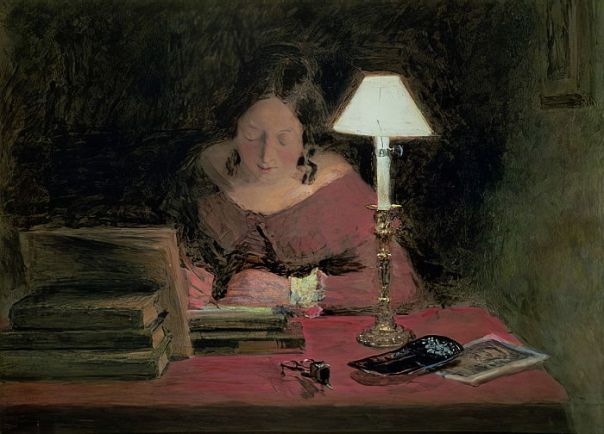
William Henry Hunt, Girl Writing by Lamplight

I seem to have given up on my journal to a greater degree than ever before, because there is just too much that I want to put in it. If I wrote in my journal the way I want to, I would never be done. I sense this, every time I try, and I start scribbling madly, racing against time, knowing that it’s hopeless: I will never be able to do a proper job. Journaling demands to be neverending.

A book I borrowed briefly from the library some years ago told the story of the author’s obsession with journaling, and then her obsession with thinking about her obsession. She asked, How could she have a life, if she journaled about everything? She feared she was ceasing to really live, because she was writing instead. I didn’t read very far in it, because if journaling was stealing time from living, using my precious hours to read her book was even worse theft.

Blogging is not the same at all, in my case. I have to be somewhat focused when I write for others to read, and I must bring every post to an end, so I can publish it. For a process-oriented person like me, each post is a manageable goal, one which I can abandon and no one will care. In the meantime, I’m able to include some of the things I would have journaled about, without getting lost in my thoroughness.

I could put myself into this poem, and I would be talking to God. Because I do write a lot, the whole thing may not seem to pertain to my situation. But it did make me think, and it made me happy.

MISSED TIME

My notebook has remained blank for months
thanks to the light you shower
around me. I have no use
for my pen, which lies
languorously without grief.

Nothing is better than to live
a storyless life that needs
no writing for meaning —
when I am gone, let others say
they lost a happy man,
though no one can tell how happy I was.

-Ha Jin

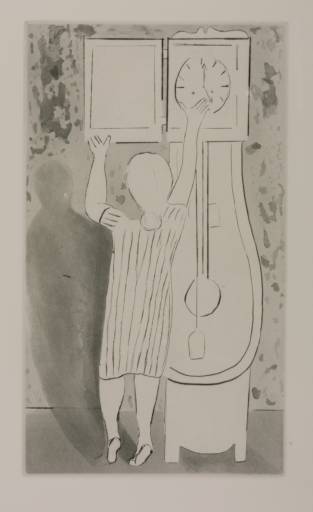
Louise Bourgeois, Woman and Clock


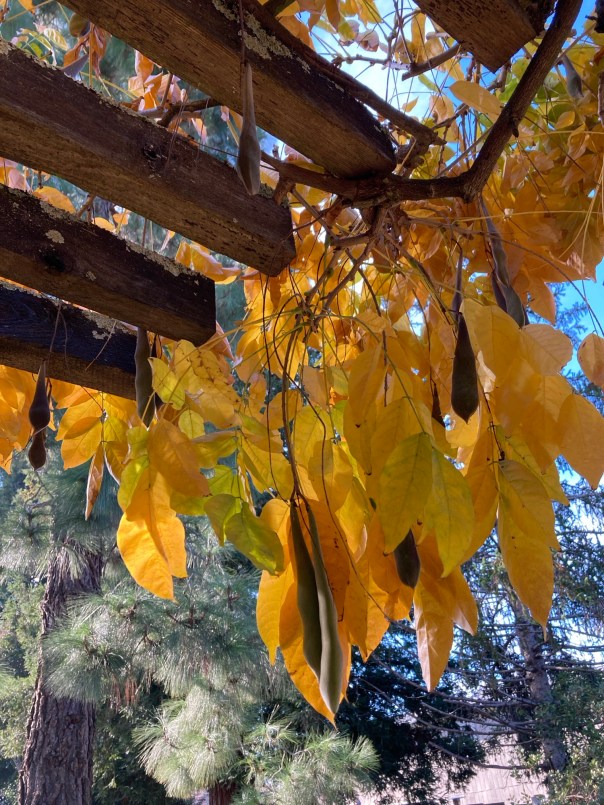
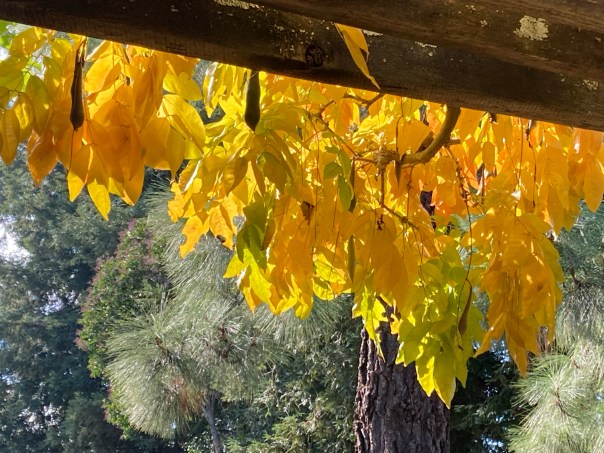
I shift my attention to wisteria leaves.

Most of the day I’ve been in a melancholy mood, except for the hour or so I was outside helping Alejandro pull the remaining leaves off the plum trees. We did this in preparation for applying the first dormant spray of the season, and I do love being in the garden, just soaking up the fresh smells and dampness. In the middle of the day, that is, when the chill doesn’t go straight to the bones.

I spent hours and hours out there this week, planting bulbs and annuals too late, and getting a little weary of the cold sogginess. But every time I would look up from the ground, there was the sky, and the varied colors of leaves drifting down from my crape myrtle, or the neighbor’s liquidamber. The whole thing overwhelms me with the beauty and sadness of the earth.

And today, it was the wisteria in my own garden that lifted my head and heart — it is a richer, deeper, brighter yellow-gold than I’ve ever noticed before. Truly, if cameras had never been invented, I would have had to learn to paint long ago.
Happy December, my Dear Readers all!

Boredom, the rhythm and the minutiae.


BORED

All those times I was bored
out of my mind. Holding the log
while he sawed it. Holding
the string while he measured, boards,
distances between things, or pounded
stakes into the ground for rows and rows
of lettuces and beets, which I then (bored)
weeded. Or sat in the back
of the car, or sat still in boats,
sat, sat, while at the prow, stern, wheel
he drove, steered, paddled. It
wasn’t even boredom, it was looking,
looking hard and up close at the small
details. Myopia. The worn gunwales,
the intricate twill of the seat
cover. The acid crumbs of loam, the granular
pink rock, its igneous veins, the sea-fans
of dry moss, the blackish and then the graying
bristles on the back of his neck.
Sometimes he would whistle, sometimes
I would. The boring rhythm of doing
things over and over, carrying
the wood, drying
the dishes. Such minutiae. It’s what
the animals spend most of their time at,
ferrying the sand, grain by grain, from their tunnels,
shuffling the leaves in their burrows. He pointed
such things out, and I would look
at the whorled texture of his square finger, earth under
the nail. Why do I remember it as sunnier
all the time then, although it more often
rained, and more birdsong?
I could hardly wait to get
the hell out of there to
anywhere else. Perhaps though
boredom is happier. It is for dogs or
groundhogs. Now I wouldn’t be bored.
Now I would know too much.
Now I would know.

-Margaret Atwood

Here we have a different perspective on boredom from what I posted yesterday…  and I love this poem. But I wondered about the line, “Now I would know too much.” Why would the narrator prefer less understanding — which is what I took as the meaning of knowing — ? In what way would it be too much? But then I mused on how well I relate to the feeling of regret, regret that there were any moments or hours in which I was not fully conscious, and thankful for my late husband. That of course would have been the perspective of a saint; if I had the chance to go back, I’m sure I would still not be one of those.

That made me think, maybe the line I didn’t get refers to the fact the narrator has come to realize, that “he” was not going to be around indefinitely, and that the loss of him would be incredibly painful. It’s the sort of intelligence that sinks deep into the soul, where the struggle to comprehend it continues indefinitely. Now, if she could go back, she would not be the same person, and the kind of knowledge she would take back to the past would be truly too much to bear in that “present.” It isn’t given to us humans to skip back and forth through time, which is a good thing, because just reading this poem demands more of my mind than is comfortable. Most of us can barely attend to the present, and excessive theorizing can be a sad waste of our hours.

That I should read the poem during the holiday season, when I’m already prone to missing my husband a LOT… well, it happened, and it’s okay. It prompted me to think of some specific moments and places, my own husband’s hands (easy for me to pay attention to), and habits, and “boring” things he would talk to me about. I even remember a time when I was sitting in a boat, trying really hard not to be bored.

Nowadays, I’m increasingly thankful for all the days that God gave me before, during and after the years I lived with him, though I can’t go back and be this thankful retroactively. And even if I was not always present in the moment, God was always present with me. That is a thought that wakes me up, again and again.

Mr Glad and His Sister

A batch of cookies and summer loves.

Crape Myrtles are in full bloom in my neighborhood, including on my own property. Mine is not more than five years old, and in the last year it seems to have doubled in size.

I’ve been walking down to the creek bridge and beyond several times a week, and all the trees and plants growing in and on the banks of that stream also seem to have mushroomed, so that I can barely see the water below the bridge.

I love the summer, because it’s only in the occasional heat waves of the season that I can feel fully at home and in sync with the earth. In this climate with marine influence, where the evenings get cold and breezy even in the summer, it’s a treat to fully sink into the warmth and stay there all evening; even when I climb into bed I am relaxed, and don’t have to pull several layers up to my chin against the chill. Of course, this sounds crazy to those of you who live in high-humidity summer zones!

Even when it was over 100 degrees last week, I was able to spend a lot of time in the garden morning and evening, and then work on other projects in the middle of the day. I have plenty of paperwork and sorting yet to accomplish. If I ever finish that — Please God, help me! — I could sew, or read, or get back into writing book reviews …

When I read on my phone, I’ve started taking screen shots of quotes that I don’t want to lose. And I often look up words I don’t know — On Substack there are so many good writers with vast vocabularies — and take screenshots of the definitions.

Spider in the plum tree.

One morning as I set out on my usual walking route, I passed by the house down on the corner, where a vegetable garden has been carved out of the lawn, next to the sidewalk. For months I have been admiring the health and size of the plants, and that morning I spied a dozen beautiful yellow summer squashes peeking out from under the leaves, several of which should have been picked days earlier; on my way back I debated about whether to inquire about them. If the owners didn’t want them for some reason, I would take them… and if the gardeners had suddenly been incapacitated and couldn’t pick their own squash, I could offer to do that for them….

It sounded reasonable… and one hates to see beautiful vegetables going to waste… but what if I got involved with people I found disagreeable? Or who were needy beyond my abilities to help? I stood on the sidewalk and thought a while, then walked up to the door and knocked. The result: I made a new gardening friend.

Dee gave me three overgrown squashes, though none of the size I’d have preferred, and she invited me to come back for more. She enjoyed talking about her garden, and told me about her family that she lives with, including her recently widowed mother, who she said is the cook of the household. I wondered if that cook prefers overgrown zucchinis…. On one of the less sweltering days I did cook the squashes into a spicy, satisfying stew, which I was glad to have..

That’s my own chard and collards in the picture above, the leaves that were not eaten by insects or mollusks; I picked almost all of my greens and now my own little squash plants are spreading out in the planter boxes. Recently I transplanted the tarragon out of a pot into one of those boxes where it will get more regular watering, and it is thriving.

I used several sprigs of it to make Anytime Apricot and Tarragon Cookies from the Dorie’s Cookies book. They were in the chapter called “Cocktail Cookies,” and the recipe includes no sweetening beyond the dried apricots and tarragon.

I baked those savory shortbread cookies to take to friends who’d invited me for lunch, who I knew didn’t care for sweets very much. But they are winemakers, so I thought they might like the kind of savory cookies one could nibble on while sipping a glass of wine. We all thought they were really nice; it was amazing how much subtle sweetness we tasted in them; I think the level of saltiness helped bring it out.

I got together with several women who are collaborating to share homemaking skills; for our first meeting we focused on knitting. I had two cotton dishcloths I’d knitted a while back, which I decided to join together. I tried crocheting them together but I couldn’t figure out how to do that while at the same time chatting with everyone, so I just sewed them together with a blanket stitch.

I don’t have hopes of becoming an expert knitter, but I like to be with these women. And their babies! (At church there is a new family with a little guy just turned one, and he is the friendliest love bug. He loves me! And I never tire of holding him.)

Our host had an awe-inspring jar of kombucha scoby on her kitchen counter, and two of our group were happy to take home a quart of it to get their own kombucha production up and running again. My own fermenting experiments stalled decades ago with yogurt-making, and a succession of three yogurt makers that never satisfied. I never tried making sauerkraut, because that was a food I have been prejudiced against ever since it made a regular appearance on our table when I was a child; I did somehow manage to enjoy kimchi when my son “Soldier” brought it into the family’s already international culinary repertoire.

But I have made Lemon Verbena Sugar Paste!  Lemon verbena is one of my garden treasures, but I haven’t pruned my plant often enough or used its leaves much, and it has gotten very leggy. So when I saw a young and well-shaped specimen in the grocery store, I brought it home and now have two such treasures. When I pruned the older plant, I took all the leaves to make Lemon Verbena Sugar Paste. There were more or less potent recipes online; I used the one with the highest ratio of herb to sugar, 2 cups to 1/2 cup.

I stuck the paste in the freezer and hope I will remember to bring it out to add to tea, sprinkle on desserts, use as a glaze, etc. Maybe I’ll also remember to tell you here if I do.

After I asked my friend Cori what were her summer reading plans, naturally she asked me back. I should have anticipated that and not asked her to begin with — because I have no real plans, and feel like an imposter. I have been reading less than usual. I see that of the nineteen books I pictured here five months ago, I have read just two. Only one of those I got to the end of was from the stack I was going to “try extra hard” to read this year. Well, the year is half over, so it doesn’t look promising for those selections. I took new pictures of the “summer books” to show Cori, because it was easier than typing out the titles.

Four of those I have at least started reading, and the Undset book is my current reading-while-falling-asleep choice. I have, typically, read several books that I didn’t anticpate back in February, and some of them were not worth talking about, or even reading to the end.

But let me just mention a young adult novel I did read to the end and liked a lot, What the Night Sings. Written by Vesper Stamper, who was one of the speakers at the Symbolic World Summit I attended earlier in the year in Florida, this is a coming-of-age-in-the-Holocaust story, illustrated by the author. First I listened to the novel, and then I borrowed the hard copy from the library, because I wanted to see the illustrations, which are many, and are very well done, as is the whole story. Stamper’s Berliners, is at hand, too, waiting for me.

If you have read — or even scrolled — this far in my ramble, I’m impressed! There is some reason you stayed so long, though there were doubtless some topics along the way that didn’t interest you. Whoever you are, I appreciate you very much.