“Of all tyrannies, a tyranny sincerely exercised for the good of its victims may be the most oppressive. It would be better to live under robber barons than under omnipotent moral busybodies. The robber baron’s cruelty may sometimes sleep, his cupidity may at some point be satiated; but those who torment us for our own good will torment us without end for they do so with the approval of their own conscience.”
In looking for the source of a C.S. Lewis quote recently, I came upon the website of William O’Flaherty, who has written a whole book about misquotes of Lewis. Many of these result from the mis-quoter having reduced a passage to a summary, taking bits of sentences and combining them into something that is a mere shadow of the original, or maybe even a shadow shading the sun of the original.
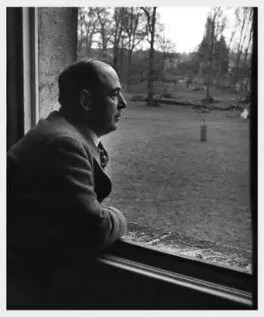
One thing Lewis wrote that I have long appreciated is the following passage, which in its emaciated form has made the rounds of the online world now. It’s so much better in the full version, in which Lewis quotes Samuel Johnson, and we thereby get extra support for his argument. Here is the excerpt, from “a letter to Mrs. Johnson”:
“I think I can understand that feeling about a housewife’s work being like that of Sisyphus (who was the stone rolling gentleman). But it is surely, in reality, the most important work in the world. What do ships, railways, mines, cars, government etc exist for except that people may be fed, warmed, and safe in their own homes?
As Dr Johnson said, ‘To be happy at home is the end of all human endeavour’. (1st to be happy, to prepare for being happy in our own real Home hereafter: 2nd, in the meantime, to be happy in our houses.) We wage war in order to have peace, we work in order to have leisure, we produce food in order to eat it. So your job is the one for which all others exist.”
What Dorothy Parker describes in her poem below reminds me of what C.S. Lewis called sehnsucht, the heart’s longing, seemingly for its home – in God. These episodes often happen at moments when we experience something very good or beautiful, and realize deep in ourselves that it doesn’t quite satisfy, but only reveals our homesickness.
In The Weight of Glory Lewis describes this aching in our heart:
“In speaking of this desire for our own far off country, which we find in ourselves even now, I feel a certain shyness. I am almost committing an indecency. I am trying to rip open the inconsolable secret in each one of you—the secret which hurts so much that you take your revenge on it by calling it names like Nostalgia and Romanticism and Adolescence….
“We cannot tell it because it is a desire for something that has never actually appeared in our experience. We cannot hide it because our experience is constantly suggesting it, and we betray ourselves like lovers at the mention of a name. Our commonest expedient is to call it beauty and behave as if that had settled the matter. Wordsworth’s expedient was to identify it with certain moments in his own past. But all this is a cheat. If Wordsworth had gone back to those moments in the past, he would not have found the thing itself, but only the reminder of it; what he remembered would turn out to be itself a remembering.
“…These things—the beauty, the memory of our own past—are good images of what we really desire; but if they are mistaken for the thing itself they turn into dumb idols, breaking the hearts of their worshipers. For they are not the thing itself; they are only the scent of a flower we have not found, the echo of a tune we have not heard, news from a country we have never visited.”
Peder Monsted
TEMPS PERDU
I never may turn the loop of a road Where sudden, ahead, the sea is lying, But my heart drags down with an ancient load– My heart, that a second before was flying.
I never behold the quivering rain– And sweeter the rain than a lover to me– But my heart is wild in my breast with pain; My heart, that was tapping contentedly.
There’s never a rose spreads new at my door Nor a strange bird crosses the moon at night But I know I have known its beauty before, And a terrible sorrow along with the sight.
The look of a laurel tree birthed for May Or a sycamore bared for a new November Is as old and as sad as my furtherest day– What is it, what is it, I almost remember?
More than one reviewer of Richard Wilbur’s late collection of poems noticed that after his wife died, the poet wrote more about death, as in this example below. That would be a natural response, of course, for someone 90 years old, even if he hadn’t been recently widowed.
I know it’s recommended that people of all ages live with awareness of the shortness of our lives, as in Psalm 90: “Teach us to number our days, that we may gain a heart of wisdom.” Or as another translation goes, “Teach us to realize the brevity of life….”
If our dearest friends and family have departed, it could exacerbate any feeling of weariness we already had with this earthly existence. In the same Psalm the poet mentions the less-than-thrilling aspects of life: “The days of our years are threescore years and ten; and if by reason of strength they be fourscore years, yet is their strength labour and sorrow; for it is soon cut off, and we fly away.”
A MEASURING WORM
This yellow striped green Caterpillar, climbing up The steep window screen,
Constantly (for lack Of a full set of legs) keeps Humping up his back.
It’s as if he sent By a sort of semaphore Dark omegas meant
To warn of Last Things. Although he doesn’t know it, He will soon have wings,
And I, too, don’t know Toward what undreamt condition Inch by inch I go.
~ Richard Wilbur
Richard Wilbur was a lot smarter than an inchworm, so I like to think he had this verse from I Corinthians in mind when he wrote those last lines: “But as it is written, Eye hath not seen, nor ear heard, neither have entered into the heart of man, the things which God hath prepared for them that love him.”
Because the Preparer is Love, our Last Things, though unimaginable, will be the best.
I first shared this poem of Wilbur’s ten years ago, before he had passed over, into what we might think of as the pupa stage; today I read this about the inchworm:
“After the larva hatches, he feeds on leaves for about a month before he drops to the ground via a silken thread. In late spring or early summer, the larva burrows up to 4 inches into the ground, spins his cocoon and pupates. If he’s a fall worm, he’ll emerge in the fall, usually between November and early December. If he’s a spring worm, he’ll wait until the next late winter to emerge.”
At the time of Wilbur’s death I posted one article written about him for the occasion, but just now I found another tribute in USA Today, in which the journalist remarks on the unusual quality of happiness in this poet, and quotes Wilbur:
“I think many people associate happiness with shallowness,” Wilbur told the AP. “What people don’t want is someone who is complacent. And I know that I am not a complacent man.”
Richard Wilbur was the farthest from complacent that I can imagine. He spent his life being attentive to the world around him and pursuing love and beauty. I hope that in his present state he knows even more what C.S. Lewis meant when he said:
“Joy is the serious business of Heaven.”
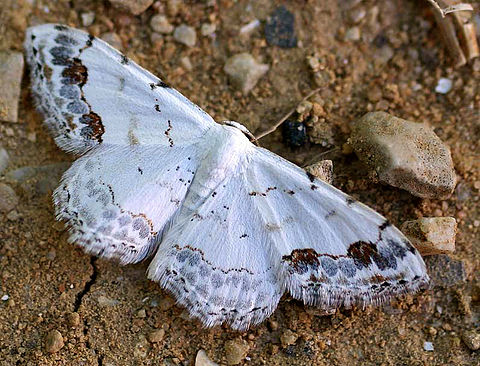
Geometer inchworm moth – Scopula Decorata or Middle Lace Borer


 One thing Lewis wrote that I have long appreciated is the following passage, which in its emaciated form has made the rounds of the online world now. It’s so much better in the full version, in which Lewis quotes Samuel Johnson, and we thereby get extra support for his argument. Here is the excerpt, from “a letter to Mrs. Johnson”:


 Gladsome Lights