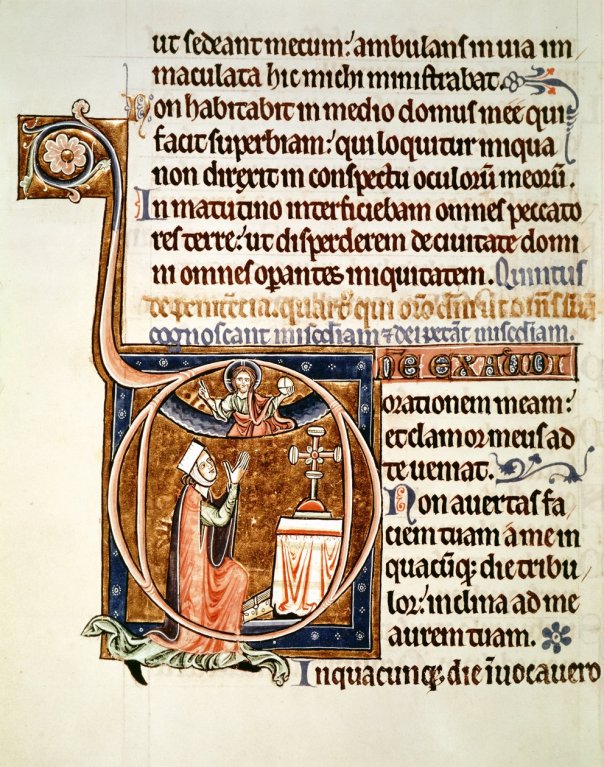
From the Psalter of St. Louis and Blanche of Castile, 13th c.
“…how did the monks train? By singing the psalms. Here is the key to the power, such as it is, of medieval communal prayer: it was focused on the psalms. And why on the psalms? Because, as every medieval Christian knew, they are focused on Christ the Lord, the Word who is with God and who is God, through whom everything was made (John 1), who set his tabernacle in the sun and came forth as a bridegroom from his wedding chamber (Ps. 18:6), the king of glory mighty in battle (Ps. 23:8) who entered into his temple (Heb.) to rescue his people from their sins (Ps. 21).
“Religion, properly speaking, is about worship, and it is the object of worship that defines the community. If the community worships itself (as a city, nation, or empire) then its religion is about belonging to the group (see, pagan Rome, and its opposition to Christians). But a community worshiping Christ is defined by Him—and its individual members have strength to stand up against other communities who define themselves by something other than Christ.”
I don’t think I ever heard this carol until today. I was checking out the YouTube channel of Clamavi De Profundis, guessing that I might find good Christmas music there. I was happy to see that they have recorded several Christmas pieces, including this one: “See Amid the Winter’s Snow”:
I read this as a poem just this fall, and did not realize at first that it is the lyrics to a Christmas carol, sung to the same tune as “Lo, How a Rose E’er Blooming.” I wonder if any of my readers is familiar with it.
I know we are all at least somewhat acquainted with the One whose birth is the glorious mystery about which St. Germanus wrote so long ago.
A GREAT AND MIGHTY WONDER
A great and mighty wonder, a glorious mystery: a virgin bears an infant who veils his deity.
Proclaim the Savior’s birth: “To God on high be glory and peace to all the earth!”
The Word becomes incarnate and yet remains on high, and cherubim sing anthems to shepherds from the sky.
While thus they sing your monarch, those bright angelic bands, rejoice, O vales and mountains, and oceans, clap your hands.
Since all he comes to ransom, by all be he adored, the infant born in Bethl’em, the Savior and the Lord.
All idols then shall perish and Satan’s lying cease, and Christ shall raise his scepter, decreeing endless peace.
-Germanus of Constantinople (634-734) Translated by John Mason Neale
The first lines of the carol “Gabriel’s Message” take my imagination straight up to Heaven, and down again to the encounter the Virgin Mary had with the Angel Gabriel. This song of the Annunciation I heard for the first time a couple of years ago. Nowadays, if I so much as think about it once in the morning, or often even without consciously bringing it to mind, it plays in my head all day, beautifully, joyously.
In looking for a YouTube video of it to share here, I found that I don’t like the ones in which boys’ choirs are singing sweetly bird-like. It seems a strong man’s voice should speak the message of the first two stanzas, which come from Gabriel.
This version is my all around favorite, in which a choir sings in lower registers.
This man singing solois my favorite manly rendition. I like the way he sings it straight, and the only way I’d improve on it is to not have to look at him as the performer.
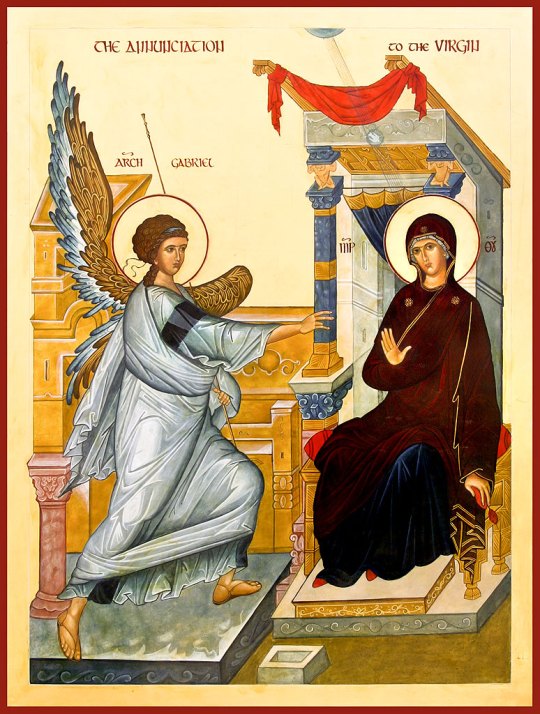
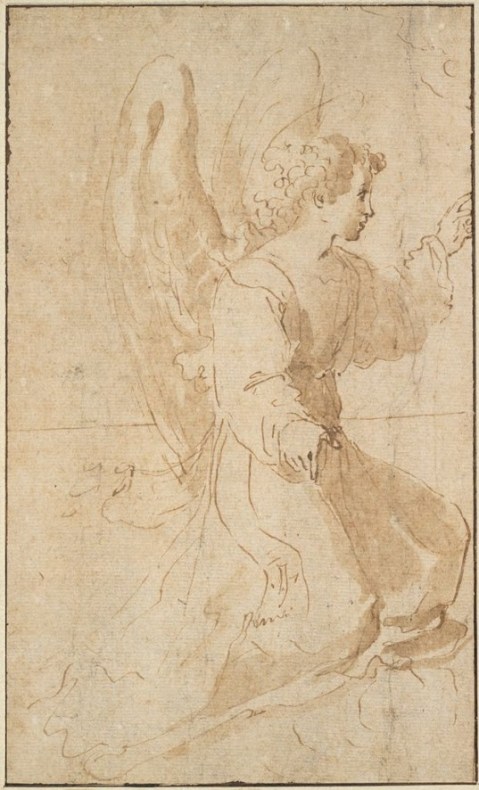
I was interested to see that there aren’t many icons or paintings of Gabriel in which his wings look anything like drifted snow. In fact, the image of drifted snow doesn’t evoke the idea of the strength that would be necessary for the swift messenger of God we know an angel to be. In many paintings Gabriel’s wings look very powerful, and poised to be in flight in an instant, at the next word from God. But the phrase does make me think of purity, and certainly the scene of fresh snow is somewhat other-worldly.
Angels do not have any inherent form; they are spiritual beings who only take on human-like form in order to be seen by those who are given the spiritual eyes to see. We don’t have a record of how the Archangel Gabriel appeared to the eyes of the Virgin, but we do know his message:
GABRIEL’S MESSAGE
1 The angel Gabriel from heaven came, his wings as drifted snow, his eyes as flame; “All hail,” said he to meek and lowly Mary, “most highly favored maiden.” Gloria!
2 “I come from heav’n to tell the Lord’s decree: a blessed virgin mother you shall be. Your Son shall be Immanuel, by seers foretold, most highly favored maiden.” Gloria!
3 Then gentle Mary meekly bowed her head; “To me be as it pleases God,” she said. “My soul shall laud and magnify his holy name.” Most highly favored maiden, Gloria!
4 Of her, Immanuel, the Christ, was born In Bethlehem, all on a Christmas morn, and Christian folk throughout the world will ever say, “Most highly favored maiden.” Gloria!

 Gladsome Lights