Tag Archives: cemeteries

The death of death, and wildflowers.

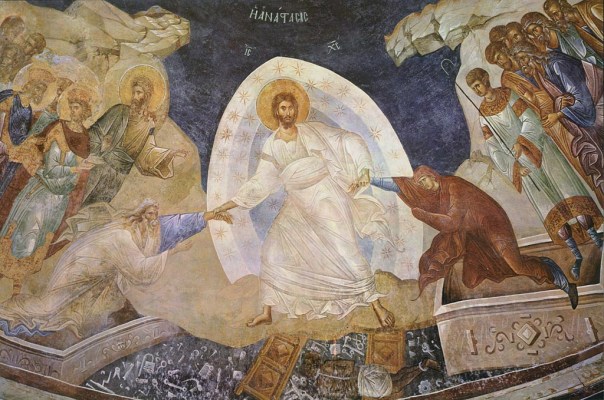
“Christ is risen from the dead, trampling down death by death,
And upon those in the tombs bestowing life.”

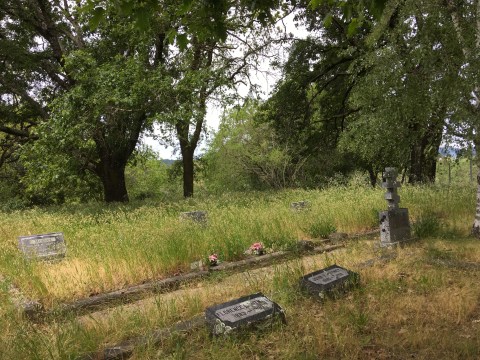
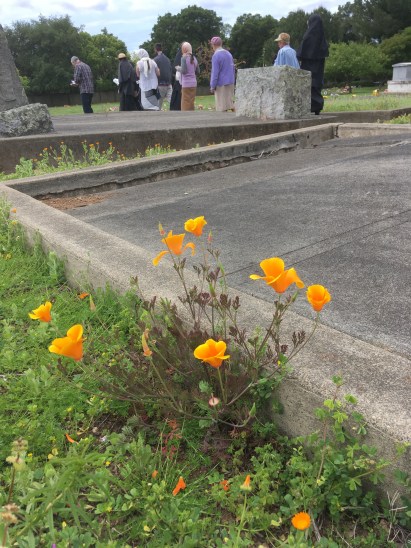
This is one of the Paschal hymns our little groups sang over and over today, as we walked among the graves at several cemeteries, rejoicing with those who wait in hope.

It is called the Day of Rejoicing, or Radonitsa,
and is always the second Tuesday after Pascha.


Today the wind was blowing, so we could not keep our candles lit. The sun peeked out from behind clouds from time to time.

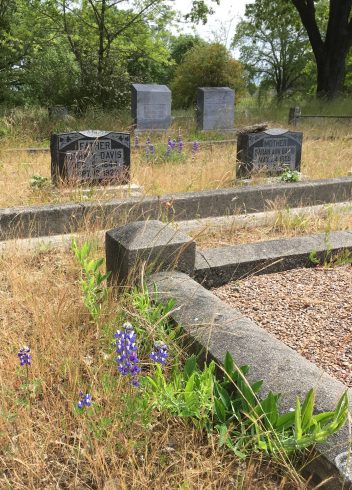
More wildflowers than I’ve ever seen were blooming in the non-endowed cemeteries. This must be because of the very wet winter and spring we have had.


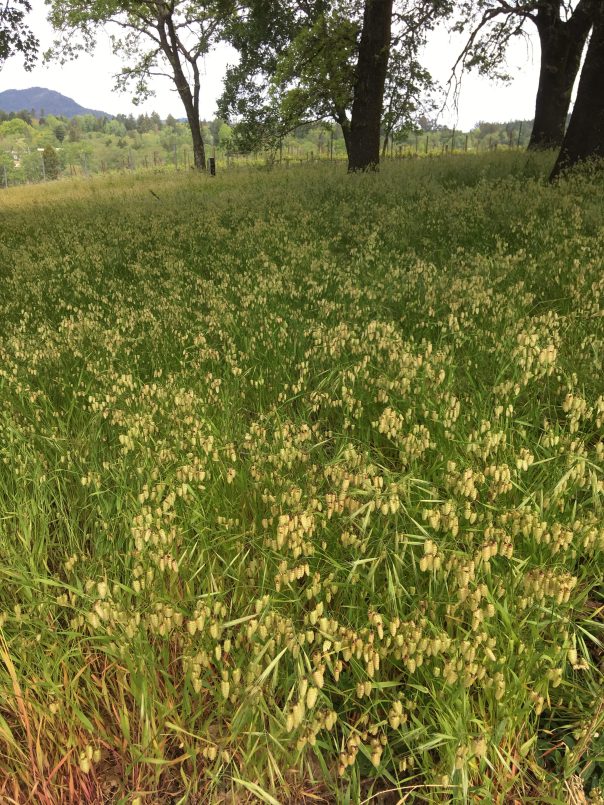
The rattlesnake grass was blowing in the breeze and making a graceful and wavy dance.

I knew that Scarlet Pimpernel was a flower, but I didn’t know it was this flower
growing among the lupines. My godmother told me.

My husband is buried at one of the cemeteries we visited, and my goddaughter at another.
We sang and burned incense and sprinkled holy water over the graves of dozens of others
who are resting in the earth, awaiting the Resurrection of the Dead.

This year I remembered to bring the shells from our red Pascha eggs
to sprinkle on the graves, and flowers from my snowball bush, too.
We were all so happy to be there!

“We celebrate the death of death, the destruction of hell, the beginning of eternal life.
And leaping for joy, we celebrate the Cause,
the only blessed and most glorious God of our fathers.”

We pray and kiss her good-bye.

The picture below is of a cemetery that I have visited a few times in the last two years. This week I was here for the burial of Nina, about whom I told you not long ago, when she was still going strong.

Fvl cemetery Radonitsa 15

Nina said recently, and smiling, I’m sure, that she didn’t really want to celebrate another birthday on this earth; and though she wasn’t sick or in pain, her heart did stop one day, just before she would have turned 104.

When I heard that she had died I was still in the mountains, and it made me sad to think I would not be able to pray at her funeral – so I was pleasantly surprised to learn that it would not take place until later. It’s not traditional to wait that long, but perhaps the birth of one of her great-great-grandchildren, who was present at the service and two weeks old, had something to do with the delay.

It was to love and honor Nina that I made the effort to get to church that morning, and not because I knew her or her family very well. I wasn’t feeling energetic or “spiritual” and you might even say I was in a bad mood. So I was completely surprised at how personally and deeply I was affected.

Her casket was in the center of the church. We were all gathered around singing, and the priests and deacons were censing Nina and the church, because something fundamental and important and holy was going on. Yes, they were censing Nina. Father addressed the common but mistakgl photos ninaen idea that people often express about the dead, saying, for example, “That’s not my mother!” as though the material aspect of the self was unessential. “Well, who is it, then?” he asked.

Father Stephen in a recent blog told about a Protestant church in his town that forbids the presence of the body at funerals. He writes, “Biology is easily the most fundamental aspect of our human existence. We do not ‘have’ bodies – we ‘are’ bodies.”

I’m so thankful that in my church we do not whisk away the body, but instead acknowledge it as the most “fundamental aspect” of the person and the way that we have known them their whole life. We sang a hymn about “the last kiss,” and we had the opportunity to kiss and venerate Nina’s holy body, with which she worshiped God and loved so many people during her many years on the earth.

I did think a lot about my husband that day, and I wept, because I still feel the raw places where he was torn away from me; but because it has been over a year since his own falling asleep, I was less distracted by my own grief and able to pay closer attention to the service than I could at the two funerals I attended last spring and summer. I noticed Christ with us at Nina’s funeral, and the palpable love of the Holy Trinity, which we reflected in and from our own bodies, still more or less intact.
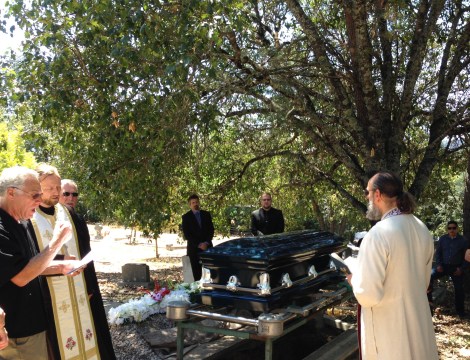
gl Nina graveside

The liturgy of the funeral service is rich and deep. It is a commending of the believer to God, praying, “Grant rest in blessed repose, O Lord, to the soul of your servant,” many times, solemnly and lovingly, with Psalms and many readings from the Gospels and other scriptures, such as this passage from John, in which Jesus tells His disciples,

Verily, verily I say unto you, he that heareth My Word and believeth in Him that sent Me, hath everlasting life and shall not come into condemnation, but is passed from death unto life…. the hour is coming and now is, when the dead shall hear the voice of the Son of God; and they that hear shall live. For as the Father hath life in Himself, so hath He given to the Son to have life in Himself, and hath given Him authority to execute judgment also, because He is the Son of Man.

Marvel not at this; for the hour is coming in which all that are in the graves shall hear His voice and shall come forth….

gl blessing grave w holy water

Hearing words like this, I couldn’t dwell too long on the horrible unnaturalness of death, and the sorrow of a soul being torn from its body. Again, I am helped by the way that Fr. Stephen explains our perspective:

In the traditional theology of the Eastern Church, this world and the “next,” are not two worlds. We use the language of place (heaven and earth) for lack of language not for accuracy. There is more to the created order than we see (“all things visible and invisible”). But that which is not seen is not inherently separate from that which is. Sacrament (mystery in the East) is a way of describing the relationship between what is seen and what is unseen. Everything is sacrament, icon and symbol.

In such a setting, death is a change, but not an end. That which we see, the body, remains important and worthy of honor. A funeral, the service of remembrance, is a sacramental gathering in the presence of God. The body is honored, even venerated. The life of remembrance, eternal remembrance, begins.

gl shovel of dirt into grave

I hadn’t planned to go to the cemetery for the burial, for various reasons, but I didn’t want to leave this event that seemed to have a stately and grace-filled momentum – I wanted that grace!

So I drove over with a couple of other women, and stood with the family and fellow parishioners, including that brand-new baby, while we committed our dear friend to the earth – for a time. The epistle we had just heard echoed in my mind,

(I Thessalonians 4) 13 But I would not have you to be ignorant, brethren, concerning those who are asleep, that ye sorrow not, even as others who have no hope.

14 For if we believe that Jesus died and rose again, even so will God bring with Him those also who sleep in Jesus.

15 For this we say unto you by the Word of the Lord: that we who are alive and remain unto the coming of the Lord, shall not precede those who are asleep.

16 For the Lord Himself shall descend from Heaven with a shout, with the voice of the archangel and with the trumpet of God; and the dead in Christ shall rise first;

17 then we who are alive and remain shall be caught up together with them in the clouds to meet the Lord in the air. And so shall we ever be with the Lord.

If you would like to read more about the Orthodox funeral service, there is a good article on this site. It’s all very encouraging!

With the saints give rest, O Christ, to the soul of Thy servant where sickness and sorrow
are no more, neither sighing, but life everlasting
.

gl harrowing med resurrection anastasis

In this case, He truly wasn’t there.

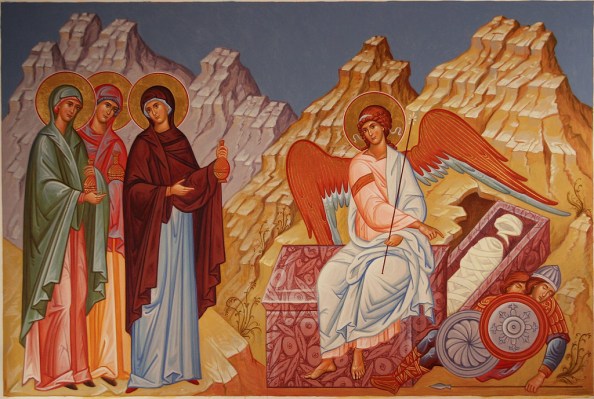
The second Sunday after Pascha we remember the myrrhbearers, the women who came early in the morning to Christ’s tomb to anoint his body. This article from our parish bulletin gave me great joy, as did the excursion I made with some others from church to several cemeteries this week, where we proclaimed Christ’s Resurrection to those in the graves. Our rector told us that we were also myrrhbearers that day, and he reminded us, “This is not a place of rotting and decomposed bodies, but a place of awaiting the Resurrection; what could be more joyful than that?”

IMG_2185

…The women came to anoint a body, a body that had ALREADY been anointed. What a strange thing to do. After all, as virtually every American mother assures her child the first time that he or she attends a funeral, the loved one isn’t THERE! Only his body! If the seven myrrh-bearing women were to have heard our 21st century dismissal of the human body, they would have been astonished. Perhaps they would have assumed that we are pagans, like the philosophers who declared soma sema — “the body is a tomb” — and who cremated their dead to allow the soul to escape that prison. But this was not the philosophy of our beloved myrrh-bearers. Mary Magdalene, when she saw the empty tomb, declared in grief, “They have taken away the LORD” and then asked, “Where have they taken him?” She didn’t ask, “Where have they taken his body?” In her mind, and to the mind of the Jewish faithful (except for the confused Sadducees!), a person was embodied: they looked for not mere spiritual continuation after death, but for the reunion of soul with body, a resurrection! And so do we as Christians! “I look for the resurrection of the dead.” Physical things matter to God….

IMG_2178

Anointing his body, then, was not such a bizarre thing to do. For this holy Tabernacle of God, this Prophet of prophets, this High Priest forever, this King of Kings, is worthy of every anointing honor that we can give him—though He has no NEED of our praise! In fact, it is He who anoints us with the Holy Spirit. But there is something for which He is looking—our faith. This ending of Mark summarizes for us many of the stories that are told in more detail in the other gospels. Briefly we hear about the women’s astonishment, and the  refusal of the apostles to believe, the surprise on the road to Emmaus, the disbelief in the upper room, and how Jesus “upbraided them” because of their disbelief. The One who struggled in the Garden with his chosen path knows what it is to be weak—though He himself was never faithless. And so, He calls to us, as he did to the early disciples, telling us not to be faithless but believing.

IMG_2170
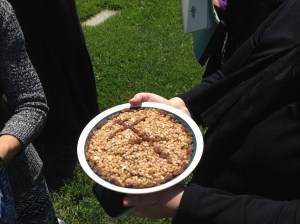
simple barley koliva

The evidences of what He has done and is doing are everywhere around us and among us. Like the early disciples, we have confirmed before our very eyes the truth of His word. Anointed by the Spirit on Pentecost, they went out with the message, and braved many dangers, even death! As the last verse of Mark tells us, “…they went forth and preached everywhere, while the Lord worked with them and confirmed the message by the signs that attended it.” (Mark 16:20)

We too, God’s little anointed ones, are led by the Spirit, as St. Paul puts it; that leading may take us places we would rather not go. “For all who are led by the Spirit of God are sons of God. For you did not receive the spirit of slavery to fall back into fear, but you have received the Spirit of sonship. When we cry, ‘Abba! Father!’ it is the Spirit himself bearing witness with our spirit that we are children of God, and if children, then heirs, heirs of God and fellow heirs with Christ, provided we suffer with him in order that we may also be glorified with him. I consider that the sufferings of this present time are not worth comparing with the glory that is to be revealed in us.” (Romans 8:14-18)

–Excerpt from article by Edith M. Humphrey, Professor of New Testament at Pittsburgh Theological Seminary

Myrrhbearing women at the tomb

Callas and Comfort

gl calla bouquet 3-16 P1030732When we broke up and filled in the swimming pool last summer, the surrounding planting beds were also excavated and new dirt was brought in for the new plants to grow in. In one corner where calla lilies had grown for a decade, we put in native California currant bushes.

Then the callas sprouted again, up through the little blooming ribes. I’ve had to go out every few days and yank out perfectly healthy lilies when they start to encroach too closely around the young plants that I am trying to encourage.

One morning last week when my daughters and I were packing up to visit the cemetery and have a picnic afterward, we discussed going to tP1030837he store to buy some flowers to lay on their father’s grave, because I said I didn’t have any flowers in the yard to take.
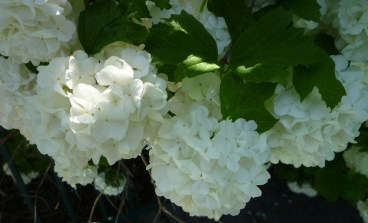
I suppose I was thinking about how the snowball bush didn’t yet have any flowers ready to pick. Last year at this time it was loaded with flowers, and one reason I did not take out the old thing was that I anticipated having its beautiful blooms to put on my husband’s grave every March. snowballs crp 15

Well, I had forgotten the calla lilies! Brave and hardy plants that keep coming…. We picked plenty to take to the cemetery, and since then have had more in vases in which they seem to fall naturally into elegant arrangements.

As you can see, we had other home-grown flowers to use — a few surviving ranunculus from the front yard, and even a Bird of Paradise from Pearl’s garden. Several freesia blooms were left after their extravagant display a couple of weeks ago. Scout and Ivy helped by decorating their grandpa’s grave, and their father drew us together by reading these words:

gl grave 3-16 P1030745

For I am sure that neither death nor life, nor angels nor rulers, nor things present nor things to come, nor powers, nor height nor depth, nor anything else in all creation, will be able to separate us from the love of God in Christ Jesus our Lord. (Romans 8:38-39)

Just now I’m reminded of another passage from I Thessalonians, which is also about our togetherness in the Lord (and it ties in nicely with my “C” post):

For the Lord himself shall descend from heaven with a shout, with the voice of the archangel, and with the trump of God: and the dead in Christ shall rise first: Then we which are alive and remain shall be caught up together with them in the clouds, to meet the Lord in the air: and so shall we ever be with the Lord.  Wherefore comfort one another with these words.