A word from an Athonite elder:
 The faithful are often scandalized by the prosperity of sinners. And it is true that if we look at things from a purely human perspective it can seem as if God has distributed His blessings unjustly. Here, where He should have given a measure of happiness, He has given only misfortune. And there, where He should have dispensed riches, He gave only poverty. And where poverty was in order, he lavished wealth. When we wait for a blessing, He often deals us a hard blow, while at the same time He maintains smiles on the faces of those around us.
In a way that echoes modern social concerns, we might say that God discriminates, and this is something that scandalizes us. Why does this scandalize us? The answer is simple. It is because our hearts are still attached to earthly things, still clinging to false “goods” that we continue to covet and crave. Thus the solution to our dil emma must be sought elsewhere, and this means that we should not be hasty in abolishing whatever strikes us as discrimination or injustice.
We live in a time of rapid change, when every innovation is presented to us as “progress,” but before real change, real progress, can take place, something must first change within us. And for this to happen we must become completely estranged to all things earthly and human, to all human logic, to all human ways of thinking, and to every so-called material good. We must be indifferent in the face of all things. And only then, when we have become strangers to all, can God become all things to us, as if there existed nothing else in the world for us except God.
It is this alone that can grant us true and lasting tranquility. Otherwise, if our heart is attached to anything earthly, no matter how small or insignificant it may seem to be, we can be sure that it will make us suffer.
—Elder Aimilianos of Athos
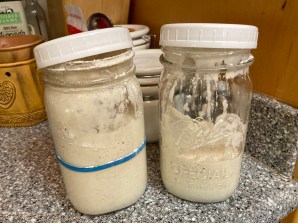 I planned to get back into making sourdough loaves, but week after week I never made time to assemble the ingredients for the “pre-ferment” that would collect wild yeasts from the air. Then when I was at my daughter Pippin’s earlier this month, I found that she had a good one going. She was happy to share it with me, so I moved half of her starter to a new quart jar and fed both jars a couple of times while I was there, and then brought the one home.
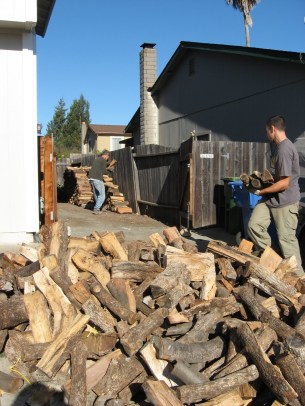 Several years ago I realized that my wood stove was becoming dysfunctional in a couple of important ways. I thought that I should probably change to having a gas fireplace insert, now that I am older and my back is not as strong as it used to be, for carrying the firewood and bending over the stove to build and tend the fire.


 Gladsome Lights