 “When St. Paul preached in Athens, the world was thronged with crosses, rooted outside cities, bearing all of them the bodies of slowly dying men. When Augustine preached in Carthage, the world was also thronged with crosses, but now in the very centre of cities, lifted in processions and above altars, decorated and jewelled, and bearing all of them the image of the Identity of dying Man.
“There can hardly ever have been — it is a platitude — a more astonishing reversion in the history of the world. It is not surprising that Christianity should sometimes be regarded as the darkest of superstitions, when it is considered that a thing of the lowest and most indecent horror should have been lifted, lit, and monstrously adored, and that not merely sensationally but by the vivid and philosophic assent of the great intellects of the Roman world. The worship in jungles and marshes, the intoxication of Oriental mysteries, had not hidden in incense and litany a more shocking idol. The bloody and mutilated Form went up everywhere; Justinian built the Church of Holy Wisdom to it in Byzantium, and the Pope sang Mass before it on the hills where Rome had been founded. The jewelled crosses hid one thing only — they hid the indecency. But original crucifixion was precisely indecent. The images we still retain conceal — perhaps necessarily — the same thing; they preserve pain but they lack obscenity. But the dying agony of the God-Man exhibited both….”
-Charles Williams in The Descent of the Dove: A Short History of the Holy Spirit in the Church
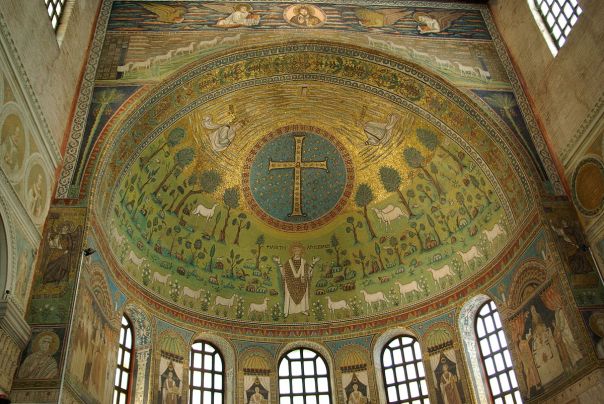
6th century Byzantine mosaic in the apse of the basilica of Sant’Apollinare in Classe, Ravenna, Italy. Photo in the public domain, on Wikipedia Commons.
 Gladsome Lights
