Tag Archives: Christmas trees

A Psalm and a tree for Advent.

This is a re-post from only three years ago, but it’s meaningful to me in a fresh way this year because now, instead of teaching little ones at church, I’m back with the high schoolers, and our lesson on the Holy Forefathers will be presented differently.
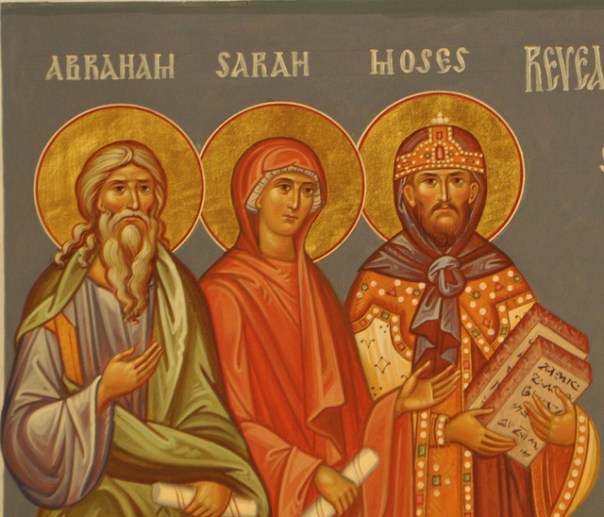
Also, this week I meditated on Psalm 89/90, “A Prayer of Moses, a man of God,” and Moses is one of those Holy Forefathers we are remembering. Because of its repentant tone, it was an answer to my prayer for guidance in how better to prepare for the Feast of the Nativity of Christ, in the short time remaining.

It’s a morning prayer, to help us focus at the outset on God instead of on our sorrows, and to keep at bay the feeling of hopelessness that lies in wait at the door of our heart. The poetry conveys so well the patience of God, and the way our longings and heartaches coexist with thankfulness and repentance:

….Lord, Thou hast been our refuge in generation and generation.
….Before the mountains came to be and the earth was formed, and the world, even from everlasting to everlasting Thou art.
….
….As for the days of our years, in their span they be threescore years and ten.
….And if we be in strength, mayhap fourscore years; and what is more than these is toil and travail.
….For mildness has come upon us, and we shall be chastened.
….
….Return, O Lord; how long? And be Thou entreated concerning Thy servants.
….We were filled in the morning with Thy mercy, O Lord, and we rejoiced and were glad.
….In all our days let us be glad for the days wherein we saw evils.
….And look upon Thy servants, and upon Thy works, and do Thou guide their sons.
….And let the brightness of the Lord our God be upon us, and works of our hands do Thou guide aright upon us, yea, the works of our hands do Thou guide aright.

From 2022:

Today is the Sunday of the Forefathers of Christ, His ancestors according to the flesh. We remember these who lived “before the Law and under the Law,” especially the Patriarch Abraham, to whom God said, “In thy seed shall all of the nations of the earth be blessed” (Gen. 12:3, 22:18).

I brought an icon of the Prophet David to stand up on the table in my church school class, and we talked about David as a shepherd boy, his killing of a lion who was threatening the sheep, his composing songs, and his anointing by the Prophet Samuel. (But first, we must chat about St. Nicholas and Santa, because he was strongly on the minds of the four- and five-year-olds.)

When I took the icon out of my bag again at home, I set it up downstairs, and lit a candle to help me keep remembering for the remainder of today. Maybe I will leave it here through next Sunday, when we remember more of these saints; the next church school lesson will focus on the Hebrew Children in the Fiery Furnace.

One thing I didn’t discuss with the children, but would be fun to teach older students about, is the Tree of Jesse, a visual depiction of the genealogy of Jesus Christ. Jesse was the father of King David; his roots extend down and back to his own forefathers including  Abraham, the Father of the Faithful; and Jesse was himself the root, or progenitor, of David’s line, which culminated in Christ the Messiah.

Jesse Tree icons must necessarily include so much information, they somewhat overwhelm me. When looking at them I tend to concentrate on Jesse himself, lying at the base of the tree, with its trunk growing out his very body.

Jesse Window detail, Dorchester Abbey
Wells Cathedral Jesse Window

Stained glass windows portraying the Jesse tree, which abound in Britain, are also a bit much for me to take in. Often they are in tall cathedrals and extend up a whole wall, the figures distant and their names unreadable. As I was looking at some online I was happy to find Val Stevens talking about the Jesse Window at Wells Cathedral, which window I no doubt saw when I visited there with daughter Pippin, but I don’t remember.

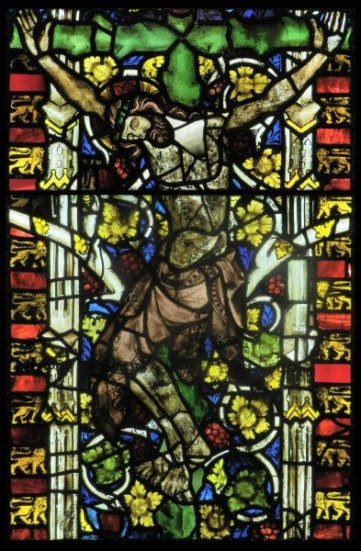
It’s a very short video (which ends with a request for contributions which are no longer needed, because the repairs have been completed), and she speaks for only two minutes, but she made me laugh with joy when she began to speak about the rare crucifixion scene that is in that window, which dates from the 14th century. The stem turns green, and takes the form of a cross, on which the Savior hangs. When she got to the part about the meaning of the green wood, or what it meant to the medieval mind, my heart leapt to hear it, and to see the change in her body language as she moved from purely artistic ideas, to the more compelling realities of the heart: Jesse Window of Wells Cathedral

Ansgar Holmberg

Also I want to share a quote I have posted before, more than once, because it pulls together several of these images, metaphors, and real people in our salvation history, in our cultural tradition. This is about a different sort of tree, the more familiar and ubiquitous Christmas tree! From Metropolitan Hierotheos Vlachos:

“I suspect that the custom of decorating a tree at Christmas time is not simply a custom which came to us from the West and which we should replace with other more Orthodox customs. To be sure, I have not gone into the history of the Christmas tree and where it originated, but I think that it is connected with the Christmas feast and its true meaning.

“First, it is not unrelated to the prophecy of the Prophet Isaiah: ‘There shall come forth a Rod from the stem of Jesse, and a Branch shall grow out of his roots’ (Is. 11:1). St. Cosmas the poet had this prophecy in mind when he wrote of Christ as the blossom which rose up out of the Virgin stem from the stump of Jesse. The root is Jesse, David’s father, the rod is King David, the flower which came from the root and the rod is Theotokos. And the fruit which came forth from the flower of the Panagia is Christ. Holy Scripture presents this wonderfully.

“Thus the Christmas tree can remind us of the genealogical tree of Christ as Man, the love of God, but also the successive purifications of the Forefathers of Christ. At the top is the star which is the God-Man (Theanthropos) Christ. Then, the Christmas tree reminds us of the tree of knowledge as well as the tree of life, but especially the latter. It underlines clearly the truth that Christ is the tree of life and that we cannot live or fulfill the purpose of our existence unless we taste of this tree, ‘the producer of life.’

“Christmas cannot be conceived without Holy Communion. And of course as for Holy Communion it is not possible to partake of deification in Christ without having conquered the devil, when we found ourselves faced with temptation relative to the tree of the knowledge of good and evil, where our freedom is tried. We rejoice and celebrate, because ‘the tree of life blossomed from the Virgin in the cave’.”

-Excerpt from: “The Feasts of the Lord: An Introduction to the 12 Feasts and Orthodox Christology” by Metropolitan of Nafpatkos Hierotheos Vlachos – November 1993. 

I’ve known families who used a Jesse Tree along with their Advent wreath as helps in Advent. But oh, my, out of curiosity I just looked at some current Pinterest-era examples, and had to abort that browsing quick; it was plenty for a Sunday afternoon to look at stained glass windows.

My daughters and I have been sharing memories this month, from our homes scattered across the country; posting photos of past and current Christmas trees, reminiscing about Christmas caroling, and recalling their father’s voice and his Christmas joy. This year I will have neither a Jesse nor a Christmas tree, but I feel rich with history and symbols and family. There’s my earthly family, and there is the heavenly family into which I’ve been adopted by the Father. Today I’m especially grateful for all those patriarchs and prophets who have gone before and who encourage me by their lives of faith.

By faith You justified the Forefathers,
when through them You betrothed Yourself beforehand
to the Church of the Gentiles.
The saints boast in glory,
that from their seed there is a glorious fruit:
she who bore You without seed.
By their prayers, O Christ God, save our souls.

-Hymn for the Feast

I begin the year with Christmas Day.

Before January is half over, I will share the last of my Christmasy activities and images. I don’t want to wait until next year to tell of the occasion shown above, when my grandsons Raj and Rigo were quick to lend a hand moving decorations into the church, the Sunday before Christmas.

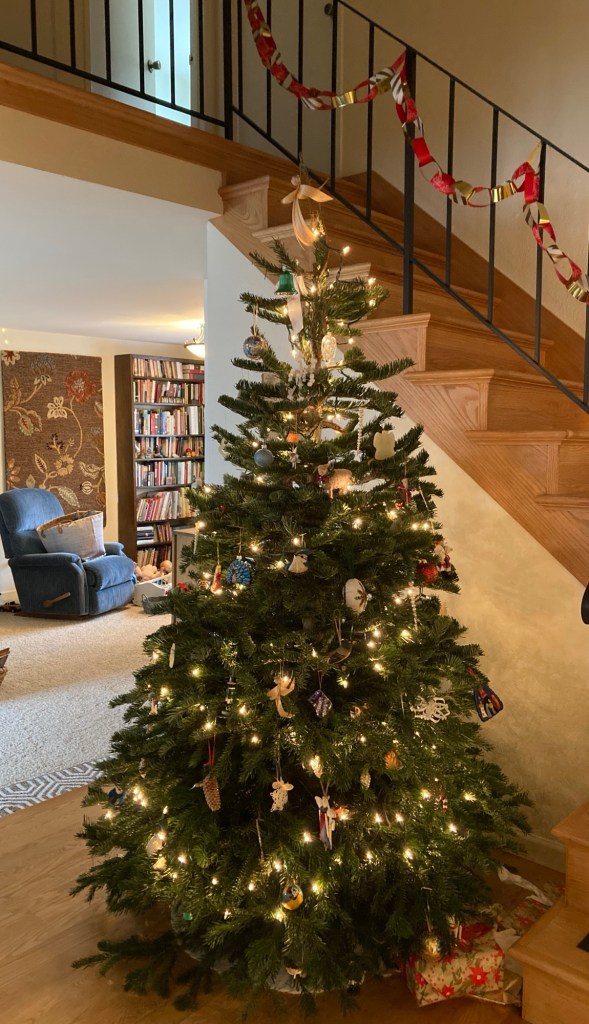
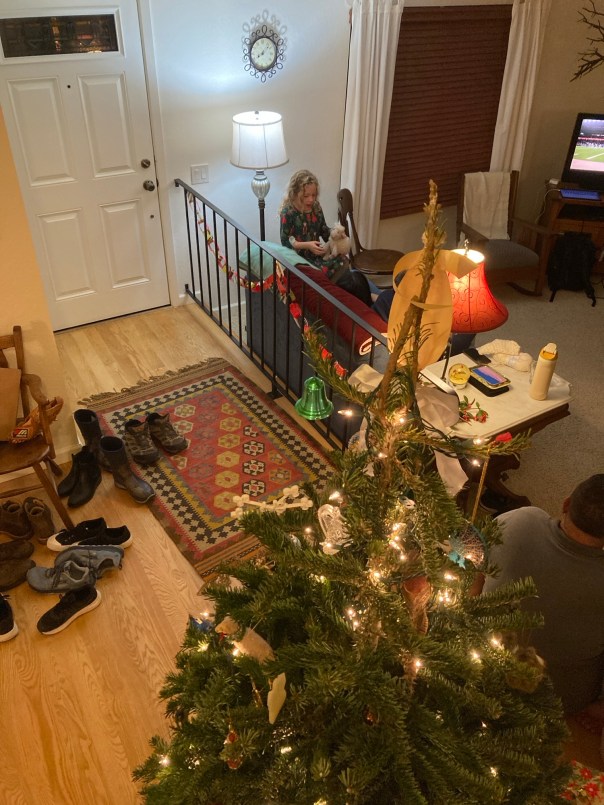
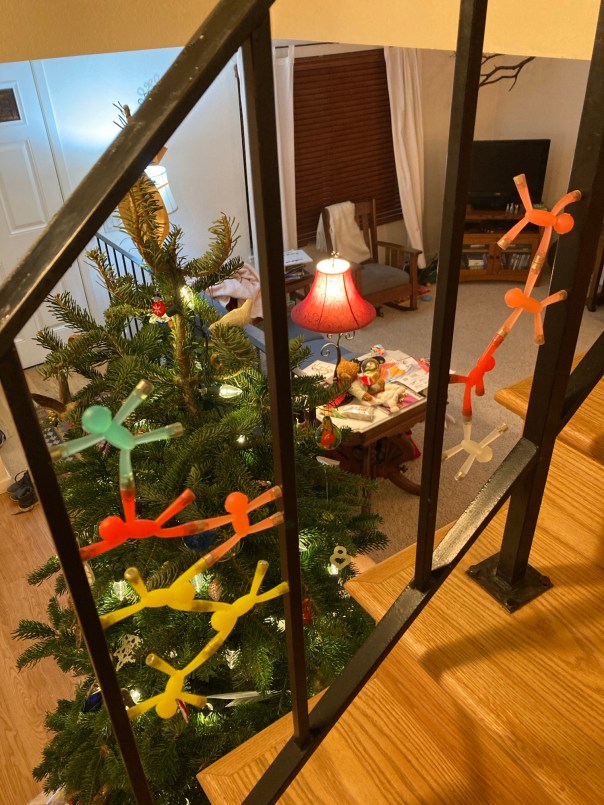
I went back to having a freshly cut tree this year; it only required getting help from a friend and a son. But I had no time to trim it before family started arriving, so Raj and Rigo helped me with that, too, almost as soon as they walked in the door.

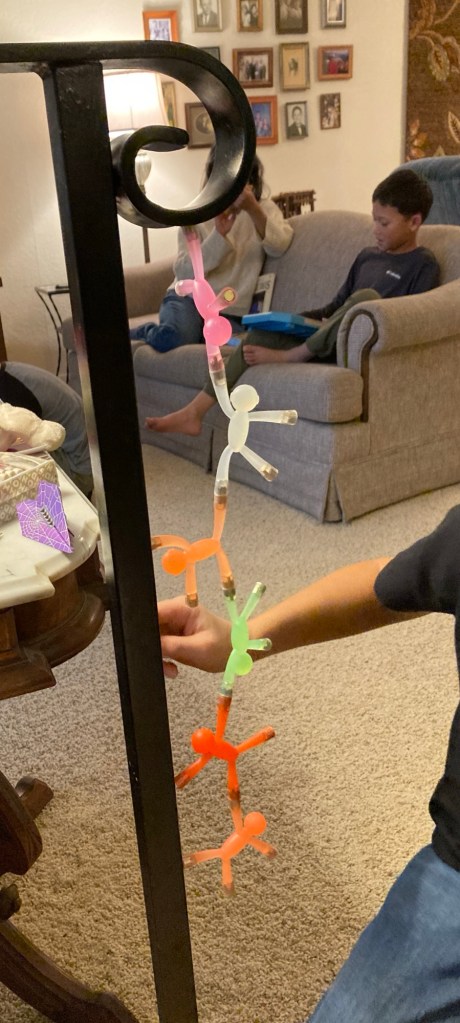
One toy I bought in advance of figuring out whom I would give it to, was these Magnet Men. They turned out to be the perfect toy to give to the whole bunch of (nine) kids to play with together, and in my house they provided hours of fun. For most people, I think, the refrigerator might be the only object they could interface with, though I heard of children using a set of dumbells for a Magnet Men playground.

They are very acrobatic, and hold on to each other, as you can see, but my entry and stair railings made the perfect equipment to show off their gymnastics. I sent all the cute toys home with the grandchildren, but maybe I should have kept some here, where they are the most fun.

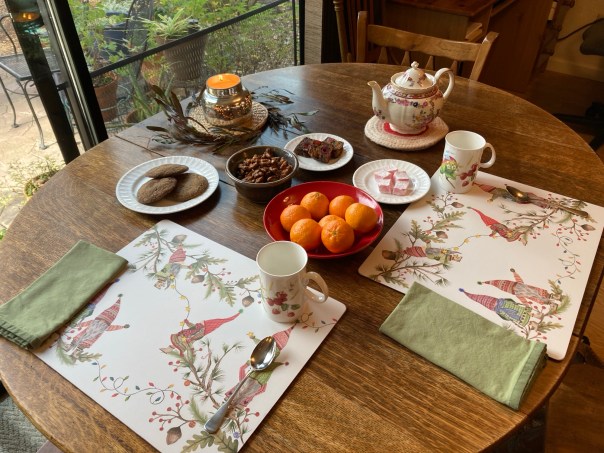
I had a friend over for tea one day and used some of my Christmas gnome placemats for the last time, serving up the last of the Christmas cookies I’d baked, and four little pieces of rose-flavored Turkish Delight that I’d bought especially for Christmas. That rose candy was so beautifully flavored, to me it seemed the exotic star of every plate of sweets. If only it weren’t so, so sweet…. but then, it wouldn’t be Turkish Delight.

We Glads have a few Christmas traditions that we return to, not always every year, but when the combination of people and days aligns properly. I’m thinking of oyster stew, which came through Mr. Glad’s German and English families. Or was it just the German side? I have made it many times using the recipe in the Joy of Cooking that my mother gave me at my marriage. This year son Soldier volunteered to make the stew, which is really a bisque or soup, and he began to read the recipe in that book.

Soon everyone in the kitchen was laughing uproariously as he read aloud the amounts of some ingredients. For example, 1/4 teaspoon chopped onion, and “a sliver of garlic.” I didn’t see how much onion Soldier put in, but I heard that several cloves of garlic were minced and added. From my garden I brought in chives and parsley, which were used in generous quantities. After all 18 of us were seated at two tables, the oysters were dropped into the broth, and soon the glorious stew was served into bowls and set before those who were willing or eager to try it. I found it to be the best I’ve ever eaten.

I have another “Overthrow the Tyranny of Months” calendar from Beauty First Films, which leads me in joyful anticipation of upcoming weeks, often several more than four at a time. Here is the page I’m looking at now:


How sweet is it, to have my 2025 calendar start with Christmas Day?? I’m waiting until February 2 to take my tree down, and will wait until next December to write any more about Christmas. More feasts and seasons are upon us, the days full of good things.

One of those that happened in our family recently was the birth of my son “Pathfinder’s” first grandchild, my second great-grandchild. I may need to meet him before I will think of a nickname, and he lives a good distance from me, so you will have to wait for details. The Whole Glad Family welcomes Little Guy ❤

Rejoice Evermore!


Jesse — root and windows.

Today is the Sunday of the Forefathers of Christ, His ancestors according to the flesh. We remember these who lived “before the Law and under the Law,” especially the Patriarch Abraham, to whom God said, “In thy seed shall all of the nations of the earth be blessed” (Gen. 12:3, 22:18).

I brought an icon of the Prophet David to stand up on the table in my church school class, and we talked about David as a shepherd boy, his killing of a lion who was threatening the sheep, his composing songs, and his anointing by the Prophet Samuel. (But first, we must chat about St. Nicholas and Santa, because he was strongly on the minds of the four- and five-year-olds.)

When I took the icon out of my bag again at home, I set it up downstairs, and lit a candle to help me keep remembering for the remainder of today. Maybe I will leave it here through next Sunday, when we remember more of these saints; the next church school lesson will focus on the Hebrew Children in the Fiery Furnace.

One thing I didn’t discuss with the children, but would be fun to teach older students about, is the Tree of Jesse, a visual depiction of the genealogy of Jesus Christ. Jesse was the father of King David; his roots extend down and back to his own forefathers including  Abraham, the Father of the Faithful; and Jesse was himself the root, or progenitor, of David’s line, which culminated in Christ the Messiah.

Jesse Tree icons must necessarily include so much information, they somewhat overwhelm me. When looking at them I tend to concentrate on Jesse himself, lying at the base of the tree, with its trunk growing out his very body.

Jesse Window detail, Dorchester Abbey
Wells Cathedral Jesse Window

Stained glass windows portraying the Jesse tree, which abound in Britain, are also a bit much for me to take in. Often they are in tall cathedrals and extend up a whole wall, the figures distant and their names unreadable. As I was looking at some online I was happy to find Val Stevens talking about the Jesse Window at Wells Cathedral, which I no doubt saw when I visited there with daughter Pippin, but I don’t remember.

It’s a very short video (which ends with a request for contributions which are no longer needed, because the repairs have been completed), and she speaks for only two minutes, but she made me laugh with joy when she began to speak about the rare crucifixion scene that is in that window, which dates from the 14th century. The stem turns green, and takes the form of a cross, on which the Savior hangs. When she got to the part about the meaning of the green wood, or what it meant to the medieval mind, my heart leapt to hear it, and to see the change in her body language as she moved from purely artistic ideas, to the more compelling realities of the heart: Jesse Window of Wells Cathedral

Ansgar Holmberg

Also I want to share a quote I have posted before, more than once, because it pulls together several of these images, metaphors, and real people in our salvation history, in our cultural tradition. This is about a different sort of tree, the more familiar and ubiquitous Christmas tree! From Metropolitan Hierotheos Vlachos:

“I suspect that the custom of decorating a tree at Christmas time is not simply a custom which came to us from the West and which we should replace with other more Orthodox customs. To be sure, I have not gone into the history of the Christmas tree and where it originated, but I think that it is connected with the Christmas feast and its true meaning.

“First, it is not unrelated to the prophecy of the Prophet Isaiah: ‘There shall come forth a Rod from the stem of Jesse, and a Branch shall grow out of his roots’ (Is. 11:1). St. Cosmas the poet had this prophecy in mind when he wrote of Christ as the blossom which rose up out of the Virgin stem from the stump of Jesse. The root is Jesse, David’s father, the rod is King David, the flower which came from the root and the rod is Theotokos. And the fruit which came forth from the flower of the Panagia is Christ. Holy Scripture presents this wonderfully.

“Thus the Christmas tree can remind us of the genealogical tree of Christ as Man, the love of God, but also the successive purifications of the Forefathers of Christ. At the top is the star which is the God-Man (Theanthropos) Christ. Then, the Christmas tree reminds us of the tree of knowledge as well as the tree of life, but especially the latter. It underlines clearly the truth that Christ is the tree of life and that we cannot live or fulfill the purpose of our existence unless we taste of this tree, ‘the producer of life.’

“Christmas cannot be conceived without Holy Communion. And of course as for Holy Communion it is not possible to partake of deification in Christ without having conquered the devil, when we found ourselves faced with temptation relative to the tree of the knowledge of good and evil, where our freedom is tried. We rejoice and celebrate, because ‘the tree of life blossomed from the Virgin in the cave’.”
-Excerpt from: “The Feasts of the Lord: An Introduction to the 12 Feasts and Orthodox Christology” by Metropolitan of Nafpatkos Hierotheos Vlachos – November 1993. 

I’ve known families who used a Jesse Tree along with their Advent wreath as helps in Advent. But oh, my, out of curiosity I just looked at some current Pinterest-era examples, and had to abort that browsing quick; it was plenty for a Sunday afternoon to look at stained glass windows.

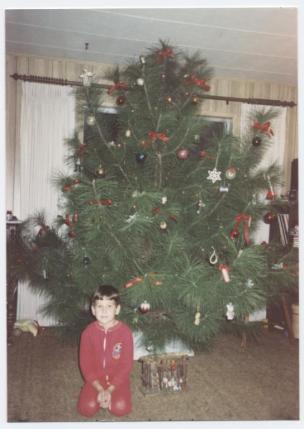
My daughters and I have been sharing memories this month, from our homes scattered across the country; posting photos of past and current Christmas trees, reminiscing about Christmas caroling, and recalling their father’s voice and his Christmas joy. This year I will have neither a Jesse nor a Christmas tree, but I feel rich with history and symbols and family. There’s my earthly family, and there is the heavenly family into which I’ve been adopted by the Father. Today I’m especially grateful for all those patriarchs and prophets who have gone before and who encourage me by their lives of faith.

By faith You justified the Forefathers,
when through them You betrothed Yourself beforehand
to the Church of the Gentiles.
The saints boast in glory,
that from their seed there is a glorious fruit:
she who bore You without seed.
By their prayers, O Christ God, save our souls.

-Hymn for the Feast

Splash of fall – then Christmas.

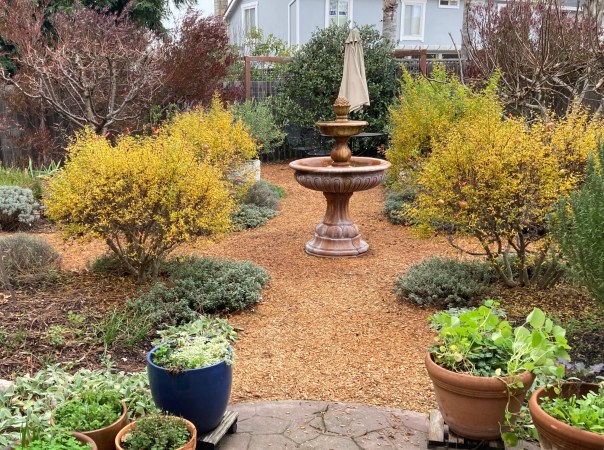
The dwarf pomegranate bushes that are at the four corners of the fountain, are just now at their most beautiful. You can see how they contrast with the dark corner where the greenhouse spends winters, in the shade of my tall house. In spite of that darkness, I have hope for a more favorable growing environment in the greenhouse, because I got it wired with outlets for heat and light and even a breeze when needed.

Many unripe figs  held on to the tree, until they turned purple from frost and had to let go.

The day after I took this picture, I drove north to Pippin’s, for a sort of early Christmas. Here there is also some color — mostly forest-green and white; the snow began to fall just as I was arriving! But also some bright spots like this pumpkin.

The snow on the road turned to ice, sending one of our vehicles into the ditch. It wasn’t mine, and I didn’t hear about it until everything was resolved. Pippin baked a pie with Honeycrisp and vowed Never Again. Pippins (the apples) are the best! But the deer relished the peelings; I watched the doe repeatedly kicking one fawn away from the bowl in which they had been served. Other humans liked the pie very much and it was beautiful and tasty — just not appley enough.

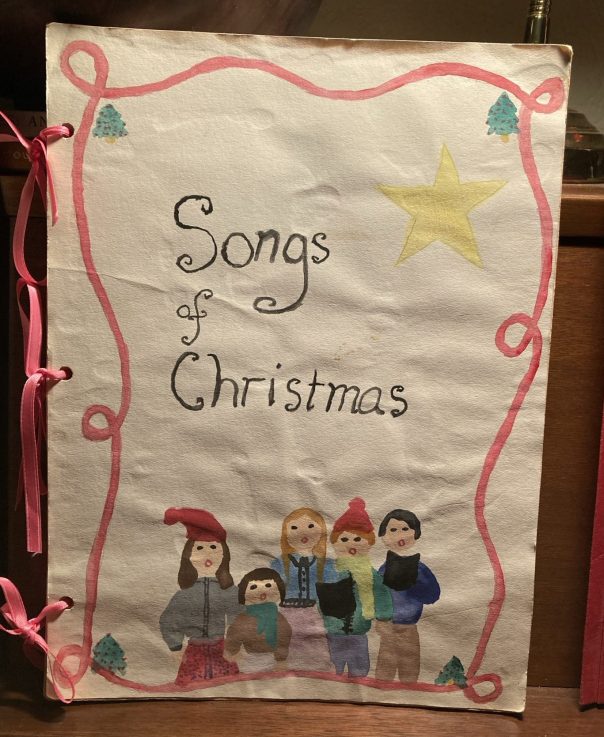
We had the best sort of evening with a few family members I haven’t seen since last Christmas, and even sang carols — for a blessedly prolonged while. (We had already sung “O Come, O Come, Emmanuel” around the Advent wreath before dinner.) Enough of us could carry a tune and even lead off, that the two pianists present were glad to be able to sing rather than play, and it was truly joyous singing.

The cousins made paper airplanes together, and Scout told his uncle all about the latest novel he is reading. He also played his newly learned guitar piece. He has been busy cutting Christmas trees in the mountains and then selling at the Boy Scouts’ lot, and their tree was one of those. It is so pristine and elegant, and pointing straight to the heavens, that I could not believe it was real. It is a red fir.

Several of our group have been working really long and odd hours lately, and it seemed a miracle that the logistics worked out for us to be together. I am joining two church school meetings on ZOOM in two days, which meant that both teachers of our high school class and the special guest we had were all participating from a distance. If we weren’t meeting online I’d have had to get a substitute. So that worked well, too.

Too soon, I’ll be driving back down the road and home again, and will proceed with Advent. I think I might add to my preparations a new tradition, and start singing remotely — but oh, so closely — with my family, a nightly round of  “O Come, O Come, Emmanuel.”