Tag Archives: David Bentley Hart

What method can do and is not.

Quoting again from David Bentley Hart’s The Experience of God. Hart spends a good while comparing what he calls the naturalistic vs. the theistic pictures of the world, so that he can eventually get on with describing the theistic, as in the title of the book.

…we should not let ourselves forget precisely what method is and what it is not. A method, at least in the sciences, is a systematic set of limitations and constraints voluntarily assumed by a researcher in order to concentrate his or her investigations upon a strictly defined aspect of or approach to a clearly delineated object. As such, it allows one to see further and more perspicuously in one particular instance and in one particular way, but only because one has first consented to confine oneself to a narrow portion of the visible spectrum, so to speak. Moreover, while a given method may grant one a glimpse of truths that would remain otherwise obscure, that method is not itself a truth. This is crucial to understand. A method, considered in itself, may even in some ultimate sense be “false” as an explanation of things and yet still be probative as an instrument of investigation; some things are more easily seen through a red filter, but to go through life wearing rose-colored spectacles is not to see things as they truly are.Rosecolored-glasses

This was a sustaining vision.

I have picked up The Experience of God: Being, Consciousness and Bliss again, and it is still as satisfying. It demands a lot, and because it had been several months since I’d opened the book I thought I better go back and at least read what I had underlined. But I found that in order to fully refresh my mind I had to start from the beginning and read every word over. Just today I caught up to where I had left off, in the middle of the chapter, “Pictures of the World,” in which the author explains the development of modern assumptions about existence, and compares them with previous worldviews.

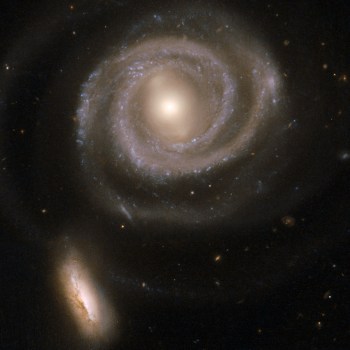
Hubble_Interacting_Galaxy_NGC_5754_
Hubble Interacting Galaxy

For the philosophers and scientists of premodern times, stretching back to the beginning of philosophical and scientific thought in the West, no absolute division could be drawn between physical and metaphysical explanations of the cosmos, or at least between material and “spiritual” causes. The universe was shaped and sustained by an intricate interweaving of immanent and transcendent agencies and powers.
…….
In the [premodern] model, the whole cosmos — its splendor, its magnificent order, its ever vaster profundities — had been a kind of theophany, a manifestation of the transcendent God within the very depths and heights of creation. All of reality participated in those transcendental perfections that had their infinite consummation in God and that came to utterance in us, in our rational contemplation and coherent articulation and artistic celebration of the beauty and grandeur of existence. The human wakefulness to the mystery of being was thus also already an openness to the divine, because the world was an image of and participation in the God who is the wellspring of all being. Again, and emphatically, this was a vision of creation’s rational order immeasurably remote from the Deist’s or Intelligent Design theorist’s notion of the world as a wonderful machine, designed and fabricated by a particularly enterprising superhuman intellect.

— David Bentley Hart

columbine church 5-15
columbine at church


Gleanings – Fashionable Philosophy

I’m going along slowly through David Bentley Hart’s book The Experience of God: Being, Consciousness, Bliss. It takes me longer to eat my soup at lunchtime, because I so often put down my spoon and pick up a pencil to underline one passage after another, sometimes just because the most obvious ideas are expressed in eloquent prose that makes me happy.

On the other hand, I also have to stop and consult the dictionary about quite a few words I don’t know, some that seem completely new to me and others I just haven’t read for several years and whose meanings have become foggy. Sapient, proleptic, etiolated, deracinated, lacunae, phylogenic, otiose. Really, I should make myself a Vocabulary List to keep handy for study and review, and maybe I wouldn’t forget so soon. This list should include scores of words I have circled on the pages of almost every book I read, words that I don’t often take the time to investigate right then — or sometimes ever.

In the second chapter, from which the following paragraphs are taken, Hart is discussing “Pictures of the World,” and he cautions the reader that “the philosophical tendencies and presuppositions of any age are, to a very great degree, determined by the prevailing cultural mood or by the ideological premises generally approved of by the educated classes.”

“…inasmuch as the educated class is usually, at any given phase in history, also the most thoroughly indoctrinated, and therefore the most intellectually pliable and quiescent, professional philosophers are as likely as their colleagues in the sciences and humanities (and far more likely that the average person) to accept a reigning consensus uncritically, even credulously, and to adjust their thinking about everything accordingly.”

“…I think it is fair to say that a majority of academic philosophers these days tend toward either a strict or a qualified materialist view of reality (though many might not use those terms), and there may be something of a popular impression out there that such a position rests upon a particularly sound rational foundation. But, in fact, materialism is among the most problematic of philosophical standpoints, the most impoverished in its explanatory range, and among the most willful and (for want of a better word) magical in its logic, even if it has been in fashion for a couple of centuries or more.”

–David Bentley Hart in The Experience of God, Chapter 2

Apart from which we have no experience.

I’ve just started reading David Bentley Hart’s The Experience of God: Being, Consciousness, Bliss. The purpose of this book is stated in the first chapter like this:

“…I also believe there are certain common forms of experience so fundamental to human rationality that, without them, we could not think or speak at all….All I want to do in the pages that follow is to attempt to explain, as lucidly as I can, how traditional understandings of God illuminate and are illuminated by those experiences.”

I heard Hart tdavid-bentley-hartalking about his book on the Mars Hill Audio Journal, and it thrilled my philosopher’s soul. Because the man can be a little hard to follow when he’s speaking quickly and extemporaneously — and I am not a good auditory learner — I am even more delighted in the book.

I can’t wait to share one gem of a thought from the introduction:

“God is not only the ultimate reality that the intellect and the will seek but is also the primordial reality with which all of us are always engaged in every moment of existence and consciousness, apart from which we have no experience of anything whatsoever.”