Tag Archives: death

Taught by The Little Match Girl


It’s quite cold today, and my feet are feeling it even though I am indoors; I didn’t turn the heat on before I went to church, so now it will take a long time for the house to get warmed by the wood fire I built. And the computer is in the coldest corner. As I sit here with my cold feet and three layers of wool sweaters, blankets of snow can be seen on the surrounding foothills. Maria has a theme of children on her blog this month, and today she posted a lovely painting of a girl reading.

All of these factors combined to spur me into writing about a story that captivated me as a child and that became a foundational piece of furniture of my mind. When people suggest sharing a list of the books that were formative in our lives, I often think that only God could say what they are. I’m pretty sure that we don’t remember in our intellect everything that our hearts know.
But “The Little Match Girl,” by Hans Christian Andersen, is the one story I know would be on my list. It was in the anthology that provided most of my reading material when I was about 5-10 years old, which my children also read, and which now sits on my shelf in its duct tape bandage.

What did I get from this story, and why did I love reading it over and over? I lived a comfortable life, so it wasn’t empathy with the poor and freezing child that held my attention. It must have been the attractiveness of God Himself, Who I understood was taking the child to be with Him, where she would also be with her grandmother. I learned from this story something about Heaven and death, and that suffering and neglected children aren’t entirely alone. Indeed, they can have spiritual experiences that adults know nothing about and with which no one can interfere.
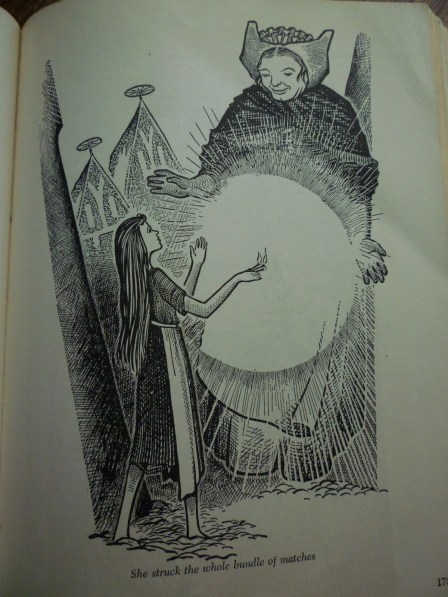
I easily found the text of the story online, in slightly different wording, but I couldn’t find an illustration that seemed right. They all showed a girl of the wrong age, or they were too cute, or irreverent. Finally I took a picture with my camera of the picture in the book, but as I look at it I see that even it doesn’t equal the much richer, if vague, images I retain from reading the words.

Evidently there have been movies telling the story, and perhaps most everyone is familiar with several versions of this tale, but I’ve never gone beyond that first encounter. For anyone wanting to read it once more — or perhaps for the first time! — I post it here.

The Little Match Girl

Most terribly cold it was; it snowed, and was nearly quite dark, and evening– the last evening of the year. In this cold and darkness there went along the street a poor little girl, bareheaded, and with naked feet. When she left home she had slippers on, it is true; but what was the good of that? They were very large slippers, which her mother had hitherto worn; so large were they; and the poor little thing lost them as she scuffled away across the street, because of two carriages that rolled by dreadfully fast.

One slipper was nowhere to be found; the other had been laid hold of by an urchin, and off he ran with it; he thought it would do capitally for a cradle when he some day or other should have children himself. So the little maiden walked on with her tiny naked feet, that were quite red and blue from cold. She carried a quantity of matches in an old apron, and she held a bundle of them in her hand. Nobody had bought anything of her the whole livelong day; no one had given her a single farthing.

She crept along trembling with cold and hunger–a very picture of sorrow, the poor little thing!

The flakes of snow covered her long fair hair, which fell in beautiful curls around her neck; but of that, of course, she never once now thought. From all the windows the candles were gleaming, and it smelt so deliciously of roast goose, for you know it was New Year’s Eve; yes, of that she thought.

In a corner formed by two houses, of which one advanced more than the other, she seated herself down and cowered together. Her little feet she had drawn close up to her, but she grew colder and colder, and to go home she did not venture, for she had not sold any matches and could not bring a farthing of money: from her father she would certainly get blows, and at home it was cold too, for above her she had only the roof, through which the wind whistled, even though the largest cracks were stopped up with straw and rags.

Her little hands were almost numbed with cold. Oh! a match might afford her a world of comfort, if she only dared take a single one out of the bundle, draw it against the wall, and warm her fingers by it. She drew one out. “Rischt!” how it blazed, how it burnt! It was a warm, bright flame, like a candle, as she held her hands over it: it was a wonderful light. It seemed really to the little maiden as though she were sitting before a large iron stove, with burnished brass feet and a brass ornament at top. The fire burned with such blessed influence; it warmed so delightfully. The little girl had already stretched out her feet to warm them too; but–the small flame went out, the stove vanished: she had only the remains of the burnt-out match in her hand.

She rubbed another against the wall: it burned brightly, and where the light fell on the wall, there the wall became transparent like a veil, so that she could see into the room. On the table was spread a snow-white tablecloth; upon it was a splendid porcelain service, and the roast goose was steaming famously with its stuffing of apple and dried plums. And what was still more capital to behold was, the goose hopped down from the dish, reeled about on the floor with knife and fork in its breast, till it came up to the poor little girl; when–the match went out and nothing but the thick, cold, damp wall was left behind. She lighted another match. Now there she was sitting under the most magnificent Christmas tree: it was still larger, and more decorated than the one which she had seen through the glass door in the rich merchant’s house.

Thousands of lights were burning on the green branches, and gaily-colored pictures, such as she had seen in the shop-windows, looked down upon her. The little maiden stretched out her hands towards them when–the match went out. The lights of the Christmas tree rose higher and higher, she saw them now as stars in heaven; one fell down and formed a long trail of fire.

“Someone is just dead!” said the little girl; for her old grandmother, the only person who had loved her, and who was now no more, had told her, that when a star falls, a soul ascends to God.

She drew another match against the wall: it was again light, and in the lustre there stood the old grandmother, so bright and radiant, so mild, and with such an expression of love.

“Grandmother!” cried the little one. “Oh, take me with you! You go away when the match burns out; you vanish like the warm stove, like the delicious roast goose, and like the magnificent Christmas tree!” And she rubbed the whole bundle of matches quickly against the wall, for she wanted to be quite sure of keeping her grandmother near her. And the matches gave such a brilliant light that it was brighter than at noon-day: never formerly had the grandmother been so beautiful and so tall. She took the little maiden, on her arm, and both flew in brightness and in joy so high, so very high, and then above was neither cold, nor hunger, nor anxiety–they were with God.

But in the corner, at the cold hour of dawn, sat the poor girl, with rosy cheeks and with a smiling mouth, leaning against the wall–frozen to death on the last evening of the old year. Stiff and stark sat the child there with her matches, of which one bundle had been burnt. “She wanted to warm herself,” people said. No one had the slightest suspicion of what beautiful things she had seen; no one even dreamed of the splendor in which, with her grandmother she had entered on the joys of a new year.

Memory and Memory Eternal

My father-in-law has been forgetting things. In fact, in the last many months he can’t remember most events longer than a couple of minutes after they take place. If they happened 60 or 80 years ago there is a good chance that he will remember them, but what one would call his short-term memory, that which he is losing, is broadening in scope. Ten years ago he often told us stories about things that happened 10, 20, 30 years previous, and I heard some of those stories enough times to remember them myself.

One had to do with his old leather jacket. We were at the assisted-living place where he lives, about to go out to dinner, and I wanted to take his recent favorite jacket home to launder, so I handed him another old favorite to put on. As we took the elevator down and signed out at the front desk, he got several compliments on his appearance. I told the concierge, “He and his cousin both bought leather jackets in Spain when they were on a trip there together more than 30 years ago.”

“I did?” he chuckled. “I’m glad you remember these things.” I remember some other stories he used to tell, but lately I hear new stories, from further back. Even his daughter was surprised to hear, when the conversation at a Christmas gathering turned to pets, “We always had fox terriers.” She didn’t know anything about a fox terrier tradition, because the dogs of her childhood were dachshunds and schnauzers. But W. was referring to the first dog he remembered, when he was a boy, named “Spot.” And he’s told us a few times since about Spot.

When we passed a purple house on the way back from a doctor’s appointment one afternoon, he said, “That reminds me of a woman in our church who we always called ‘The Purple Lady.’ Everything she had was purple. I haven’t thought of Mrs. Finnegan for a long time.” That was a church of his childhood, 75 yeas ago. It’s as though the loss of one data set has forced his mind to resort to a long-neglected mine of memory if it wants to keep busy.

One tale that is like the overarching First Story of his life, sweetly involves his wife, my late mother-in-law. And it happened when he was only about five years old, so I hope it will be the last one to be forgotten. Their families were friends–an aunt and uncle had even married–and they lived only a couple of blocks from each other. W. came by and walked F.K. to school on the first day of Kindergarten. They were always companions, never dated anyone else, and married when they were 21. The picture was taken in 2nd grade, cropped from the class photo where they were sitting next to each other.

W. has some good habits, which trump the rational; that is, he doesn’t have to remember to do these tasks. On another laundry-gathering visit, I asked him to take off his clothes and put on clean ones right then, so I could take the dirty ones home. When I came back into the bedroom, he had neatly folded the pants and hung them back on their hanger on the doorknob, and hung up the shirt likewise. Because he always does. And he had already forgotten why he was changing his clothes in the middle of the day.

He has a habit of being friendly and gentlemanly, so that he kept trying to help ladies scoot their chairs up to the table even when he was becoming unsteady on his feet. And he cracks really funny jokes–new ones–in the emergency room or anywhere there are people, strangers or friends.

God only knows if I have any good habits that will remain when I lose my mind’s faculties. How many pair of pants needed folding before it made a habit that endured? If I start now, building the habits I think might serve me, or God, is it too late?

I once heard Wynton Marsalis exhorting young people about the power of the daily habit of practicing their musical instruments: “Every day you go around making yourself into you.” We are not what we dream of being, we are not our vision of ourselves, or God’s plan for us, but a collection of usually little, seemingly insignificant acts that add up to a unique person.

I see people I love weaken and become confused by the afflictions of age and the loss of memory, like Vivian, who asked her daughter, “Am I myself?”

“Yes, Mom, you are.”

But there are people who don’t seem to know themselves, and certainly multitudes who have forgotten their own important stories. One aunt of ours thought she was in her right mind, but did not recognize her own daughter, and told her she was an impostor.

The possibility that I might forget important people, forget who I am, is certainly disturbing. It happens to a lot of people, being another way we are not in control, even of our own memories.

The scariest thing imaginable is to forget God. When Christ said to “take no thought for the morrow,” surely this thought was included! I have to quickly move on, and rest in the belief that it’s more important for God to remember me, than for me to remember Him. And I pray He will not soon forget someone who has tried to “stick to Christ like a burr to a coat,” as Martin Luther’s wife Katharina is said to have resolved.

Recently I read Tolkien’s “Leaf by Niggle,” which added a new dimension to my musings on this mysterious unknown toward which we are all headed. Niggle and his art are eventually forgotten by everyone on earth, and what he accomplished in his life “down here,” which was always less than he should have done, and always incomplete, has faded somewhat from his own memory. God remembers him, though, and makes use of Niggle in surprising and grand ways. What Niggle learns of Love becomes a story, a work of art and even a spiritual retreat, called by his own name, that continues to benefit souls out of time.

In the Orthodox Church we sing a simple hymn, “Memory Eternal,” at the end of memorial services, and in me it is a prayer for just this wondrous kind of thing God can do, to wrap us up in Himself and carry us through whatever shadowy places we encounter, whether in our minds or along our pathways, until our minds and hearts, and all things, are made new in that heavenly and everlasting Kingdom.

Review: For the Time Being

Giacometti said, “The more I work, the more I see things differently, that is, everything gains a grandeur every day, becomes more and more unknown, more and more beautiful. The closer I come, the grander it is, the more remote it is.”

This clip from the book is as good an introduction to Annie Dillard’s book For the Time Being as anything I could write. I’ve been struggling for months now to write a simple review, but I’m not equal to the task. It occurred to me that I could let Dillard speak by transcribing some passages (in boldface) from the book. I hope they are not enough to be copyright-infringing.

There is always a lot of factual knowledge, especially of geography, history, and natural science, in her books. In this one you learn things about Mao Tse-tung, about the Aztecs, the Romans, and grotesque birth defects. Many statistics about natural things and about what percentage of us are dead, and many stories and sayings of Teilhard de Chardin, who I think is a kindred spirit to her: Do you suffer what a French paleontologist called “the distress that makes human wills founder daily under the crushing number of living things and stars?”

Annie Dillard does suffer this way, as many theologians may suffer from contemplating mankind, the universe, and the finite mind’s inability to take it all in, much less neatly organize it and find ultimate meaning. Augustine said to a group of people, “We are talking about God. What wonder is it that you do not understand. If you do understand, then it is not God.”

If the mystery of life makes you uncomfortable, if you like a good reductionist dogma, I don’t think you will enjoy Dillard in most of her writing. Even I tire of her eventually, as she sometimes appears to be a woman who could be described by II Timothy 3:7: “Ever learning, and never able to come to the knowledge of the truth.” She likes to see how everything is connected, and I agree, it all is connected, but we have been given the key to the mystery in Jesus Christ, who reveals the Holy Trinity to us, the Alpha and the Omega, the Beginning and the End.

Several Jewish theologians down the centuries figure in this particular compendium, her favorite being from the Ukraine in the 18th Century:…the Baal Shem Tov delighted in the spark, the God within. This is not pantheism, but pan-entheism: The one transcendent God made the universe, and his presence kindles every speck of it. Each clot of clay conceals a coal. A bird flies the house. A live spark heats a clay pot.

The thousands of wealth have fallen with wonders, said Rabbi Nathan of Nemirov. Do you find this unclear? It certainly sounds like the sort of thing thousands of wealth do.

And Buddhists: They say there is a Buddha in each grain of sand. It is this sort of pop wisdom that makes the greatness of Buddhism seem aggravating.

“God is in the details” might be Annie Dillard’s motto, as she does always bring all these bits and pieces to bear on a quest for the Ultimate. Every event, every piece of matter, can speak of God. But not in its specialness–rather, its ordinariness. However, It is literally sensible to deny that God exists.

These times of ours are ordinary times, a slice of life like any other. Who can bear to hear this, or who will consider it?

The closer we grow to death, the more closely we follow the news. Year after year, without ever reckoning the hours I wasted last week or last year, I read the morning paper. I buy mass psychotherapy in the form of the lie that this is a banner year.

So, we are not the center of the universe, but there is meaning, and it has something to do with a transcendent God, not foggy pop wisdom and not a gnostic sort of dualism. The thing to do is to engage, to plunge into life in all its materiality and chaos, and make yourself useful.

As Martin Buber saw it–writing at his best near the turn of the last century–the world of ordinary days “affords” us that precise association with God that redeems both us and our speck of the world.

[Teilhard] “Purity does not lie in a separation from the universe, but in a deeper penetration of it.”

[In an introduction to an account of birds mating in Galilee] Our lives come free; they’re on the house to all comers…. God decants the universe of time in a stream, and our best hope is, by our own awareness, to step into the stream and serve, empty as flumes, to keep it moving.

The first book I read by Dillard was An American Childhood, the story of her youth in the mid-20th Century, and I’d have to say that God used it to make me consider all the many details of my own childhood and how they combined in a significant story that God was writing. In all her books I have read I am impressed with her vision of the sacredness of matter, even while she can’t figure it all out. She accepts her own embodiment and relishes her sensate being, which of course feels more real than the intangible.

[Teilhard] “If I should lose faith in God, I think that I should continue to believe invincibly in the world.”

[when we who are alive now are dead] the living might well seem foolishly self-important and overexcited.

One reason I have spent a ridiculous number of hours trying to write about Annie Dillard, is that the quality of her writing seems to demand a comparable response. She doesn’t waste a word; there is no fluff, and I know that she has a reason for juxtaposing the paragraphs on sand and death and Chinese warriors just so. Surely I could study this one book like the Bible, and keep getting more out of it.

I would get not just philosophy and theology, but also whatever the evasive thing is that one learns from reading a lot of good writing. In The Writing Life she teaches by example, both by relating her attitude and ruthlessness toward second-best work, and in the way she respects the language and makes the most of its potential.

I still haven’t looked up all the words–at least 25 in 204 pages–that were completely new to me, including einkorn, heiratic, schleppernish, and geomantic. Saltate is one I will remember, as Dillard used it three times, first to describe the action of sand:

Mostly, the continents’ streams and rivers make sand. Streams, especially, and fast rivers bear bouncing rocks that knock the earth, and break themselves into sharp chips of sand. The sand grains leap–saltate–downstream.

Later she uses this word, which can also mean to dance, along with another new one, knap: Jerusalem….we have come saltating to worship here–to knap ourselves round.

I’m not sure I could come up with a good closing paragraph if I gave it another hour’s effort. My apologies for the inferior review that took me so long; I justify it on a principle I’m not sure Annie would agree with: Any job worth doing is worth doing poorly, at first while you practice.

So I will close with another snippet from the book, a thought that I’m confident is connected to everything else I’ve put down here. It’s mostly a quote from John Muir in 1869:

“What can poor mortals say about clouds?” While people describe them, they vanish. “Nevertheless, these fleeting sky mountains are as substantial and significant as the more lasting upheavals of granite beneath them. Both alike are built up and die, and in God’s calendar, difference of duration is nothing.” 

[a few more of my thoughts on Dillard here]