Tag Archives: Dostoevsky

The joys of Holy Week.

Palm Sunday is the beginning of Holy Week, and here on the eve of it I’m sharing again, slightly updated, my experience of about ten years ago when I was in the middle of reading The Brothers Karamazov, and I came to the the part “From the Life of the Elder Zosima,” which takes place during this week leading up to Christ’s death and resurrection: 

The Elder Zosima first relates about his older brother, who only at the age of seventeen and sick unto death, turned from anger and scoffing toward a path that might lead to repentance, and seemingly only to please his mother. But that is not an entirely bad reason.

… on Tuesday morning my brother started keeping the fast and going to church. “I’m doing it only for your sake, mother, to give you joy and peace,” he said to her….But he did not go to church for long, he took to his bed, so that he had to confess and receive communion at home. The days grew bright, clear, fragrant — Easter was late that year. All night, I remember, he used to cough, slept badly, but in the morning he would always get dressed and try to sit in an armchair. So I remember him: he sits, quiet and meek, he smiles, he is sick but his countenance is glad, joyful. He was utterly changed in spirit — such a wondrous change had suddenly begun in him!

The young man asked forgiveness of everyone and talked about his great sin, but at the same time was so happy and full of thankfulness and exhortations, that people thought he was going mad.

Thus he awoke every day with more and more tenderness, rejoicing and all atremble with love. The doctor would come — the old German Eisenschmidt used to come to us: “Well, what do you think, doctor, shall I live one more day in the world?” he would joke with him. “Not just one day, you will live many days,” the doctor would answer, “you will live months and years, too.” “But what are years, what are months!” he would exclaim. “Why count the days, when even one day is enough for a man to know all happiness. My dears, why do we quarrel, boast before each other, remember each other’s offenses? Let us go into the garden, let us walk and play and love and praise and kiss each other, and bless our life.”
This older brother died a few weeks after Easter, when the teller of the story, the elder Zosima, was only eight years old. Now now near death himself, he talks more about his childhood, and how it was also during Holy Week that he began to see more when he went to church.

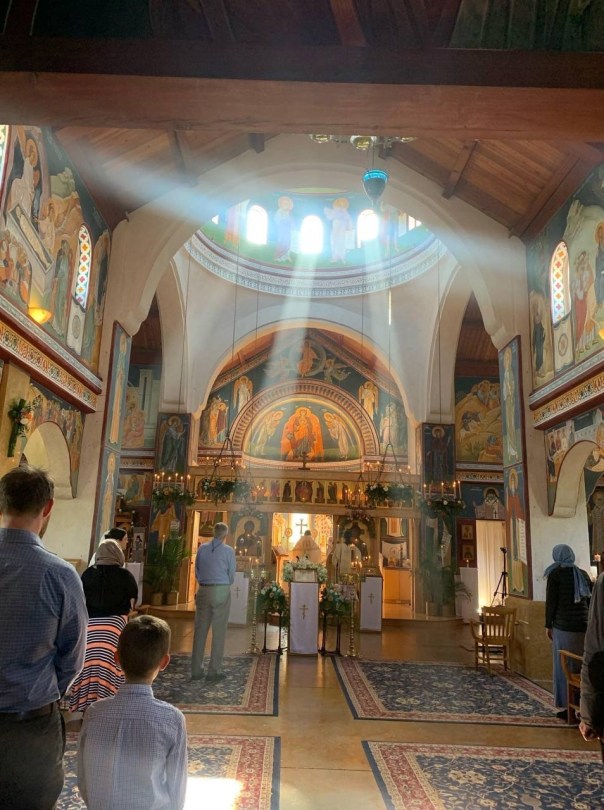
But I remember how, even before I learned to read, a certain spiritual perception visited me for the first time, when I was just eight years old. Mother took me to church by myself (I do not remember where my brother was then), during Holy Week, to the Monday liturgy. It was a clear day, and, remembering it now, I seem to see again the incense rising from the censer and quietly ascending upwards, and from above, through a narrow window in the cupola, God’s rays pouring down upon us in the church, and the incense rising up to them in waves, as if dissolving into them. I looked with deep tenderness, and for the first time in my life I consciously received the first seed of the word of God in my soul. A young man walked out into the middle of the church with a big book, so big that it seemed to me he even had difficulty in carrying it, and he placed it on the analogion [lectern], opened it, and began to read, and suddenly, then, for the first time I understood something, for the first time in my life I understood what was read in God’s church.

The reading was from the book of Job. I myself have attended these same services over the years, and they grow more precious every time I hear the readings and hymns. The gifts of the Church are too rich to ever plumb their depths, but there is no need to fret about our limitations, when, as the sick brother says, even one day is enough for a man to know all happiness.” How many times have I also watched the beams of light shining down when I stood in church, and even felt their heat on my face, like the warmth of God’s love?

Christ the Bridegroom

The Elder Zosima is a fictional character, but he is believed to be based on a real-life monk in old Russia. In the novel the Elder proceeds from this point in his very moving fashion to tell his life’s story: “– and over all is God’s truth, moving, reconciling, all-forgiving!”

The “accidental” timing of my reading seemed to be a gift from God that morning, helping me in an unusual way to become even more receptive to His being with us at the evening service by means of hymns such as, “Let my prayer arise in Thy sight as incense….,” and the Psalms of Ascent — and the Holy Mysteries.

When our bishop was with us the previous week, he gave a good word about the last days of Lent — well, technically Lent has come to an end, but we are still in the anticipation and preparation that is Holy Week. He said that Lent is not about finding every bit of dirt in our souls, but about the bridal chamber, about discovering the great love that our Lord Jesus has for us. It is truly a “bright sadness” that colors these days as we accompany Him to the Cross.

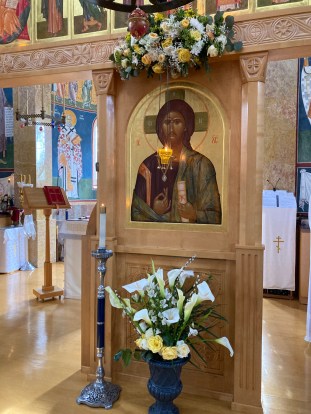
Perhaps Zosima’s brother went to a Bridegroom Matins service on Tuesday; we have three of them during Holy Week. The Lord Himself has been filling my lamp with the oil of His Holy Spirit.
Divine Flower, Divine Wisdom.

Sophia, by Thomas Merton

AND IT WAS HERE — IT WAS AUTUMN

And it was here — it was autumn —
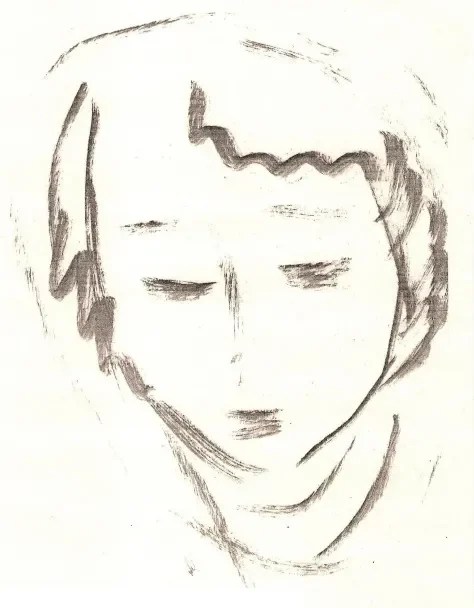
When I told Her: “Divine Flower,
I feel Your touch! But why have you hidden Yourself
From my sight since I was a boy?”

At the very moment these thoughts moved through my mind —
Instantly, golden azure filled the room,
And she shone before me once again —
But just Her face — Her face.

At that instant lasting bliss was born in me!
Once more my soul went blind to mundane matters.
If I gave a sober hearing to Her, I know not what I heard;
Her words were incomprehensible, talk fit for a fool.

-Vladimir Solovyov (or Soloviev) (1853 – 1900) Russia
      Translated by Ivan M. Granger

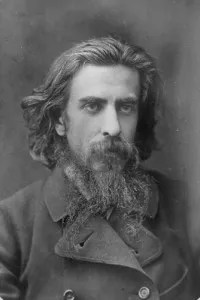
Vladimir Solovyov

Vladimir Solovyov loved Sophia, that is, Divine Wisdom. He philosophized about her throughout his life; I think this is probably a poem to that Sophia.

Solovyov  was an influential person in the late 19th century and into the 20th, and is thought to be a source for some of his friend Fyodor Dostoevsky’s characters, Ivan and/or Alyosha, in The Brothers Karamozov; he gave a eulogy at Dostoevsky’s funeral. His ideas definitely were stimulating to Tolstoy, and to many other thinkers, and he continues to be controversial in the 21st century. This article: “Holy Wisdom,” explains why his ideas about Sophia have generally not been accepted by the Orthodox Church.

Wikipedia quotes David Bentley Hart, another controversial philosopher, from his forward to Solovyov’s Justification of the Good,

“In truth, the divine Sophia is first and foremost a biblical figure, and ‘Sophiology’ was born of an honest attempt to interpret intelligibly the role ascribed to her in the Wisdom literature of the Old Testament, in such a way as to complement the Logos Christology of the Fourth Gospel, while still not neglecting the ‘autonomy’ of creation within its very dependency upon the Logos.”

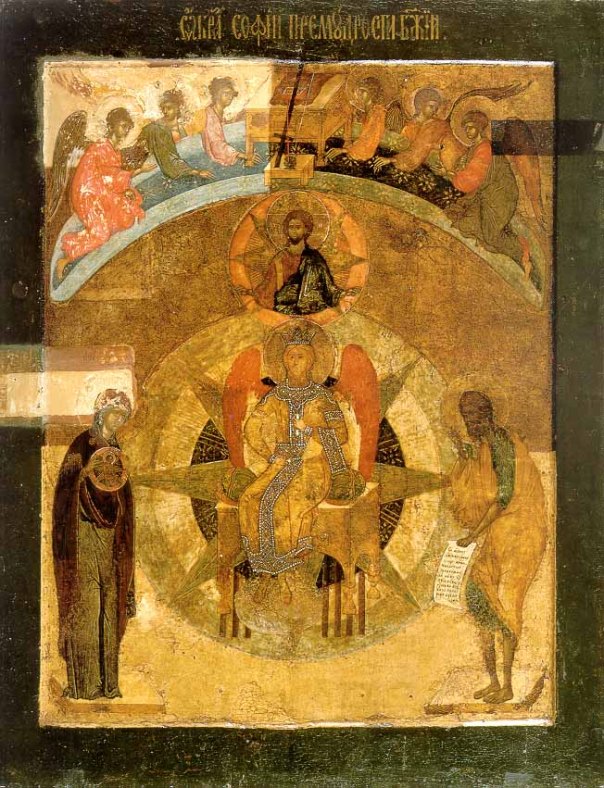
The Orthodox icon of Holy Wisdom often shows a “fiery angel” seated on a throne, with the Theotokos and St. Cosmas on either side, as in the example below. There is so much to ponder about Wisdom in the Bible. Even one of these verses I chose might provide for plenty of profitable contemplation:

Do not forsake wisdom, and she will keep you;
love her, and she will guard you.
Wisdom is the principal thing; therefore get wisdom:
and with all thy getting get understanding.
Proverbs 4:6-7

But the wisdom that is from above is first pure, then peaceable, gentle,
and easy to be intreated, full of mercy and good fruits,
without partiality, and without hypocrisy.
James 3:17

But if any of you lacks wisdom, let him ask of God,
who gives to all generously and without reproach,
and it will be given to him.

James 1:5

Icon “Holy Wisdom,” 15th Century, Moscow

LOVE WISDOM, and GET WISDOM.

A batch of cookies and summer loves.

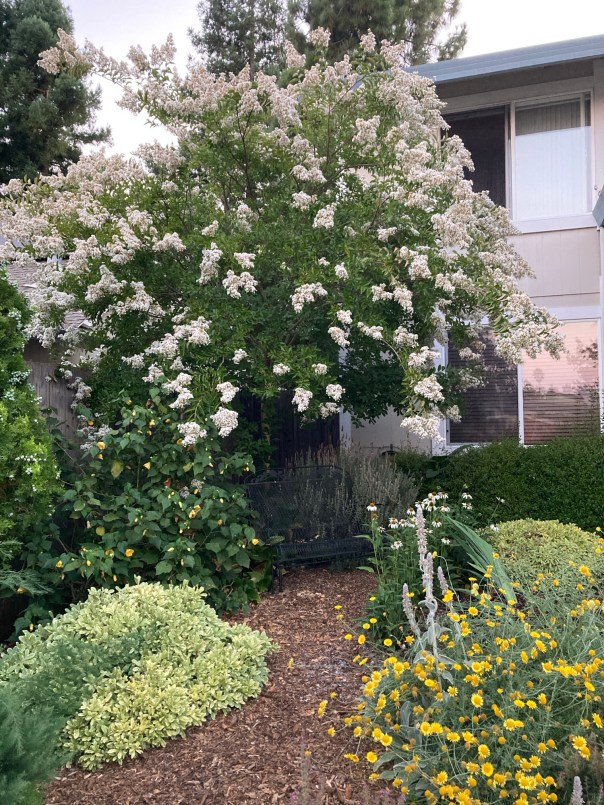
Crape Myrtles are in full bloom in my neighborhood, including on my own property. Mine is not more than five years old, and in the last year it seems to have doubled in size.

I’ve been walking down to the creek bridge and beyond several times a week, and all the trees and plants growing in and on the banks of that stream also seem to have mushroomed, so that I can barely see the water below the bridge.

I love the summer, because it’s only in the occasional heat waves of the season that I can feel fully at home and in sync with the earth. In this climate with marine influence, where the evenings get cold and breezy even in the summer, it’s a treat to fully sink into the warmth and stay there all evening; even when I climb into bed I am relaxed, and don’t have to pull several layers up to my chin against the chill. Of course, this sounds crazy to those of you who live in high-humidity summer zones!

Even when it was over 100 degrees last week, I was able to spend a lot of time in the garden morning and evening, and then work on other projects in the middle of the day. I have plenty of paperwork and sorting yet to accomplish. If I ever finish that — Please God, help me! — I could sew, or read, or get back into writing book reviews …

When I read on my phone, I’ve started taking screen shots of quotes that I don’t want to lose. And I often look up words I don’t know — On Substack there are so many good writers with vast vocabularies — and take screenshots of the definitions.

Spider in the plum tree.

One morning as I set out on my usual walking route, I passed by the house down on the corner, where a vegetable garden has been carved out of the lawn, next to the sidewalk. For months I have been admiring the health and size of the plants, and that morning I spied a dozen beautiful yellow summer squashes peeking out from under the leaves, several of which should have been picked days earlier; on my way back I debated about whether to inquire about them. If the owners didn’t want them for some reason, I would take them… and if the gardeners had suddenly been incapacitated and couldn’t pick their own squash, I could offer to do that for them….

It sounded reasonable… and one hates to see beautiful vegetables going to waste… but what if I got involved with people I found disagreeable? Or who were needy beyond my abilities to help? I stood on the sidewalk and thought a while, then walked up to the door and knocked. The result: I made a new gardening friend.

Dee gave me three overgrown squashes, though none of the size I’d have preferred, and she invited me to come back for more. She enjoyed talking about her garden, and told me about her family that she lives with, including her recently widowed mother, who she said is the cook of the household. I wondered if that cook prefers overgrown zucchinis…. On one of the less sweltering days I did cook the squashes into a spicy, satisfying stew, which I was glad to have..

That’s my own chard and collards in the picture above, the leaves that were not eaten by insects or mollusks; I picked almost all of my greens and now my own little squash plants are spreading out in the planter boxes. Recently I transplanted the tarragon out of a pot into one of those boxes where it will get more regular watering, and it is thriving.

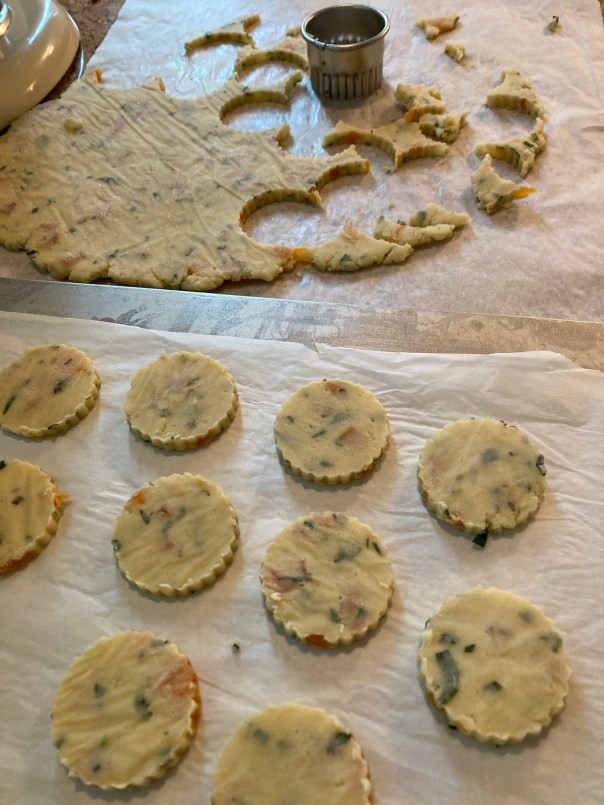
I used several sprigs of it to make Anytime Apricot and Tarragon Cookies from the Dorie’s Cookies book. They were in the chapter called “Cocktail Cookies,” and the recipe includes no sweetening beyond the dried apricots and tarragon.

I baked those savory shortbread cookies to take to friends who’d invited me for lunch, who I knew didn’t care for sweets very much. But they are winemakers, so I thought they might like the kind of savory cookies one could nibble on while sipping a glass of wine. We all thought they were really nice; it was amazing how much subtle sweetness we tasted in them; I think the level of saltiness helped bring it out.

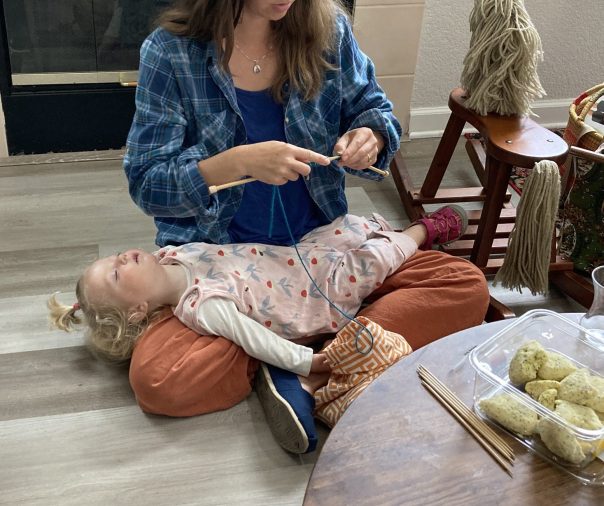
I got together with several women who are collaborating to share homemaking skills; for our first meeting we focused on knitting. I had two cotton dishcloths I’d knitted a while back, which I decided to join together. I tried crocheting them together but I couldn’t figure out how to do that while at the same time chatting with everyone, so I just sewed them together with a blanket stitch.

I don’t have hopes of becoming an expert knitter, but I like to be with these women. And their babies! (At church there is a new family with a little guy just turned one, and he is the friendliest love bug. He loves me! And I never tire of holding him.)
Our host had an awe-inspring jar of kombucha scoby on her kitchen counter, and two of our group were happy to take home a quart of it to get their own kombucha production up and running again. My own fermenting experiments stalled decades ago with yogurt-making, and a succession of three yogurt makers that never satisfied. I never tried making sauerkraut, because that was a food I have been prejudiced against ever since it made a regular appearance on our table when I was a child; I did somehow manage to enjoy kimchi when my son “Soldier” brought it into the family’s already international culinary repertoire.

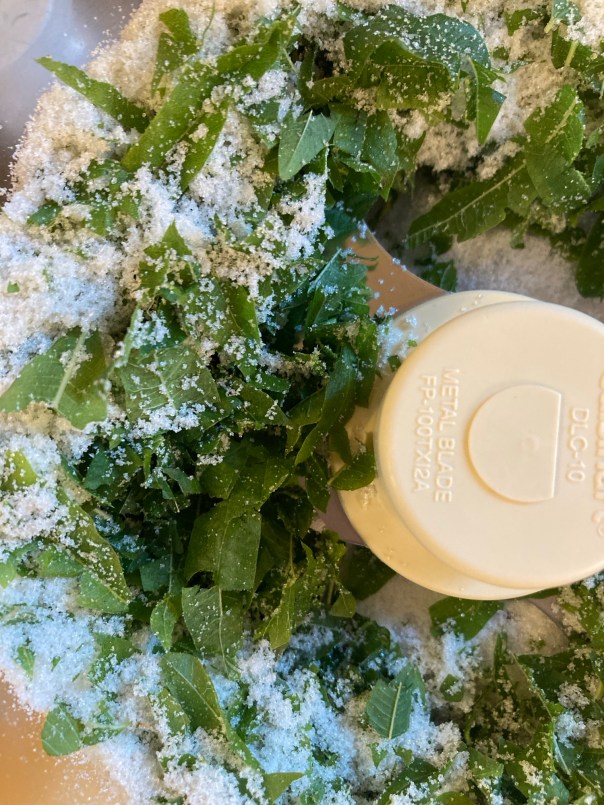
But I have made Lemon Verbena Sugar Paste!  Lemon verbena is one of my garden treasures, but I haven’t pruned my plant often enough or used its leaves much, and it has gotten very leggy. So when I saw a young and well-shaped specimen in the grocery store, I brought it home and now have two such treasures. When I pruned the older plant, I took all the leaves to make Lemon Verbena Sugar Paste. There were more or less potent recipes online; I used the one with the highest ratio of herb to sugar, 2 cups to 1/2 cup.

I stuck the paste in the freezer and hope I will remember to bring it out to add to tea, sprinkle on desserts, use as a glaze, etc. Maybe I’ll also remember to tell you here if I do.

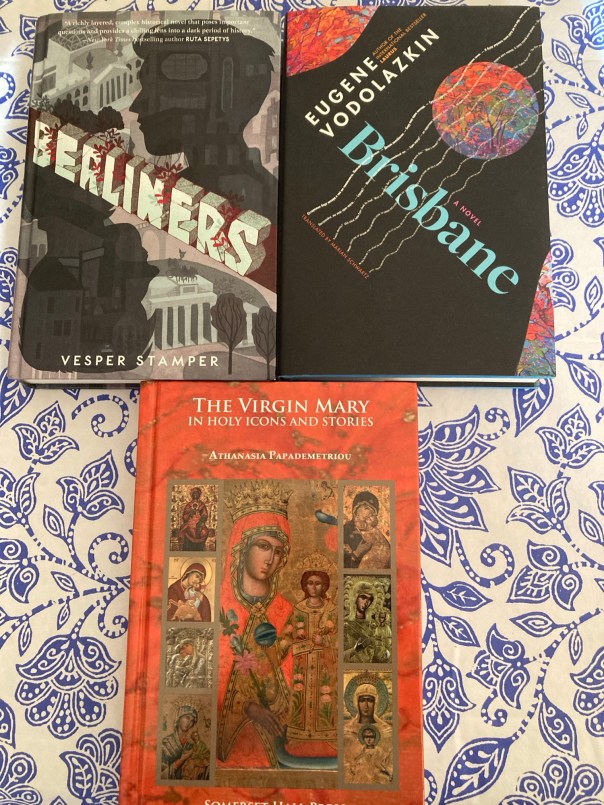
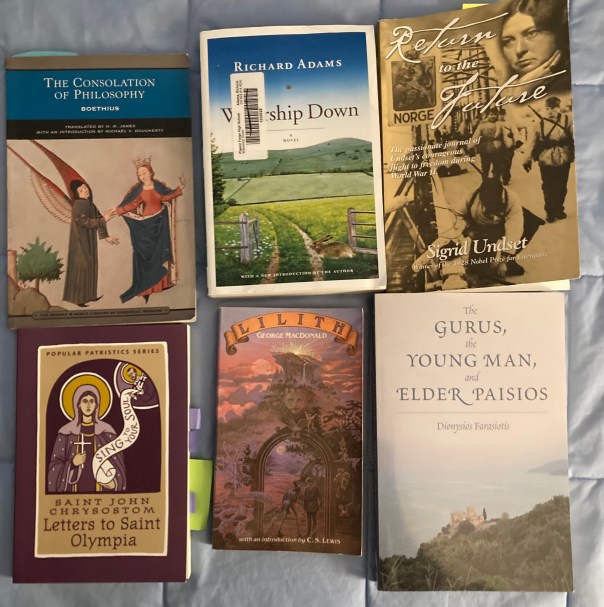
After I asked my friend Cori what were her summer reading plans, naturally she asked me back. I should have anticipated that and not asked her to begin with — because I have no real plans, and feel like an imposter. I have been reading less than usual. I see that of the nineteen books I pictured here five months ago, I have read just two. Only one of those I got to the end of was from the stack I was going to “try extra hard” to read this year. Well, the year is half over, so it doesn’t look promising for those selections. I took new pictures of the “summer books” to show Cori, because it was easier than typing out the titles.

Four of those I have at least started reading, and the Undset book is my current reading-while-falling-asleep choice. I have, typically, read several books that I didn’t anticpate back in February, and some of them were not worth talking about, or even reading to the end.

But let me just mention a young adult novel I did read to the end and liked a lot, What the Night Sings. Written by Vesper Stamper, who was one of the speakers at the Symbolic World Summit I attended earlier in the year in Florida, this is a coming-of-age-in-the-Holocaust story, illustrated by the author. First I listened to the novel, and then I borrowed the hard copy from the library, because I wanted to see the illustrations, which are many, and are very well done, as is the whole story. Stamper’s Berliners, is at hand, too, waiting for me.

If you have read — or even scrolled — this far in my ramble, I’m impressed! There is some reason you stayed so long, though there were doubtless some topics along the way that didn’t interest you. Whoever you are, I appreciate you very much.

Only by daring to leap.

Bright Monday

“No frail human morality can ever hope to contain the overflowing fullness of life with which Christ desires to rejuvenate the faithful.

“The world will not be saved by optimistic humanism that believes human progress and morality will eventually save the world. For Dostoevsky and the church fathers, man’s deepest problems are not moral, nor even psychological, but ultimately existential and ontological. It’s not about following the rules or feeling balanced. It is a matter of choice and it is a matter of human nature being touched by the hand of God Himself.

“Only by daring to leap towards God in spite of the good and evil that exist in the heart can the believer hope to get beyond the contradiction of the human condition. In order to avoid descending into nihilism, Dostoevsky offers his readers another path: the acceptance of suffering and affliction in the context of a relationship with God. It is only in this context that man is able to recognize a path out of his fallen condition. It is only this Love that is able to transform suffering into salvific joy.”

-Father Alexis Trader (Now Bishop Alexis of the Diocese of Sitka)

Read more here: Ancient Christian Wisdom blog