Tag Archives: Fr. Thomas Hopko

St. Justinian’s Hymn

I always look forward to the time in during Divine Liturgy when we sing St. Justinian’s Hymn. I don’t have to wait long, as it comes only a few minutes into the service.  Nov 14 is the day we commemorate St. Justinian (along with St Gregory Palamas, St. Justinian’s wife St. Theodora, and the Apostle Philip), so I thought it a good day to share this hymn with you.Justinian contemp mosaic

St. Justinian reigned as Byzantine emperor for nearly forty years during the sixth century. He was responsible for the construction of the glorious Hagia Sophia, and though he may not have written the ancient hymn affirming the Incarnation, he did command that it be sung every Sunday.

I love the way our choir sings this part of the Liturgy, and I always try to sing along. I found two examples on YouTube that most resemble the way I know it:

here and here.

The words are simple but so fundamental to our faith:

Only begotten Son and Word of God,
Thou Who art immortal
And didst deign for our salvation
to become incarnate
of the Holy Theotokos and ever-virgin Mary,
without change becoming man,
and who was crucified O Christ God,
trampling down death by death;
Thou who art one of the Holy Trinity,
glorified together with the Father and the Holy Spirit,
save us.

You might be interested in this series on the Divine Liturgy in which Fr. Thomas Hopko gives a lecture about the theology of “Only-Begotten Son.”

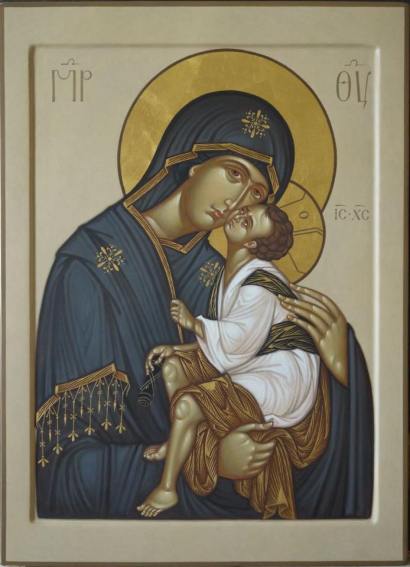
And finally, an icon of the Incarnation:
Mystical Supper

mysticalsupper02

On Thursday of Holy Week (today) we commemorate the first eucharist as the Lord Jesus instituted it, what we Orthodox call The Mystical Supper. On the Orthodox Wiki discussion page I found that someone had asked for clarification of what the Real Presence is, according to Orthodoxy; it seemed confusing to them. Then various people gave input. One said that it may be confusing because it is a Mystery. [Think smiley face] It is a common joke in or on the Church that this is a facile answer.

But it points to the true nature of the faith, that our relationship with God is not purely intellectual. We do not know Him by putting together all the facts we’ve learned; He doesn’t reveal Himself through our intellects alone, or even primarily.

Fr. Thomas Hopko says, “The mystery of the holy eucharist defies analysis and explanation in purely rational and logical terms. For the eucharist — and Christ himself — is indeed a mystery of the Kingdom of Heaven which, as Jesus has told us, is ‘not of this world.’ The eucharist — because it belongs to God’s Kingdom — is truly free from the earth-born ‘logic’ of fallen humanity.”

The page on The Holy Mysteries, what we call the sacraments, is very good! It starts right out with this perspective and reality about the Church that I love:  “…the Orthodox Church considers everything which is in and of the Church as sacramental or mystical.” I suppose this is why “There has never been a universal declaration within the Orthodox Church that there are only seven sacraments.”

I knew that, but I learned some other things, more historical and not so mystical, reading these pages today: “While the Synoptics do give the Last Supper as a Passover seder, John’s Gospel (which the Church privileges over the others) has it happen before the Passover.” The contributors all seemed to agree on these points though they differed on their theological significance.

On a more personal note, while I am grieving the death of my husband, I’ve been so grateful that we are in Holy Week, with its numerous opportunities to participate in this sacrament, this mystery of the Kingdom of Heaven — and truly, in all the abundant graces of the Church. It’s not facts that have been sustaining me, but His Real Presence.

At the Heart of Prayer – quote

“When the disciples asked Jesus to teach them to pray, the Lord did not tell them to use their imaginations and express their feelings.  He did not tell them that it really did not matter how they prayed, as long as they were sincere.  And he certainly did not tell them to talk to God in their own words. . .the Lord’s Prayer is at the heart of Christian prayer.  All other prayers of the Church exist in relation to this prayer given by the Master Himself.  They are either abbreviations or elaborations of it.  They are in harmony with it, and cannot contradict it in any way.”
-Thomas Hopko


That Temple You Are

We have begun the celebration of the Feast of the Entrance of the Most Holy Theotokos into the Temple, focusing on an event that is not mentioned in the Bible, but is a story with important meaning.

As Fr. Thomas Hopko explains in The Winter Pascha, “Its purpose is not so much to commemorate an historical happening as to celebrate a dogmatic mystery of the Christian faith, namely, that every human being is made to be a living temple of God.

“The festal event is that the three-year-old Mary, in fulfillment of a promise made at her conception by her parents, Joachim and Anna, is offered by them to God in the temple at Jerusalem.”

And in the next chapter, “In the Orthodox Church the Virgin Mary is the image of those who are being saved….she shows how all people must be when they are sanctified by the Holy Spirit as servants of God and imitators of Christ.”

Lord, may we by your grace imitate your Mother in her glad obedience, and also by your grace live as becomes temples of your Holy Spirit.

“For God’s temple is holy, and that temple you are.”  I Corinthians 3:17