Tag Archives: freedom

We encounter the small black dot.

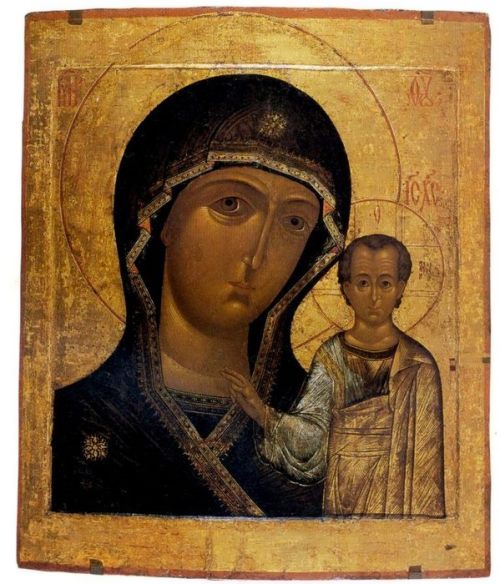
“The intimate darkness of our most precious cognitive organ constantly reminds us – whether we like it or not – that the “inner” content of any human is never absolutely available to our cognitive powers. The most powerful among the senses, thus, recognizes the deepest human cognitive powerlessness precisely during the encounter with the most powerful sense organ of another human being. However carefully we approach or analyze it, the unique personal existence of every human always stays partly hidden in the darkness of the unknowing.

“And this is most expressively manifested when we encounter the small black dot that is the pupil of the  eye. At this place we truly do “enter into the human soul,” but at the same time –confusingly and paradoxically –  we realize that we cannot enter it. In this kind of darkness, we can get lost and go crazy, or feel warm and safe – for the same reason: because we cannot possess what it reveals/hides. This darkness can be scary or the most welcoming place in the world for the very same reason: because, herein, we recognize the utmost freedom of the human being.

“Through the encounter with the pupil of another human being, we fall directly into the other’s personal infinity, which can never be fully attained – even if our faces are only a few centimeters from each other. Experiencing this kind of infinity, finally, becomes the cognition of the utmost human freedom – freedom that does not depend even on itself.”

I added paragraph breaks to this excerpt from an article by Todor Mitrović from the Orthodox Arts Journal, on “The Epiphany of the Eye.”

I found the author’s ideas fascinating, and convincing. I am not an artist, but I do gaze upon icons quite a bit. When I do, I am looking through the “window,” not caring to analyze what features of the image are having what effect on me. This article nonetheless does help me to better appreciate the whole phenomenon. The artistry of an icon is not the most important thing about it, but contributes to its beautiful effect on our souls, our deepening relationship to Christ through prayer.
Prisoners in a thousand ways.

Metropolitan Anthony Bloom:

I remember something my grandmother told me when I was a child. She was talking to me about the Greek war of independence against Turkey…and she told the case of a soldier who, after the battle, in the dark night, called his lieutenant and cried: ‘Lieutenant, Lieutenant, I have taken a prisoner!’ — ‘Bring him here,’ answered the lieutenant.– ‘I can’t, he is holding me so tight,’ replied the soldier.

This seems absurd…and yet I have the impression that very often it is the situation in which we find ourselves with respect to the world when we who are prisoners of this world in a thousand ways — not so much outwardly as inwardly — think that we can transform it….

From God and Man

What’s left is The Nothing.

“What is left to a people who have believed only in politics after they lose their faith is ‘nothing,’ or perhaps ‘The Nothing.’ And what follows the failure of politics is not another form of political order but most likely the end of political community as such and therefore of properly human self-government. We are on the cusp of a new age that is at once post-political and post-human….”

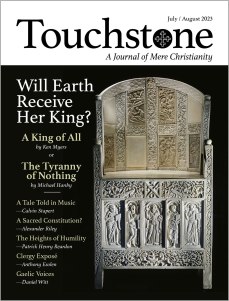
The quote is from the opening paragraphs of Michael Hanby’s article, “Nothingness Rules,” in the latest Touchstone magazine. Hanby writes about the modern mind, especially its expression in the American vision, and how it sees the world from the standpoint of pragmatism. As an example he quotes John Dewey saying, “things are what they can do, and what can be done with them.” Any consideration of what things are in themselves, what their nature is, is unnecessary; more likely, it is a bothersome hindrance to getting on with controlling and changing what is.
“At the core of this metaphysical vision is the elevation of possibility or power over the givenness of the actual world. The celebration of possibility takes on mythic tones in American romanticism about the ‘frontier,’ in our political homage to the ‘American dream,’ and in a thousand mind-numbing commercials. But it is also deeply inscribed into our public philosophy, both political and natural.

“Liberalism elevates possibility over actuality in the political sphere by identifying freedom with rights. Rights create what D.  C. Schindler calls an ‘enclosure of a field of power’ around each citizen, transforming every given reality that would define me prior to my choosing—God, the moral order, and, now we discover, even my own nature—into a possible object of choice. Liberal order thereby undermines these basic realities while appearing to uphold them.”

Hanby goes on to discuss the difference between Marxist atheism and previous versions, why authority and not power is the “true source of the law’s efficaciousness,” and how “technocracy is not the rule of technocrats, but the rule of nobody.” He points out that the seeds of the new vision of nature are right there in our U.S. Constitution:

“The U.S. Constitution grants Congress the power to ‘promote the Progress of Science and the Useful Arts,’ prompting Leon Kass to comment that ‘the American Republic is  . . . the first regime explicitly to embrace scientific and technical progress and officially to claim its importance for the public good.'”

It’s a thought-provoking read which you can access online: “Nothingness Rules.”

He spoke of prison with nostalgia.

Braga quote joy OCN crp

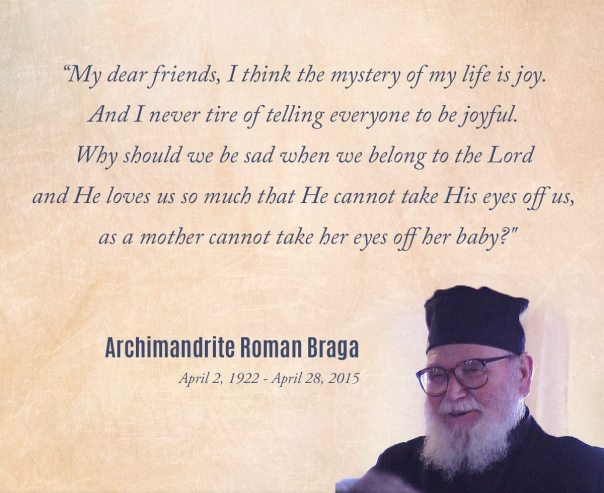
“My dear friends, I think the mystery of my life is joy, and I never tire of telling everyone
to be joyful. Why should we be sad when we belong to the Lord and He love us so much
that He cannot take His eyes off us, as a mother cannot take her eyes off her baby?”

About ten years ago, James Kushiner interviewed Father Roman Braga for Salvo magazine, and the interview was published in this article: “Solitary Refinement.”

Not long afterward, following Fr. Roman’s repose in death, Kushiner wrote again, in a 2015 Touchstone magazine newsletter:

Prisoner of the Redeemer   

Early this morning, about a four-hour drive east of Chicago’s Holy Name Cathedral, a new and much smaller church in the Michigan countryside sheltered the body of a recently departed priest-monk of the Orthodox Church, Fr. Roman Braga. His funeral was scheduled to begin at 9:30 AM.

While Fr. Roman held no office as elevated as the Archbishop of Chicago, it would not surprise me if in some ways he influenced nearly as many people over the years through his counsel, prayers, and service to the church–to all who spoke with him.

Fr. Roman moved to Michigan from Brazil the same year I moved from Michigan to Chicago (1972). Twenty-five years later, on October 7, 1997, I met him for the first time at Holy Dormition Orthodox Monastery in Michigan. I was privileged to have a several conversations with him over the years, including an interview published in Salvo Magazine (Solitary Refinement: How One Man Found Freedom Inside a Communist Prison. A former high school teacher, he *loved* Salvo and young people.) His counsel helped me in many ways.

Fr. Roman was expelled from his native Romania in 1968, where he had served as a priest of the Romanian Orthodox Church. He had spent 5 years in a labor camp digging the Black Sea Canal, and later served 6 years of a new 18-year sentence, including time in solitary confinement, before being released under a general amnesty in 1964. He began his priestly ministry, watched carefully by the secret police, who came one night in 1968 with a Brazilian passport in hand and expelled him.

Fr. Roman said he discovered Jesus Christ more deeply in the depths of his being in prison, especially in solitary confinement, where he came to experience true spiritual freedom. He spoke of prison with nostalgia.

The New Testament has many scenes in prison: John and Peter, then Peter, Paul and Silas, then Paul. How many of Paul’s epistles were written from prison?

Didn’t the new church of God began in a prison (phulake), with the first sermon preached (ekeruxen) to its prisoners by Pilate’s former Prisoner (1 Peter 3:19)? Here the “gates of hell” did not prevail against Christ and his new church as he burst those gates and led the captives free.

I could sense from the way Fr. Roman prayed and chanted the “Akathist Hymn to Jesus Christ” on Sundays before Divine Liturgy that I was witnessing a loving communion between the Lord and his servant. One stanza is an icon of his faith:

Jesus, true God.
Jesus, Son of David.
Jesus, glorious King.
Jesus, innocent Lamb.
Jesus, Shepherd most marvellous.
Jesus, Protector of mine infancy.
Jesus, Guide of my youth.
Jesus, Boast of mine old age.
Jesus, my Hope at death.
Jesus, my Life after death.
Jesus, my Comfort at Your judgment.
Jesus, my Desire, let me not then be ashamed.

He also praised Jesus Christ, “Redeemer of those below” and “Vanquisher of the nethermost powers.” Fr. Roman was singing a song to his Paschal Liberator. I will always think of him with a captivating twinkle in his eye, revealing an inner joy forged in the crucible of prison. He was, with St. Paul, a “prisoner of the Lord” and true servant.

Father Roman, I trust, beholds the face of his Beloved Savior in the mansions of the righteous. Christ is risen! Memory eternal!

Yours for Christ, Creed & Culture,

James M. Kushiner

Executive Director, The Fellowship of St. James